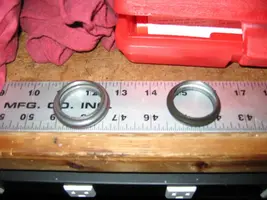
4.10s in and making noise!

Did you remove the brakes when setting the preload? Ideally, the extra load on the pinion should be as small as possible so that the torque wrench is seeing only the bearing pre-load.

I have done three pinion nut installs. In each case, the turning of the nut was a real work out. Easily 150+ foot pounds. The actual crushing of the sleeve could be felt. It required turning the pinion nut in very small increments (towards the end, less than 1/4" of wrench movement) to get the preload correct.

From your post, the flange was not fully seated when the pre-load measurement was taken. The flange must be fully seated as well as the bearing races fully seated into the diff. The crush sleeve can not provide enough force to seat an unseated race. Something to consider is installing the flange with no crush sleeve. Tighten everything together overloading the preload. This may provide enough force to fully seat the races. Remove and redo correctly.

This may explain why backlash changed and the gears whined. Obviously, the paint markings taken prior to this are useless because the preload/set up is not correct.

There must have been something else dragging on the pinion to account for the turning effort. Hence the false torque reading.

From prior bad experiences, my last rear end rebuild I removed the entire axle from the car. This afforded better access and easier working conditions. It showed up in the final result (my best by far).
 
Did you remove the brakes when setting the preload? Ideally, the extra load on the pinion should be as small as possible so that the torque wrench is seeing only the bearing pre-load.

I have done three pinion nut installs. In each case, the turning of the nut was a real work out. Easily 150+ foot pounds. The actual crushing of the sleeve could be felt. It required turning the pinion nut in very small increments (towards the end, less than 1/4" of wrench movement) to get the preload correct.

From your post, the flange was not fully seated when the pre-load measurement was taken. The flange must be fully seated as well as the bearing races fully seated into the diff. The crush sleeve can not provide enough force to seat an unseated race. Something to consider is installing the flange with no crush sleeve. Tighten everything together overloading the preload. This may provide enough force to fully seat the races. Remove and redo correctly.

This may explain why backlash changed and the gears whined. Obviously, the paint markings taken prior to this are useless because the preload/set up is not correct.

There must have been something else dragging on the pinion to account for the turning effort. Hence the false torque reading.

From prior bad experiences, my last rear end rebuild I removed the entire axle from the car. This afforded better access and easier working conditions. It showed up in the final result (my best by far).

when i set the prelaod the only thing in the housing was the pinion. i was kinda of afraid i messed up when i did the preload because the flange wasnt full seated and the pinion nut wasnt hard to turn when i checked the preload and it messured about 30 in/lb and i was like o s**t i already over torqued it so i just sat there for a second just playing with the flange spinning it then i measured the preload again and it went down to between 20 and 26 and i was relieved and thought i was finished lol, you think i just didnt tighten it enough?

so is the crush sleeve strong enough to pull the flange all the way on without crushing?

im pretty sure the races were seated all the way, i used the old races over the new ones and beat them in with a hammer until it wouldnt go any farther.

ill have to check it out wen i get some time, have to work all weekend and next week:notnice:
 
takes a ****load of torque to crush the crush spacer. should use new race with new bearing, if not your better with the old bearing.

you can pull the pinion and compare new and old crush spacer to se if you've crushed it yet, I can pretty much guarantee you havent
 
takes a ****load of torque to crush the crush spacer. should use new race with new bearing, if not your better with the old bearing.

you can pull the pinion and compare new and old crush spacer to se if you've crushed it yet, I can pretty much guarantee you havent

kk thx, so i should be able to get the flange on with the nut before the sleeve crushes

i did use new races. i was just saying i used the old races to tap in the new ones because theyre the same size
 
what is a new crush sleeve supposed to look like? i finally got time to pull the pinion and i crush sleeve i used(the one that came with the gears) looks just like it did before i put it in, but it also looks just like the original one i pulled out. the reason im wondering is because i have another crush sleeve that came with a mini install kit i have and it looks different.

the one on the left came with the gears and the one on the right is the original one. the one on the left is also bigger than the one on the right.

the other pic is of the one that came with the mini install kit
 

Attachments

  • IMG_0280.webp
    IMG_0280.webp
    81.5 KB · Views: 98
  • IMG_0290.webp
    IMG_0290.webp
    24.9 KB · Views: 89
For what it is worth, the purpose of the crush sleeve is to apply a constant pre-loading pressure to the bearings. It does this by deforming along is short axis (height). The metal is soft and easily deformed (hence the name).

The pre-loading forces are not very high (measured in inch-pounds).

From the pictures, the diameter can be seen. It is difficult to tell the thickness of the two sleeves. However, as best as I can tell from the pictures the sleeves are the same height. If true, both are in the same state (crushed or not).

I believe I have an extra crush sleeve at home (not positive). Will measure and let you know.

Again, for what it is worth, when I did mine, there was no doubt when the crush sleeve started being compressed. The compressing begins before all of the in/out slack has been removed. You can feel the crush sleeve resist and then give way with each turn of the wrench.
 
kk thx, i just measured the one on the left(the one i was using) and it measured .508 and the one on the right(original) was .440.

i tried to tighten the pinion before i removed it and it was impossible to tighten the nut any farther, i had a screw driver in the flange to keep it from turning and bent the screw driver, and the housing was moving up when i was trying to tighten it farther, and the flange wasnt seated yet.
 
No luck on finding an extra crush sleeve. I really thought the full list price from Ford was about $5. Not many items cost as little.

While it is somewhat $$, the companion flange holding tool does make things easier.

Holding Fixture, Drive Pinion Flange
205-126 (T78P-4851-A)

Flange Holding Companion Tool 205-126

http://cgi.ebay.com/ebaymotors/SPX-...emQQimsxZ20091229?IMSfp=TL0912291810004r30759

Yes I know it's hard to justify an $$ tool for a one shot job. However, it may help to look at the value of your time. Anyway, that's what I tell my Wife after I buy expensive tools.:D
 
haha i wish i had moneyz to spend on tools, all the tools im using are my dads.

but today i looked at the races and they are fully seated, and i tried reinstalling the pinion with the new crush sleeve with no luck. the flange would not go all the way down even with a 250 ft/lb impact wrench, then i took it back out and examined the crush sleeve, and it crushed a little but still the flange still had maybe 1/8th of an inch to go, and i could not get the nut to turn any further with an impact wrench or long breaker bar, im starting to think i should just take it to a garage or dealer to get it fixed lol. have to have my car fixed by the 18th cuz i thats when school starts:notnice:
 
There must be a reason that the flange is not fully seating on the bearings. I am assuming that there still was in/out play on the Pinion.

Did you put the oil slingers and washers back on between the flange and front bearing?

Can you post pictures?

Consider comparing the old pinion with the new one. One possibility that comes to mind is there is a difference in machining that is making the crush sleeve start out much higher on the pinion.

Are there any machining defects on the pinion that could keep the front pinion bearing from moving down the pinion? Defects on the pinion splines?

Again pictures may help someone spot what is wrong.
 
had basicly the same problem your haveing on 1 of my swaps, couldnt get enough torque to crush the sleeve(some sleeve's take more force to crush), I put it together with the old crush sleeve, had no problems at all. this is considered a no-no but worked completly fine for me. try this before spending $$$$ at a shop.
 
today i so frustrating!!!, i took pics but my computer wont read my memory card so i cant post them!

i did not install the washer or oil slinger. bear with me im a noob lol, im assuming the oil slinger is the round wire like thing? and the washer is kinda bent from when i removed the oil bearing, race, and seal. could this be my problem? also there was a little grime or sludge on the splines but i didnt see any defects.
 
had basicly the same problem your haveing on 1 of my swaps, couldnt get enough torque to crush the sleeve(some sleeve's take more force to crush), I put it together with the old crush sleeve, had no problems at all. this is considered a no-no but worked completly fine for me. try this before spending $$$$ at a shop.

ill prolly try that if that if the problem isnt something else like messed up splines or the oil slinger and washer
 
today i so frustrating!!!, i took pics but my computer wont read my memory card so i cant post them!

i did not install the washer or oil slinger. bear with me im a noob lol, im assuming the oil slinger is the round wire like thing? and the washer is kinda bent from when i removed the oil bearing, race, and seal. could this be my problem? also there was a little grime or sludge on the splines but i didnt see any defects.
There should be two washers between the flange and the front pinion bearing. The purpose of the oil slinger is to direct oil away from the seal. It also provides a flat surface for the flange to interface with.

I am working completely from memory here but I recall there being two washers. One very thin and the other thicker.

If there is NO washer at all, then the false pre-load may be from the flange binding against the bearing. Further, without the washers taking up space, more compression of the crush sleeve would be needed.

Further, consider that if the flange is pressing against the outer part of the bearings, then the flange would be loading the bearings instead of the inner races of the bearings themselves. The washer should press the inner race into the rollers which in turn is pressed into the outer races.

This may offer an explaination for the false pre-load and why you can not completely compress the crush sleeve.

Note, would be OK to re-use a crush sleeve as long as there is still "crush" left in it. The crush sleeve is a one way device. Additional crush can be added. But it can never be taken away.
 
i looked and i only have one washer and a wire like thing(im guessing its the oil slinger) that came out of the housing originally. what order does the washer and slinger go in? and will i have to take the pinion seal back off to get them in?
 
The description of a "wire thing" concerns me. The oil slinger is really nothing more than a thin washer. Pictures?

Are you saying that the washer was NOT installed? Then yes. To install the washer may require the seal to be removed.

Did you look at the back of the flange and see if the flange could/would interfere with the bearing (if a washer not present)? The reason I ask, the oil slinger is rather thin. By itself it can not take up an 1/8" of slack.
 
On the first picture, the "wire thing" is from the OLD seal. There is a spring that goes around the inside of the pinion seal. Its purpose is to apply pressure to the rubber thus improving the seal. Throw it away.

On the first picture, the thing on the left is the oil slinger. However, it looks damaged to me.

Has the pinion seal been damaged? If so, consider getting a new one. Would be a shame to put it back together and have it leak.

Reminder. Put some RTV between the pinion nut and the flange. This is to prevent oil migration through the splines.

What I was trying to get you to do is image how everything fits together. If there is no washer between the flange and bearing, how would the flange contact the bearing? Look to see if the actually touches the outside of the rollers.

Personal opinion follows: My Son and I work on cars together from time to time. When he has trouble solving a problem, it is usually because he does not understand how things are supposed fit together. The 1st key to understanding is often visualizing the assembly.

This job has obviously been a tough nut to crack. Multiple attempts have been made with less than ideal results. In my experience tough problems like this are frequently resolved by stopping and reviewing everything done. Don’t assume everything was done correctly. In fact, it is sometimes useful to explore some of the ways things could have been put together incorrectly. Check and double check.

There is some reason that the bearings are not seating fully. Try this. Put the pinion back together WITHOUT the seal and the crush sleeve. Use an old nut.

Set the pre-load to an absolute minimum. Turn the flange by hand. It should turn smoothly by hand. The bearing should feel like they are fully seated. There should be NO in/out play.

This will show what a properly seated flange SHOULD look like.

Next, tighten the nut some more and set the pre-load to the specification. Turn the pinion by hand. This will show you what it should feel like.

Take everything back apart. The next time will be for real.

While we are on the double checking your work, how are your measuring the pre-load? Just to be sure that a torque wrench capable of measuring INCH-POUNDS is being used. The forces involved are very small. Forces too small for most torque wrenches to measure.

I purchased a beam style 1/4" drive torque wrench for this.

Good luck.
 
i have already installed a new seal, but the oil slinger is the only thing i have i dont remember there being a washer and the oil slinger is bent. can i get a new washer and oil slinger from some place like autozone?
ill have to try putting it on without the seal and crush sleeve. i do have an in/lb torque wrench, but its a click style one and the lowest setting it has is 20in/lbs, which is why i bought new bearings because i read old bearings are only supposed to have 8-14in/lbs of preload. i will try and do what you said and if i still cant get it to work, ill try what tanus said to do with the original crush sleeve, and if it still doesnt work out ill probably end up taking it to a shop becaues i only have 2 weeks left!
thx for all the help and info guys
 
IMO, highly unlikely that any after market autoparts store will have these parts. Recommend going to Ford or salvage yard (note, most salvage yards will not sell parts from a rear end unless it is already damaged).

With regards to the re-using a crush sleeve, here's my recommendation. MEASURE the thickness of the old crush sleeve. Compare it to the others that you have. This will help to make an informed decision regarding if it will work or not. This beats just "trying" things everyday.

Did you have any luck comparing the old pinion to the new one? Is it possible that the machined lip that acts as a stop for the crush sleeve is in a different location? Is is possible that the crush sleeve doesn't go all the way down on the pinion?

Keep an open mind. For example, if the crush sleeve can not be compressed enough to allow for full seating, it may be necessary to grind away some of it. As long as the crush sleeve is applying and holding the pre-load force, it is doing it's job.

Here is an example of a beam an inexpensive beam style torque wrench that may work better for this job. Any beam style torque wrench in the 60 inch-pound range will work fine.

Amazon.com: KD Tools 2955 Beam Torque Wrench (0-60-Inch/Pounds 1/4-Inch drive): Automotive