87' 5.0 Need Help

Adamo141

Member
Jul 8, 2015
30
2
18
Mass
Recently purchased an 87' 5.0 hatch that had been sitting for about 3 years. changed out the gas, oil and antifreeze and it was running like a champ. I added a cold air intake, 70mm TB with EGR spacer and replaced the EGR valve because it was all carboned up. I also replaced the vacuum hoses coming off the upper intake and replaced the gasket between upper and lower intake. After all this the car ran like crap, it had a rough idle and was bucking in every gear and would stall randomly. I replaced plugs, cleaned distributor cap with no luck. I adjusted the timing to 12-14 degrees and the car ran great for 1 week. Last night on my 35 mile drive home from school the car began to stagger in 3rd gear, further down while coming down the mountain I downshifted, When I engaged the clutch the RPM's took off like I was flooring it. After putting it back into gear the RPM's were normal. This happened 2-3 times and I eventually shut the car off and restarted it which fixed the problem. Now It has a rolling idle, it does not stall and the tach needle does not fluctuate at idle but you can hear the idle surging. The whole engine block is also shaking back and forth a lot more than normal.

Any thoughts?
 
Vacuum leak somewhere. Go back over all of the hoses and ensure good connections on all intake clamps etc. If you had all that carbon on the intake tract then it's possible that the IAC has a massive build up and is no longer functioning correctly.
 
Finding vacuum leaks

Revised 04-Aug-2011 to add pintle cap, PCV grommet & power brake check valve grommet to checklist.

There is no easy way to find vacuum leaks. It is a time consuming job that requires close inspection of each and every hose and connection.

Small vacuum leaks may not show much change using a vacuum gauge. The range of "good readings" varies so much from engine to engine that it may be difficult to detect small leaks. The engine in my first Mustang pulled about 16.5" of vacuum at 650-725 RPM, which I consider rather low. It was a mass market remanufactured rebuild, so no telling what kind of camshaft it had. Average readings seem to run 16"-18" inches at idle and 18"-21" at 1000 RPM. The only sure comparison is a reading taken when your car was performing at its best through all the RPM ranges and what it is doing now. Use one of the spare ports on the vacuum tree that is mounted on the firewall near the windshield wiper motor.

Use a squirt can of motor oil to squirt around the mating surfaces of the manifold & TB. The oil will be sucked into the leaking area and the engine will change speed. Avoid using flammable substitutes for the oil such as starting fluid, propane or throttle body cleaner. Fire is an excellent hair removal agent, and no eyebrows is not cool...

The vacuum line plumbing is old and brittle on many of these cars, so replacing the lines with new hose is a good plan. The common 1/8” and ¼” vacuum hose works well and isn’t expensive.

The PCV grommet and the power brake booster check valve grommet are two places that often get overlooked when checking for vacuum leaks. The rubber grommets get hard and lose their ability to seal properly. The PVC grommet is difficult to see if it is correctly seated and fitting snugly.

Fuel injector O rings can get old and hard. When they do, they are prone to leaking once the engine warms up. This can be difficult to troubleshoot, since it is almost impossible to get to the injectors to squirt oil into the fuel injector mounting bosses. If the plastic caps on the fuel injectors (pintle caps) are missing, the O rings will slide off the injectors and fall into the intake manifold.

Fuel injector seal kits with 2 O rings and a pintle cap (Borg-Warner P/N 274081) are available at Pep Boys auto parts. Cost is about $3-$4 per kit. The following are listed at the Borg-Warner site ( BWD - Home ) as being resellers of Borg-Warner parts:
Parts Plus – Premium Auto Parts & Accessories or Auto Value or Pep Boys | Tires | Auto Repair & Service | Car Parts | Car Accessories or Federated Auto Parts

Most of the links above have store locators for find a store in your area.

Use motor oil on the O rings when you re-assemble them & everything will slide into place. The gasoline will wash away any excess oil that gets in the wrong places and it will burn up in the combustion chamber. Heat the pintle caps in boiling water to soften them to make them easier to install.


Diagram courtesy of Tmoss & Stang&2birds
mustangFoxFordVacuumDiagram.webp


Vacuum leak due to slipped lower intake manifold gasket...

Ask Nicoleb3x3 about the intake gasket that slipped out of place and caused idle and vacuum leak problems that could not be seen or found by external examination. I don't care what you spray with, you won't find the leak when it is sucking air from the lifter valley. It simply isn't possible to spray anything in there with the lower manifold bolted in place.

photodisplay.php


See the following website for some help from Tmoss (diagram designer) & Stang&2Birds (website host) for help on 88-95 wiring Mustang FAQ - Wiring & Engine Info Everyone should bookmark this site.

Ignition switch wiring
http://www.veryuseful.com/mustang/tech/engine/images/IgnitionSwitchWiring.gif

Fuel, alternator, A/C and ignition wiring
http://www.veryuseful.com/mustang/tech/engine/images/fuel-alt-links-ign-ac.gif

Complete computer, actuator & sensor wiring diagram for 88-91 Mass Air Mustangs
http://www.veryuseful.com/mustang/tech/engine/images/88-91_5.0_EEC_Wiring_Diagram.gif

Vacuum diagram 89-93 Mustangs
http://www.veryuseful.com/mustang/tech/engine/images/mustangFoxFordVacuumDiagram.jpg

HVAC vacuum diagram
http://www.veryuseful.com/mustang/tech/engine/images/Mustang_AC_heat_vacuum_controls.gif

TFI module differences & pinout
http://www.veryuseful.com/mustang/tech/engine/images/TFI_5.0_comparison.gif

Fuse box layout
http://www.veryuseful.com/mustang/tech/engine/images/MustangFuseBox.gif


After you have eliminated the vacuum leaks as a possibility, dump the computer codes.
Dump the codes: Codes may be present even if the Check Engine Light (CEL) isn't on.

Dumping the computer diagnostic codes on 86-95 Mustangs

Revised 26-July-2011. Added need to make sure the clutch is pressed when dumping codes.

Codes may be present even if the check engine light hasn’t come on, so be sure to check for them.

Here's the way to dump the computer codes with only a jumper wire or paper clip and the check engine light, or test light or voltmeter. I’ve used it for years, and it works great. You watch the flashing test lamp or Check Engine Light and count the flashes.

Post the codes you get and I will post 86-93 model 5.0 Mustang specific code definitions and fixes. I do not have a complete listing for 94-95 model 5.0 Mustangs at this time.

Be sure to turn off the A/C, and put the transmission in neutral when dumping the codes. On a manual transmission car, be sure to press the clutch to the floor.
Fail to do this and you will generate a code 67 and not be able to dump the Engine Running codes.

Underhoodpictures007-01.jpg


Underhoodpictures010.jpg


If your car is an 86-88 stang, you'll have to use the test lamp or voltmeter method. There is no functional check engine light on the 86-88's except possibly the Cali Mass Air cars.

attachment.php


The STI has a gray connector shell and a white/red wire. It comes from the same bundle of wires as the self test connector.

89 through 95 cars have a working Check Engine light. Watch it instead of using a test lamp.

attachment.php


The STI has a gray connector shell and a white/red wire. It comes from the same bundle of wires as the self test connector.


WARNING!!! There is a single dark brown connector with a black/orange wire. It is the 12 volt power to the under the hood light. Do not jumper it to the computer test connector. If you do, you will damage the computer.

What to expect:
You should get a code 11 (two single flashes in succession). This says that the computer's internal workings are OK, and that the wiring to put the computer into diagnostic mode is good. No code 11 and you have some wiring problems. This is crucial: the same wire that provides the ground to dump the codes provides signal ground for the TPS, EGR, ACT and Map/Baro sensors. If it fails, you will have poor performance, economy and driveablity problems

Some codes have different answers if the engine is running from the answers that it has when the engine isn't running. It helps a lot to know if you had the engine running when you ran the test.

Dumping the Engine Running codes: The procedure is the same, you start the engine with the test jumper in place. Be sure the A/C is off, and clutch (if present) is pressed to the floor, and the transmission is in neutral. You'll get an 11, then a 4 and the engine will speed up to do the EGR test. After the engine speed decreases back to idle, it will dump the engine running codes.

Trouble codes are either 2 digit or 3 digit, there are no cars that use both 2 digit codes and 3 digit codes.

Your 86-88 5.0 won't have a working Check Engine Light, so you'll need a test light.
See AutoZone Part Number: 25886 , $10
4


Alternate methods:
For those who are intimidated by all the wires & connections, see Actron® for what a typical hand scanner looks like. Normal retail price is about $30 or so at AutoZone or Wal-Mart.

Or for a nicer scanner see Equus Digital Ford Code Reader (3145) Equus - Digital Ford Code Reader (3145It has a 3 digit LCD display so that you don’t have to count flashes or beeps.. Cost is $22-$36.
 
The IAC didnt look bad but I will try to replace it, The vacuum lines are all good and there are no leaks that I can find, If there was a vacuum leak why did my car run great for a week after I adjusted the timing?
 
The IAC didnt look bad but I will try to replace it, The vacuum lines are all good and there are no leaks that I can find, If there was a vacuum leak why did my car run great for a week after I adjusted the timing?
Things break... Especially on a 28+ year old car. Your pretty lady friend may be in her prime at 28, but most cars aren't.
The vacuum lines tend to get very brittle over time and exposure to heat. I recommend that you borrow, buy or rent a vacuum gauge (many auto parts stores will loan tools).

After the careful vacuum line inspection and check with the vacuum gauge, dumping the codes is the step after you have chased those two rabbits.
 
Ordered a new IAC, it came back at 12 volts which I guess is bad, also when i desconnect the IAC the car idles fine. I also ordered a new pcv valve and rubber gromet. Its cheap and is a potential cause of the vaccuum leak which i can now hear and it sounds like its coming from the rear of the intake, When i get these in a few das ill give an update, as for now the mustang will sit ;(
 
One side of the IAC (red wire) will have 12 volts anytime the ignition is in the Run position.
The other side is a computer provided ground with a varying voltage using PWM control
.
pwm-explanation-gif.58887
 
I dont have a scanner at the moment, working on getting one. I did have a garage scan it 2 weeks ago, looking for the codes that came up but i remember one was that the EGR was stuck open or closed, replaced the EGR valve. The other two had to do with the Thermactor system which when I bought the car I was told it was deleted.
 
I dont have a scanner at the moment, working on getting one. I did have a garage scan it 2 weeks ago, looking for the codes that came up but i remember one was that the EGR was stuck open or closed, replaced the EGR valve. The other two had to do with the Thermactor system which when I bought the car I was told it was deleted.
You don't need a scanner to dump the codes with 86-95 Mustangs. All you need is a paper clip and a test light for an 87 Mustang. See the Dumping the computer diagnostic codes on 86-95 Mustangs that I posted above...
 
Installed the new IAC and it seems to have taken away the rough idle. It is still bucking and sounds like theres a vacuum leak. Going to try and get my hands on a vacuum gauge today (at work until midnight tonight). Still going through the vacuum line list and trying to cross possibilities out. I really hope I don't have to take the upper intake off again.
I will try the paper clip and testing light trick to see if I can pull any codes.
I appreciate all the responses and hope to be able to cruise again soon.
 
Update, rough idle only at cold start. Still bucks on occasion seems to be mostly in 1,2,3 gears and only at idle or when going uphill. I have replaced Egr valve, IAC valve, timing has been set at 10 degrees with the connector Unplugged and increases to 14 degrees when plugged in. I have replaced spark plugs, and Wednesday I will be replacing cap and rotor as they show signs of wear. Wires are in good shape.
After testing vacuum by connecting the gauge to the open spot on the tree I had 20#s of pressure. I have checked all visible vacuum lines and replaced ones That were cracked.
I have noticed my engine running hot, I'm going to replace my thermostat on Wednesday as well in hopes that is the issue and not the water pump. (Not sure if this could have anything to do with my bucking or idle issue)
After Wednesday if it is not resolved my next options seem to be either the TFI or a wiring issue somewhere? Anybody have any new suggestions?

When codes are ran it has 2 that deal with the thermactor (smog pump has been deleted)
 
Definitely get the codes and post them up, otherwise youre shooting in the dark...

Cant he spray brake cleaner around the top end and look for leaks too?
 
Someone on another forum suggested my EGR could not be working correctly still. I pulled the vacuum line off the EGR valve and brought it to 2000 RPM, I never felt vacuum from the line. Next I took the two vacuum lines off the EVR, The line coming from the intake had good vacuum. Maybe the EVR? or maybe the vacuum line is blocked from the EVR to the EGR?
 
Someone on another forum suggested my EGR could not be working correctly still. I pulled the vacuum line off the EGR valve and brought it to 2000 RPM, I never felt vacuum from the line. Next I took the two vacuum lines off the EVR, The line coming from the intake had good vacuum. Maybe the EVR? or maybe the vacuum line is blocked from the EVR to the EGR?
Why guess and spend money needlessly. Learn how the EGR system works...


Some basic theory to clarify how things work is in order…

EGR System theory and testing

Revised 29-Sep-2013 to add code definitions for EGR sensor and EVR regulator.

The EGR shuts off at Wide Open Throttle (WOT), so it has minimal effect on performance. The addition of exhaust gas drops combustion temperature, increases gas mileage and reduces the tendency of the engine to ping. It can also reduce HC emissions by reducing fuel consumption. The primary result of EGR usage is a reduction in NOx emissions. It does this by reducing the amount of air/fuel mixture that gets burned in the combustion process. Less air from the intake system means less air to mx with the fuel, so the computer leans out the fuel delivery calculations to balance things out. This reduces combustion temperature, and the creation of NOx gases. The reduced combustion temp reduces the tendency to ping.

The computer shuts down the EGR system when it detects WOT (Wide Open Throttle), so the effect on full throttle performance is too small to have any measurable negative effects.

The EGR system has a vacuum source (line from the intake manifold) that goes to the EVR, computer operated electronic vacuum regulator. The EVR is located on the back of the passenger side shock strut tower. The computer uses RPM, Load. and some other factors to tell the EVR to pass vacuum to open the EGR valve. The EGR valve and the passages in the heads and intake manifold route exhaust gas to the EGR spacer (throttle body spacer). The EGR sensor tells the computer how far the EGR valve is open. Then computer adjusts the signal sent to the EVR to hold, increase or decrease the vacuum. The computer adds spark advance to compensate for the recirculated gases and the slower rate they burn at.

The resistor packs used to fool the computer into turning off the CEL (Check Engine Light) off are a bad idea. All they really do is mess up the data the computer uses to calculate the correct air/fuel mixture. You can easily create problems that are difficult to pin down and fix.

egr-system-legal-size-paper-55-gif.51276


Troubleshooting:
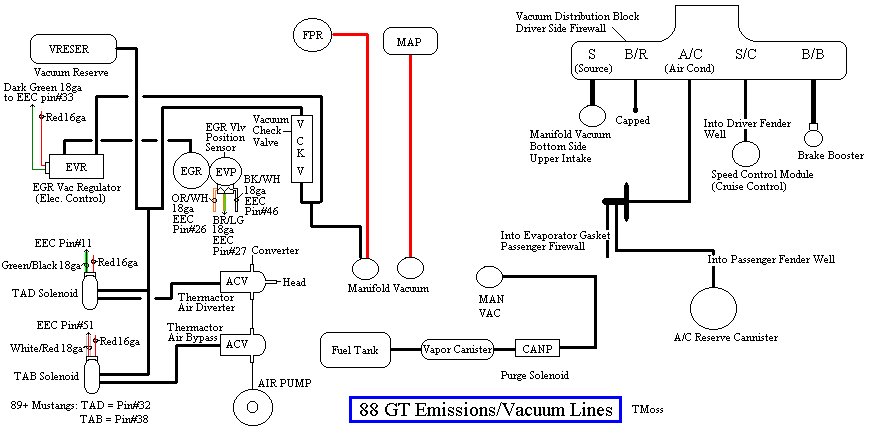
There should be no vacuum at the EGR valve when at idle. If there is, the EVR (electronic vacuum regulator) mounted on the backside of the passenger side wheelwell is suspect. Check the vacuum line plumbing to make sure the previous owner didn’t cross the vacuum lines.

Diagram courtesy of Tmoss & Stang&2birds. (the diagram says 88 GT, but the EGR part is the same for 86-93 Mustangs)
88Stang5.0Vacuum.gif


The EGR sensor is basically a variable resistor, like the volume control on a radio. One end is 5 volt VREF power from the computer (red/orange wire). One end is computer signal ground (black/white), and the middle wire (brown/lt green) is the signal output from the EGR sensor. It is designed to always have some small voltage output from it anytime the ignition switch is the Run position. That way the computer knows the sensor & the wiring is OK. No voltage on computer pin 27 (brown/lt green wire) and the computer thinks the sensor is bad or the wire is broken and sets code 31. The voltage output can range from approximately .6-.85 volt. A defective or missing sensor will set codes 31 (EVP circuit below minimum voltage) or 32 ( EGR voltage below closed limit).

The EVR regulates vacuum to the EGR valve to maintain the correct amount of vacuum. The solenoid coil should measure 20-70 Ohms resistance. The regulator has a vacuum feed on the bottom which draws from the intake manifold. The other vacuum line is regulated vacuum going to the EGR valve. One side of the EVR electrical circuit is +12 volts anytime the ignition switch is in the run position. The other side of the electrical circuit is the ground path and is controlled by the computer. The computer switches the ground on and off to control the regulator solenoid. A defective EVR will set codes 33 (insufficient flow detected), 84 (EGR Vacuum Regulator failure – Broken vacuum lines, no +12 volts, regulator coil open circuit, missing EGR vacuum regulator.)


EGR test procedure courtesy of cjones

To check the EGR valve:
Bring the engine to normal temp.

Connect a vacuum pump to the EGR Valve or see the EGR test jig drawing below. Connnect the test jig or to directly to manifold vacuum.

Do not connect the EGR test jig to the EVR (Electronic Vacuum Regulator).


Apply 5in vacuum to the valve. Using the test jig, use your finger to vary the vacuum

If the engine stumbled or died then EGR Valve and passage(there is a passageway through the heads and intake) are good.

If the engine did NOT stumble or die then either the EGR Valve is bad and/or the passage is blocked.

If the engine stumbled, connect EGR test jig to the hose coming off of the EGR Valve.
Use your finger to cap the open port on the vacuum tee.
Snap throttle to 2500 RPM (remember snap the throttle don't hold it there).
Did the vacuum gauge show about 2-5 in vacuum?
If not the EVR has failed

EGR test jig
egr-test-jig-gif.58022


To test the computer and wiring to the computer, you can use a test light across the EVR wiring connectors and dump the codes. When you dump the codes, the computer does a self test that toggles every relay/actuator/solenoid on and off. When this happens, the test light will flicker. If the test light remains on the computer or the wiring is suspect.

To check the EVR to computer wiring, disconnect the EVR connector and connect one end of the Ohmmeter to the dark green wire EVR wiring. Remove the passenger side kick panel and use a 10 MM socket to remove the computer connector from the computer. Set the Ohmmeter to high range and connect the other ohmmeter lead to ground. You should see an infinite open circuit indication or a reading greater than 1 Meg Ohm. If you see less than 200 Ohms, the dark green wire has shorted to ground somewhere.