a/c question...first time diagnosing..please help!

bcmbcmbcm

20+ Year Stangneter :roc</strong><span class=
Jan 29, 2003
455
0
16
OK it is still cool here but it is socal and I would like my a/c working again!

I bought a fill up kit from Pep Boys. I hooked it up, but with the engine running i didn't see the gauge move or hear the compressor engage. I tried to fill it but I don't think any 134A got in there.... (yes this was converted some time back)

Anyway, later in the day, I hear the compressor pop on. I hook it up, and I watch the gauge move up to the appropriate zone and the can gets very cold (does this mean 134A moved OUT of the can)?

Anyway, the A/C cooled off the car pretty good... but about 5 minutes later warm again....I don't hear the compressor any more.

How can I be sure the compressor is actually turning on? I don't think it is...is there a relay or something to check? Could the compressor have failed?

Thanks and sorry for being such a meathead...this is my first time screwing with the A/C.
 
when the can got cold on you that meant it "was" filling the system. since it stopped blowing cold air again you might have a leak somewhere. usually the o-rings go bad in the lines. i'd take it to a shop and have them do a leakdown test to see where its leaking from and go from there.
 
OK it is still cool here but it is socal and I would like my a/c working again!

I bought a fill up kit from Pep Boys. I hooked it up, but with the engine running i didn't see the gauge move or hear the compressor engage. I tried to fill it but I don't think any 134A got in there.... (yes this was converted some time back)

Anyway, later in the day, I hear the compressor pop on. I hook it up, and I watch the gauge move up to the appropriate zone and the can gets very cold (does this mean 134A moved OUT of the can)?

Anyway, the A/C cooled off the car pretty good... but about 5 minutes later warm again....I don't hear the compressor any more.

How can I be sure the compressor is actually turning on? I don't think it is...is there a relay or something to check? Could the compressor have failed?

Thanks and sorry for being such a meathead...this is my first time screwing with the A/C.


If the compressor was completely 'dry', you'll need at least two cans of R134A and I'd HIGHLY suggest the oil lube as well. SOunds like it took the 134, but was simply not enough..don't forget the OIL!!!

Let the system cycle for a bit after you add the can of oil lube.

If you don't hear any noise when the compressor engages, it's probably Ok..since it doesn't have any R134A in it.....the low/high pressure switch keeps the compresser from cycling..thus saving your compressor ;-)

Hope this helps.
Bobby
 
R134a conversion and recharge instructions.

Here goes Rev 2 as they say in the computer business. I have added more detail in view that some of the readers may not have done A/C work before

R134a = $9 a can – takes 2 - 2 ½ cans.

R134a compatible oil = $7 for an 8 oz bottle – better get 2 bottles

Gauge set for recharging = $20-$120 – check out the pawn shops for a bargain before you pay retail.
http://www.harborfreight.com/cpi/photos/92600-92699/92649.gif
92649.gif


Vacuum pump – I use an old refrigerator compressor = $20- $40 at used appliance stores, or go to the Dump and get one for free. Be sure to have some R12 compatible oil handy to keep it lubed up properly.
index.php


Pump to force cleaning fluid through the system $20-$50 (may use compressed air to do the same thing)

O ring seal kit = $8

R134a charging adapter = $13 (I cut mine up to use it with the R12 gauge set that I have had for a long time)

Plastic tools to disconnect refrigerant lines - 1/2" & 5/8" = $4 each

Flushing agent – Advance Discount Auto Parts has some flushing solvent in a 1 gallon plastic bottle - try that first Or use Mineral spirits = $4.50 a gallon, tetrachloroethylene =$7-$12 a gallon, takes 2 gallons of either one.

Miscellaneous hoses and fittings to adapt the flushing pump to the system, and the R134a adapter to the R12 gauge set = $15

I did a R134a conversion on my 89GT, and used all stock parts. You will need to replace the dryer/receiver (about $75 if you get the one with the hose made as part of the unit), and should replace all of the rubber “O” ring seals as well. You will need to drain all of the oil out of the compressor and replace it with new R134a compatible oil. Next comes the nasty part – in order to get all the old oil out of the system, you will need to flush it with special flushing solvent, or mineral spirits (ok) or tetrachloroethylene (better, but may be hard to get). If you leave the old oil in place it will congeal and reduce the heat transfer in the condenser and evaporator (read that it won’t cool good) and possibly damage the compressor. As for the oil in the compressor, unbolt the compressor from its mounts, remove both fittings at the bolt on flange joint. Then turn the compressor upside down over a bucket and the oil will drain out. Pour a cup full of mineral spirits into the suction side (the side with the biggest hose) and swish it around, turn the compressor hub 5 turns, and dump out the mineral spirits. Set the compressor aside for 30 minutes or so that the mineral spirits can evaporate out. Then add 6-8 oz of r134a compatible oil to the suction port, swish it around while you turn the hub 10 turns so that the oil coats everything real good. Get the new O rings, coat them with oil, and replace the O rings at the flange joint you took apart. Re-install the compressor in the vehicle.

Connect the pump (I had an electric sump pump I bought for $20) to the hose from the high-pressure side of the compressor. Alternately, you could use compressed air to force the cleaning fluid through the system. I didn’t like to do this since compressed air has lots of moisture in it, which is death to A/C systems. Pump the cleaning fluid through the system and let it come out the hose that was attached to the old dryer/receiver. I used 2 gallons of mineral spirits and pumped it all through the condenser and evaporator. The expansion valve is located near the firewall in the high-pressure line of the evaporator, and may cause the cleaning fluid to trickle through the lines at a very slow pace. You may want to pump cleaning fluid through the evaporator and condenser separately to speed up the process.

Next comes the changing of all the old “O” rings so that the chances for leaks is minimized. Use the plastic connector tools to separate the lines, place the extended collar part of the tool so that it faces the large part of the connector and push inwards: this expands the spring so that you can pull the tube apart. You may need a helper to push on the tool while you pull on the tubes to separate them. Install the new “O” rings: be sure to coat them with new oil when you put them in. Install the new dryer/receiver, R134a service port adapter, connect the compressor, add about more 4oz of oil to high pressure line and tighten up all the lines. Close the hood, start the engine, let everything get hot under the hood, but don’t add the R134a or turn the A/C on. Connect the charging gauge hoses to the service ports on the A/C (red gauge = high pressure, blue gauge = low pressure) and open both valves, then connect the center hose to the vacuum pump. The purpose of this exercise is to heat up the system so that when you vacuum it all down (yes, you will need a vacuum pump- mine is an old refrigerator compressor), that all the air, vapor and moisture from the cleaning fluid vaporizes and is removed from the system. Vacuum it down for about 30 minutes, this should give you about 28” of vacuum or more inside the A/C system. I have a vacuum gauge “T” connected into the vacuum pump line so that I can accurately watch the vacuuming process. This is a good time to take a soda and sandwich break since it doesn’t go faster if you watch it.

Remove the electrical connector from the dryer/receiver and jumper the two connections inside the wiring harness side of the connector together: this allows the compressor to engage in spite of low pressure/no gas in the system. Close both charging gauge valves, and then disconnect the center hose of the charging gauges from the vacuum pump and connect it to the R134a can tapper. Put the R134a can in the can tapper and screw it down with the can tapper valve closed, then open the valve. Loosen the hose at the center connection of the charging gauge set until the R134a squirts out: this purges the line of air and moisture. The refrigerant is added through the low pressure side of the system, so open the low pressure gauge valve to add the R134a. As you add refrigerant, be sure to hold the can upright: this will insure that gas is added and not liquid. If you turn the can over so that liquid refrigerant is added, you may damage the compressor since gas compresses and liquid doesn't. Start the car and take note of the idle speed, then set the idle speed up to about 1200-1500 rpm, and turn the A/C on inside and set the fan speed on high. Watch for the pressure on the low side to drop off as you are filling, and the R134a can will get warm and stay warm. This tells you the current can is empty and needs to be changed for a fresh one. Before you disconnect the can, be sure to close the valve on the R134a can tapper.

Watch the high side pressure on the charging gages and regulate the adding of gas to keep the high side pressure under 350 psi. You will probably need a fan in front of the car to keep the readings below 350 psi. I had to put the R134a can in hot water while I was charging the system with it, or else the can got so cold that it quit flowing. Use caution when you do this so that you don’t get water in the charging adapter when you change the cans. When you have added the 2 cans of gas, the high side will read about 250-300 psi and low side about 28-38 psi. Turn the idle speed back to where it was, turn the A/C off, disconnect the charging gauges, and re-install all the caps on the service ports. Remove the jumper from the low pressure switch harness and plug it back on the switch connectors. Then put the R134a Service Sticker on, secure all the loose wiring on the system and you are done. I hope it cools good, mine doesn’t get quite as cold as it used to driving around town.

I have an EPA 609 MVAC certification. And yes, you can shortcut the process, but there are negative factors if you do. Sooner or later, something will cease to function like it should. Shoddy work is a time bomb ticking away, waiting to explode.
 
The compressor kicked in today! How can I rule out an electrical problem? Where are the relay(s), switche(s) etc. I can bypass to see if I can get the compressor on? Today when I was driving it kicked in and I got mucho cold air.
 
The low pressure cutout switch is mounted above the accumulator (aluminum canister on the firewall).
If the pressure drops because you are low on refrigerant, it will shut off to protect the system. The refrigerant
helps circulate the oil and lubricate the compressor. Do not jumper the contacts inside the wiring connector for
very long if the system is low on gas. You could damage the compressor due to lack of lubricant.

The WOT cutout relay located below the MAF cuts the A/C off at wide open throttle. The relay
wiring is subject to heat damage, and the relay sometimes goes bad. I think that the automotive relay
sockets sold by Radio Shack are a match in terms of contact arrangement.

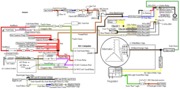
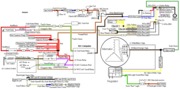
Diagram courtesy of Tmoss & Stang&2birds
fuel-alt-links-ign-ac.gif


See the following website for some help from Tmoss (diagram designer) & Stang&2Birds (website host) for help on 88-95 wiring http://www.veryuseful.com/mustang/tech/engine/

Ignition switch wiring
http://www.veryuseful.com/mustang/tech/engine/images/IgnitionSwitchWiring.gif

Fuel pump, alternator, ignition & A/C wiring
http://www.veryuseful.com/mustang/tech/engine/images/fuel-alt-links-ign-ac.gif

Computer,. actuator & sensor wiring
http://www.veryuseful.com/mustang/tech/engine/images/88-91_5.0_EEC_Wiring_Diagram.gif

Fuse panel layout
http://www.veryuseful.com/mustang/tech/engine/images/MustangFuseBox.gif

Vacuum routing
http://www.veryuseful.com/mustang/tech/engine/images/mustangFoxFordVacuumDiagram.jpg
 

Attachments

  • fuel-alt-links-ign-ac.gif
    fuel-alt-links-ign-ac.gif
    83.1 KB · Views: 138
What kind of manifold pressures indicate a charged system?

What kind of pressures indicate a charged system? I bought a manifold gauge kit at Pep Boys and I am reading about 100PSI on the high and low sides...but right now I don't hear the compressor kicking in.
 
Ok if i understand this right the low pressure reading of 90-100 indicates that the system still needs juice and it will DROP as I add juice ? At the same time, the high pressure side will RAISE as I add juice?

Also, on a speed density car, where is the WOT relay (since there is no MAF!!??)?

I pulled the connector off the accumumator (I think...the can on the pass side firewall) and jumpered the two connections inside the connector. I heard some clicking but it wasn't a totally positive sound (maybe the compressor wasn't engaging??) Is it possible the WOT relay is shot?

Please help me...I know I can lick this one!
 
WOT relay and wiring fried!

The low pressure cutout switch is mounted above the accumulator (aluminum canister on the firewall).
If the pressure drops because you are low on refrigerant, it will shut off to protect the system. The refrigerant
helps circulate the oil and lubricate the compressor. Do not jumper the contacts inside the wiring connector for
very long if the system is low on gas. You could damage the compressor due to lack of lubricant.

The WOT cutout relay located below the MAF cuts the A/C off at wide open throttle. The relay
wiring is subject to heat damage, and the relay sometimes goes bad. I think that the automotive relay
sockets sold by Radio Shack are a match in terms of contact arrangement.

Diagram courtesy of Tmoss & Stang&2birds
fuel-alt-links-ign-ac.gif


See the following website for some help from Tmoss (diagram designer) & Stang&2Birds (website host) for help on 88-95 wiring http://www.veryuseful.com/mustang/tech/engine/

Ignition switch wiring
http://www.veryuseful.com/mustang/tech/engine/images/IgnitionSwitchWiring.gif

Fuel pump, alternator, ignition & A/C wiring
http://www.veryuseful.com/mustang/tech/engine/images/fuel-alt-links-ign-ac.gif

Computer,. actuator & sensor wiring
http://www.veryuseful.com/mustang/tech/engine/images/88-91_5.0_EEC_Wiring_Diagram.gif

Fuse panel layout
http://www.veryuseful.com/mustang/tech/engine/images/MustangFuseBox.gif

Vacuum routing
http://www.veryuseful.com/mustang/tech/engine/images/mustangFoxFordVacuumDiagram.jpg

OK I looked underneath the air snorkel, where a MAF would be...and there was a little relay. I unbolted the relay from the body of the car and the wiring insulation fell apart in my hand. I jumped the black/yellow wire to a positive, the compressor kicked on, and I had cold air!

I let it suck down one more can...the low side pressure reading was about 28 and the high side about 180.

So....

Leaks in the lines aside....how do I fix this relay? Can I bypass it? Is this relay a Pep Boys type of item or a dealer item? How about the connector? I can tape up the bad piece now but are replacements available?

Thanks much!! I know many of you are working on your heaters right now but here in socal I need ac baby!
 

Attachments

  • fuel-alt-links-ign-ac.gif
    fuel-alt-links-ign-ac.gif
    83.1 KB · Views: 133
you can go to the junkyard and get one. they cost ~$20-$40 from the auto parts store. the plug and relay are similar to the fuel pump ones, but there is an extra terminal present on both, so you cant just use the fuel pump items for the wac (wide open throttle ac cutoff)