blown cylinder heads?

tommy_1812

New Member
Dec 21, 2005
41
0
0
Kerrville, TX
This morning I drove my car to my pops and it drove fine. It felt strong as can be. Once I got out there, I turned the key off and let it sit for several hours. I tried starting it up after 5 hours, and it cranked and cranked, but wouldn't start. I smelled a strong odor of gasoline. It finally cranked over, but the motor sounded VERY raspy at first. I was able to reverse out of the driveway and get onto the street.

It lacked power. Going in 1st and 2nd it lacked power and sputtered if if I pressed the gas all the way down. Once shifting into neutral at the stop sign, the rpms idled at 2000. Getting onto the highway, it only had 10% power and couldn't go over 50 mph. I was able to limp the 5 miles to the auto shop where I get my car serviced. The whole time, blue and black smoke was blowing out the exhaust.

Once I parked the car, it idled at 2000 to 2500 RPMs. There was no knocking or pinging noise coming from the motor. The raspy sound dissapeared from the motor, but obviously it has some serious issues.

Does this sound like a blown head gasket or bad cylinder head?

The weird thing is it ran like a champ this morning. Then the afternoon it's like Satan or something took over the motor and made it run like crap. It was a very unexpected event. Hopefully anyone can give me bad news now before the mechanic calls me in the morning with bad news. I can at least sleep somewhat better.

There was no burning oil smell, the motor was not shuddering or vibrating bad, it was running smooth while idling abnormaly high. No knocking sound was heard. The oil appeared to be in sound condition. The oil pressure was normal, no overheating was noted.
 
Dump the codes and see what the computer says is wrong…Codes may be present in the computer even if the Check Engine light isn’t on.

Here's the link to dump the computer codes with only a jumper wire or paper clip and the check engine light, or test light or voltmeter. I’ve used it for years, and it works great.

See http://www.troublecodes.net/Ford/

index.php


index.php


attachment.php


IF your car is an 86-88 stang, you'll have to use the test lamp or voltmeter method. There is no functional check engine light on the 86-88's except possibly the Cali Mass Air cars.

Codes have different answers if the engine is running from the answers that it has when the engine isn't running. It helps a lot to know if you had the engine running when you ran the test.

Trouble codes are either 2 digit or 3 digit, there are no cars that use both 2 digit codes and 3 digit codes.

For those who are intimidated by all the wires & connections, see http://www.actron.com/product_detail.php?pid=16153 for what a typical hand scanner looks like. Normal retail price is about $30 or so at AutoZone or Wal-Mart.

Or for a nicer scanner see http://www.midwayautosupply.com/pc-7208-90-equus-digital-ford-code-reader-3145.aspx – It has a 3 digit LCD display so that you don’t have to count flashes or beeps.. Cost is $30.
 
It sounds like you have a bad overfuelling problem. Start by checking for codes. Follow the codes if there are any. If not I would need to know the year of the car to point you in the proper direction.
 
It's a 1990 mustang. I do know that it had issues starting up a month prior. It would be the same as a failing fuel pump. Fail to start up hot, then start up fine when cool. Did the same darn thing. It took several minutes to try and start her up. A strong odor of gasoline was prevalent. I did press the gas pedal down several times.

Is it possible that it was gasoline in the cylinders that caused that bad outburst?

May I also add that pulling codes is not possible. The Check engine light IS on, but unable to communicate with the computer is the only communication I get. So my computer is pmsing. Obviously a code or codes is present but won't allow me to pull them.
 
May I also add that pulling codes is not possible. The Check engine light IS on, but unable to communicate with the computer is the only communication I get. So my computer is pmsing. Obviously a code or codes is present but won't allow me to pull them.

Would you please provide more information? How do you know this?
 
ever elusive problem

The code puller my mechanic uses is unable to communicate with the computer. We've tried pulling codes and the code puller can't pull codes. The computer will not give them up.

A few days ago, it started up fine, but the idle was still high (around 2K). I was told it could be a fuel issue.
 
Try the 2 cent paper clip method described in my first post. It often works when the fancy new code readers don't.

If the paper clip method won't work, here's the fix...

Computer will not go into diagnostic mode

How it is supposed to work:
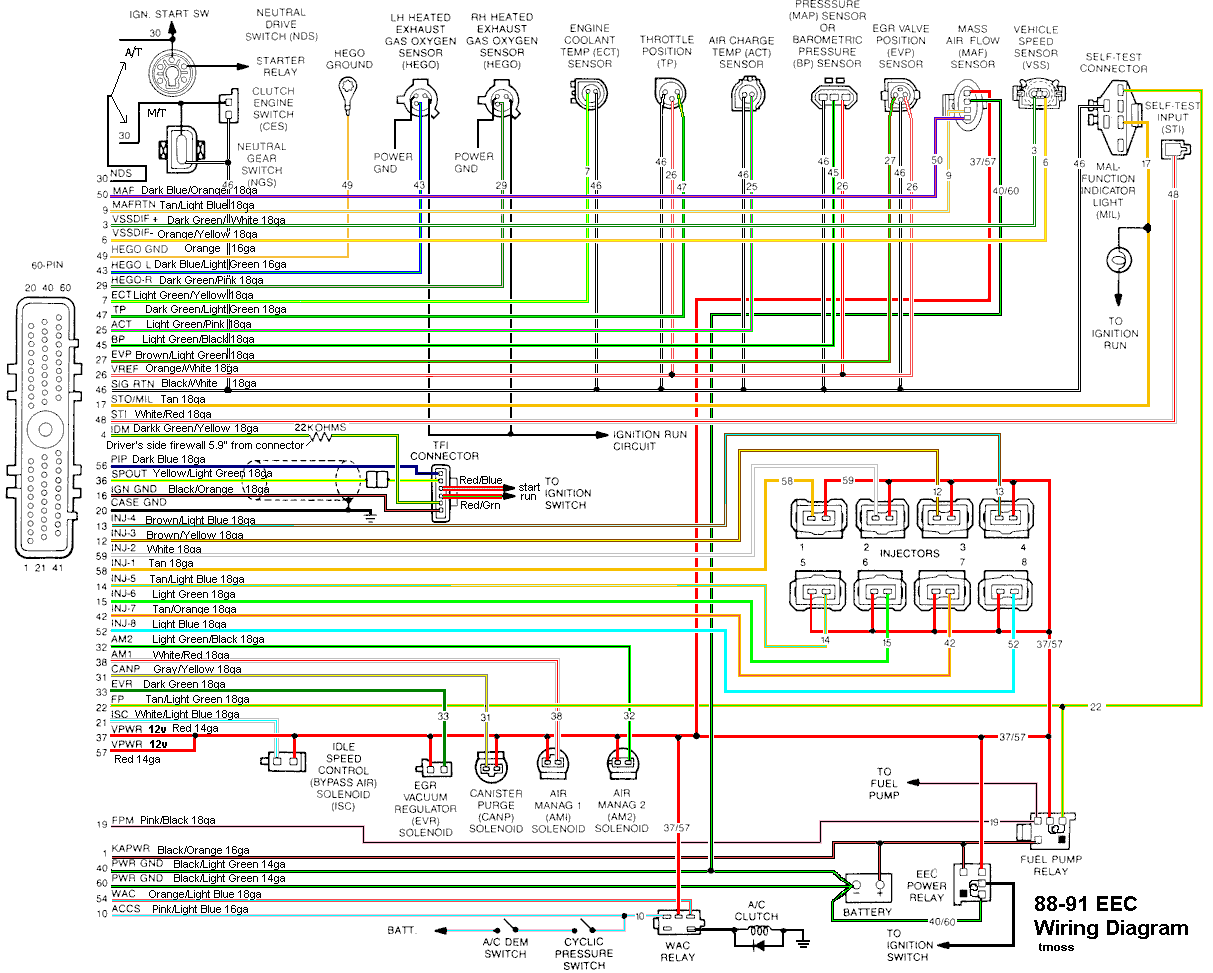
The black/white wire (pin 46) is signal ground for the computer. It provides a dedicated
ground for the EGR, Baro, ACT, ECT, & TPS sensors as well as the ground to put the
computer into self test mode. If this ground is bad, none of the sensors mentioned will work
properly. That will severely affect the car's performance.
Since it is a dedicated ground, it passes
through the computer on its way to the computer main power ground that terminates at the
battery pigtail ground. It should read less than 1.5 ohms when measured from anyplace on the
engine harness with the battery pigtail ground as the other reference point for the ohmmeter
probe. What sometimes happens is that it gets jumpered to power which either burns up the
wiring or burns the trace off the pc board inside the computer. That trace connects pins 46 to pins
40 & 60. Only an experienced electronics technician can open the computer up & repair the trace if
it burns up and creates an open circuit.

The STI (Self Test Input ) is jumpered to ground to put the computer into test mode. Jumpering
it to power can produce unknown results, including damage to the computer. The ohm test
simply verifies that there are no breaks in the wiring between the test connector and the computer input.

How to test the wiring :
With the power off, measure the resistance between the computer test ground
(black/white wire) on the self test connector and battery ground. You should see less than
1.5 ohms.

attachment.php


If that check fails, remove the passenger side kick panel and disconnect the computer
connector. There is a 10 MM bolt that holds it in place. Measure the resistance between
the black/white wire and pin 46: it should be less than 1.5 ohms. More that 1.5 ohms is a
wiring problem. If it reads 1.5 ohms or less, then the computer is suspect. On the
computer, measure the resistance between pin 46 and pins 40 & 60: it should be less than
1.5 ohms. More that that and the computer’s internal ground has failed, and the computer
needs to be replaced.

If the first ground check was good, there are other wires to check. Measure the
resistance between the STI computer self test connector (red/white wire) and pin 48 on
the computer main connector: it should be less than 1.5 ohms. More that 1.5 ohms is a
wiring problem

The following is a view from the computer side of the computer connector.
eec04.gif


Diagram courtesy of Tmoss & Stang&2birds

88-91_5.0_EEC_Wiring_Diagram.gif


See the following website for some help from Tmoss (diagram designer) & Stang&2Birds
(website host) for help on 88-95 wiring http://www.veryuseful.com/mustang/tech/engine

harness02.gif