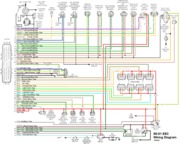
Fix the code 56 first and the code 41 will probably go away
Code 41 or 91 - O2 indicates system lean. Look for a vacuum leak or failing O2 sensor. Code 41 is a RH side
sensor, code 91 is the LH side sensor.
The computer sees a lean mixture signal coming from the O2 sensors and tries to compensate by adding more fuel. Many times the end result is an engine that runs pig rich and stinks of unburned fuel.
The following is a Quote from Charles O. Probst, Ford fuel Injection & Electronic Engine control:
"When the mixture is lean, the exhaust gas has oxygen, about the same amount as the ambient air. So the sensor will generate less than 400 Millivolts. Remember lean = less voltage.
When the mixture is rich, there's less oxygen in the exhaust than in the ambient air , so voltage is generated between the two sides of the tip. The voltage is greater than 600 millivolts. Remember rich = more voltage.
Here's a tip: the newer the sensor, the more the voltage changes, swinging from as low as 0.1 volt to as much as 0.9 volt. As an oxygen sensor ages, the voltage changes get smaller and slower - the voltage change lags behind the change in exhaust gas oxygen.
Because the oxygen sensor generates its own voltage, never apply voltage and never measure resistance of the sensor circuit. To measure voltage signals, use an analog voltmeter with a high input impedance, at least 10 megohms. Remember, a digital voltmeter will average a changing voltage." End Quote
Testing the O2 sensors
Measuring the O2 sensor voltage at the computer will give you a good idea of how well they are working. You'll have to pull the passenger side kick panel off to gain access to the computer connector. Remove the plastic wiring cover to get to the back side of the wiring. Use a safety pin or paper clip to probe the connections from the rear. The computer pins are 29 (LH O2 with a dark green/pink wire) and 43 (RH O2 with a dark blue/pink wire). Use the ground next to the computer to ground the voltmeter.
Note that all resistance tests must be done with power off. Measuring resistance with a circuit powered on will give false readings and possibly damage the meter. Do not attempt to measure the resistance of the O2 sensors, it may damage them.
Testing the O2 sensor wiring harness
Most of the common multimeters have a resistance scale. Be sure the O2 sensors are disconnected and measure the resistance from the O2 sensor body harness to the pins on the computer.
The O2 sensor ground (orange wire with a ring terminal on it) is in the wiring harness for the fuel injection wiring. I grounded mine to one of the intake manifold bolts
Replace the O2 sensors in pairs if replacement is indicated. If one is weak or bad, the other one probably isn't far behind.
Code 56 MAF - output voltage too high. Failed MAF sensor, short between
MAF sensor and heater or short in wiring between pin A (12 volts) and pins C or D.
There are three parts in a MAF: the heater, the sensor element and the amplifier.
The heater heats the MAF sensor element causing the resistance to increase.
The amplifier buffers the MAF output signal and has a resistor that is laser
trimmed to provide an output range compatible with the computer's load tables.
The MAF output varies with RPM which causes the airflow to increase or
decease. The increase of air across the MAF sensor element causes it to cool,
allowing more voltage to pass and telling the computer to increase the fuel flow.
A decrease in airflow causes the MAF sensor element to get warmer, decreasing
the voltage and reducing the fuel flow. Measure the MAF output at pins C & D
on the MAF connector (dark blue/orange and tan/light blue) or at pins 50 & 9
on the computer.
At idle = approximately .6 volt
20 MPH = approximately 1.10 volt
40 MPH = approximately 1.70 volt
60 MPH = approximately 2.10 volt
Disconnect the MAF sensor, battery negative post and computer connector.
The computer connector is located under the passenger side kick panel & is
secured by a single 10 MM bolt.
Do not make any resistance checks
without disconnecting the connectors. You will get incorrect readings.
Check the resistance between the MAF signal wiring and power.
Pin D on the MAF (dark blue/orange wire) and Pin A (red wire) should be
1 megohm or higher (meter shows infinite resistance or open circuit.).
Pin C on the MAF (tan/light blue wire) and Pin A (red wire) should be
1 megohm or higher (meter shows infinite resistance or open circuit.).
See the following website for some help from Tmoss (diagram designer) & Stang&2Birds (website host)
http://www.veryuseful.com/mustang/tech/engine/images/fuel-alt-links-ign-ac.gif