Cranks but no start, weird noise w/ video

Measure the resistance of the injectors. SHould get 14.4 ohms across the two prongs.

You said you had 40 psi, so sounds like the regulator may not be the case. Just a matter of if the injectors are firing, or if the are gummed up after 2 years of sitting. I know when my car sat for 6 years, i lost an injector. Only 7 were firing.

You might be able to pull plug #1, leave it open and crank it and see if you can smell fuel in that cylinder. Might give you an idea if the injectors are spraying fuel.
 
Ok thanks for the advice Mike. After I fixed the computer grounds, and it sounded like it was about to crank I was smelling a lot of fuel, where as before I was smelling none. Like I said, it sounds like its about to crank but just wont keep itself running. I am going to check the injectors like you said, I think it is very much so possible some are shot.

Edit: Ok I checked the ohms on them. I may sound stupid but I am not sure if I did this right with my multimeter. I am not sure what scale to put it on to get ohms. I put it on the 200 scale and got 15.2 on them.
 
You do hear the fuel pump prime right?

It should fire with spraying ether down the intake, regardless if there is fuel or not.

I would pull your number one plug, crank it to the top of the compression stroke, put the dizzy on no.1 on the cap, not aiming it at the no.1 cylinder, and re-do your firing order...

It sounds like timming.
 
Ok thanks for the advice Mike. After I fixed the computer grounds, and it sounded like it was about to crank I was smelling a lot of fuel, where as before I was smelling none. Like I said, it sounds like its about to crank but just wont keep itself running. I am going to check the injectors like you said, I think it is very much so possible some are shot.

Edit: Ok I checked the ohms on them. I may sound stupid but I am not sure if I did this right with my multimeter. I am not sure what scale to put it on to get ohms. I put it on the 200 scale and got 15.2 on them.

The injector resistance seems to be correct. The range is 13.5-19 ohms according to the Probst book I have.
 
It does sounds very close to starting now. I would loosen the distributor just enough to advance it or retard it a bit while its cranking. Or if you have a timing light you could put that on it and see if you can determine where it's at. Edit: Pull the spout connector out either way if you adjust the timing.
 
Well if you have fuel then the only thing i can think of is a bad tfi module or you may need to take the dizzy out and turn the motor to tdc and put the dizzy in and set the timing.
 
Look I appreciate the help but please read the previous posts before posting if you really want to help. The dizzy is new with a new tfi module, and pickup, I'm 100% sure I stabbed the dizzy correctly, but I am going to pull it and do it again and set the timing while crank, which is something I haven't done. I still think it is a problem with my injectors not firing though.
 
I tell you what smart guy... i really wanted to help ...other wise i would not have made a reply to your post. I am not going to read every single reply... i was telling you what i think ...not going along with what everybody else said. If you really want more help... stop trying to be so smart on the comments..because i didn't have to post anything to try and help you. Now i know why i don't come on the site that much anymore.... every time you try and help people and they want to talk alittle crap.If you really appreciate the help stop making ******* comments to people that's trying to help you or you will not find any help.
 
I wasn't being smart or talking crap, I was actually being polite. I know people have good intentions which is why I didn't go crazy, but it is very aggravating when people recommend things I have already covered. I said in the very first post that I have fuel pressure but yet you asked if my pump was working. I don't expect anyone to read every single post in my threads, but I appreciate the people who do. Not the people who just throw random ideas out there. If I was such a smart guy I wouldn't be on here asking for help. Thanks anyways.

Three things I am going to do tomorrow:

-See if i can dump any codes from computer
-Check connections from TFI module to computer
-Restab dizzy and adjust timing while cranking
 
You might be flooded. if you are smelling fuel, then they are probably squirting.

If you press the accelerator to the floor, it signals the EEC to turn off injector firing during cranking. You could give that a shot and try to start the engine with the pedal floored. See if the reason it's not cranking is due to the engine flooding out.

When my ECT sensor failed, i had issues with the engine flooding out frequently. Only way to start it was mash the gas and crank it and it would start.
 
I'm beginning to think your injectors are stuck (as mentioned earlier), probably from sitting. I think it's possible the injectors can stick open or closed. So you could be rich on some cylinders and lean on others. If you have a stethoscope try and listen for the injectors to actually fire (click) while you are cranking, indicating the internal plunger is actually moving. If you don't have a stethoscope I've found that a heater hose or a wooden stick will work pretty good. I haven't done it but they say the injectors can be tested with a 9V transistor battery as well.
 
I am going to get a stethoscope and see if I can hear the injectors firing, this is a sure way to see if they actually are.

A little update. I tested the wires from the TFI module to the computer and got some confusing results.
There are a couple wires that are in question.

-The pink wire coming from the computer that has the spout connector on it is completely open when testing from the module connector to the computer, same results testing both sides of the spout connector.

-Next the tan/yellow wire that goes from the TFI module to the coil and pin #4 are also completely open on both sides, coil and computer.

-Last the Red/lt green wire that goes to the coil measured about 75 ohms of resistance, from the module connector to the coil plug.

Now I am not sure what these wires are supposed to measure at but looking at the wiring diagram I dont see any breaks that would cause these wires to be open. Any suggestions?

This is the diagram I am looking at.
91-93_5.0_EEC_Wiring_Diagram.gif
 
Use a noid test light rather than a test light or regular automotive bulb. The filament in a regular bulb takes time to heat up, and that can make it difficult to see if the injectors are getting a pulse.

If you have another good coil laying around, try swapping it.
 
Ok, will do, Joe if you look at my last post, do you think those wires being open could be my problem?

I also pulled the codes and got a 31,81,82, and 84, all seem to be emissions codes which would make sense, since I have no smog or EGR. Not sure if a successful code dump can eliminate anything.
 
How the TFI ignition works in 86-93 model Mustangs:

Tools needed: DVM, noid light, safety pin.

Theory of operation:
The TFI ignition in 86-93 Mustangs has 4 main components: the ignition switch, the coil, the TFI module and the PIP sensor inside the distributor.

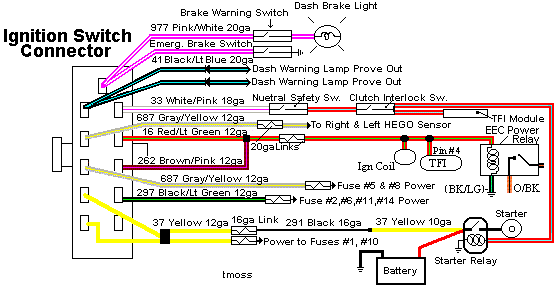
The ignition switch gets power from the two yellow wires that are supplied power by a fuse link located in the wiring harness that connects to the starter solenoid.

Diagram courtesy of Tmoss & Stang&2birds
IgnitionSwitchWiring.gif


The coil is mounted on the driver’s side strut tower on most EFI Mustangs. It gets power from a red/green wire and a brown/pink wire from the ignition switch. That wire from the ignition switch feeds a 20 gauge blue fuse link that connects to the red/green wire. The fuse link protects the wiring and the ignition switch, since the fuse link for the two yellow power supply wires has a much higher current rating. Without the smaller fuse link protecting the smaller wiring used in the ignition circuit, a short there would cause the red/green wire to overheat and burn up.

The TFI module is mounted on the side of the distributor and supplies the ground for the coil. Every automotive power supply circuit uses the ground as the return path to carry power back to the negative side of the battery. The TFI switches the tan/yellow wire coming from the coil to ground. It gets power from the red/green wire when the ignition switch is in the Run position. The red/lt blue wire supplies a signal to turn on more power (dwell time) when the engine is cranking. The trigger signal comes from the PIP sensor when cranking and the computer when the engine is running. The SPOUT jumper plug enables computer controlled spark advance. When the SPOUT is removed, spark advance is locked at the setting determined by the mechanical position of the distributor.

The PIP sensor is in the bottom of the distributor under the shutter wheel. It is a Hall effect magnetic sensor that senses a change in the magnetic field when one of the slots in the shutter wheel uncovers the sensor. Then it supplies a pulse that triggers the TFI module to provide a ground to the ignition coil. A bad PIP will often set code 14 in the computer and cause hot start problems. Replacing the PIP sensor requires removal of the distributor and pressing the gear off the distributor shaft to expose the sensor. For most people, a remanufactured distributor ($55-$75) is the solution, since they may not have access to a press.

Troubleshooting the ignition system – no spark or weak spark. All the tests are done with the ignition switch in the Run position unless specified otherwise. A safety pin may be used to probe the wiring connectors from the back side.
1.) Check for 12 volts at the yellow wires on the ignition switch. No 12 volts and the fuse link near the starter solenoid has open circuited.
2.) Check for 12 volts on the red/green and brown/pink wires coming out of the ignition switch. No 12 volts, replace the ignition switch.
3.) Check for 12 volts at the ignition coil. No 12 volts and the blue 20 gauge fuse link has open circuited.
4.) Check for 12 volts at the red/green wire on the TFI module. No 12 volts and you have wiring problems.
5.) Remove the small red/blue wire from the starter solenoid (looks like it is stuck on a screw). This is a safety measure to keep the engine from turning while you are making measurements. Have a helper turn the ignition switch to Start and look for 12 volts on the red/lt blue wire on the TFI module. No 12 volts and you will have starting problems, but push starting the car will work OK. No 12 volts, replace the ignition switch. Be sure to reconnect the red/blue wire to the starter when you finish.
6.) A noid light available from any auto parts store, is one way to test the PIP pulse. The computer uses the PIP signal to trigger the fuel injectors. The noid light plugs into the fuel injector harness in place of any easily accessible injector. Plug it in and it will flash if the PIP is working. No flash from the noid light and the PIP is suspect. To confirm the PIP is being the source of the non flashing noid light, look for 12 volts on the red injector wiring. Good 12 volts and no flashing noid light means the PIP has failed.
7.) Remove the SPOUT plug from the harness and try to start the engine. If it starts, replace the PIP. This is a common no start condition when the engine is hot.
8.) The TFI module is a go/no go item when you have a no spark/weak spark condition on a cold engine. It either works or it doesn’t.
The TFI failure mode on a running car is usually a high speed miss on a warm engine. Many auto parts stores will test your TFI module for free. Bring along a hair dryer to get it hot while testing it and run several test cycles, since it often gets weak when it heats up.
The coil is somewhat more difficult to pinpoint as a problem. A good coil will make a nice fat blue spark 3/8”-1/2” long. The problem is that one person’s perception of a fat blue spark looks like may not be accurate enough to spot a weak coil. The coil is cheap enough ($13-$16) that having a known good working spare might be a good idea.

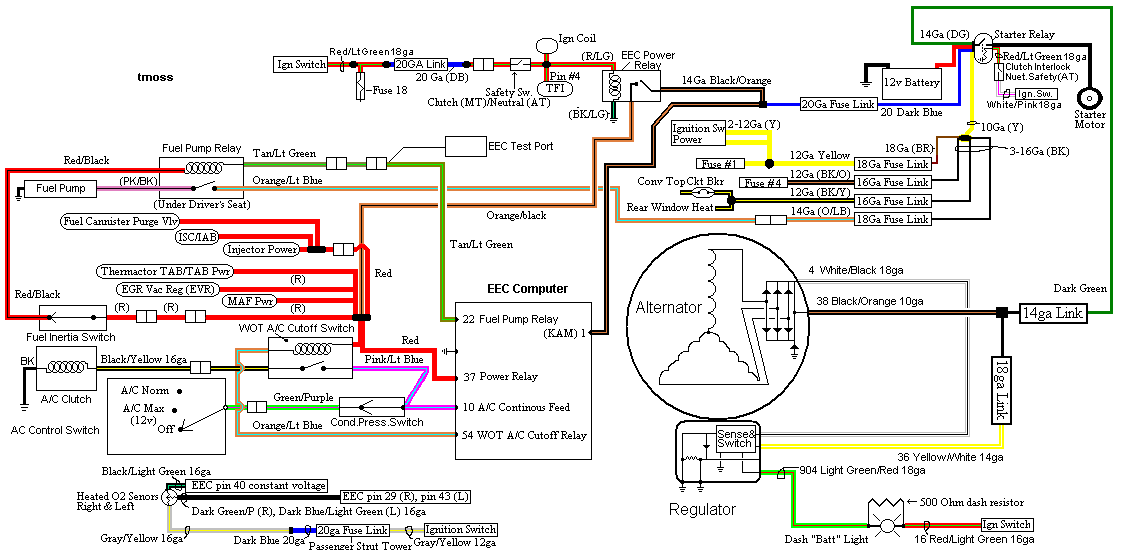
diagram courtesy of Tmoss & Stang&2Birds
fuel-alt-links-ign-ac.gif


TFIModuletroubleshooting.jpg


See the following website for some help from Tmoss (diagram designer) & Stang&2Birds (website host) for help on 88-95 wiring Mustang FAQ - Wiring & Engine Info Everyone should bookmark this site.

Ignition switch wiring
http://www.veryuseful.com/mustang/tech/engine/images/IgnitionSwitchWiring.gif

Fuel, alternator, A/C and ignition wiring
http://www.veryuseful.com/mustang/tech/engine/images/fuel-alt-links-ign-ac.gif

Complete computer, actuator & sensor wiring diagram for 88-91 Mass Air Mustangs
http://www.veryuseful.com/mustang/tech/engine/images/88-91_5.0_EEC_Wiring_Diagram.gif

Vacuum diagram 89-93 Mustangs
http://www.veryuseful.com/mustang/tech/engine/images/mustangFoxFordVacuumDiagram.jpg

HVAC vacuum diagram
http://www.veryuseful.com/mustang/tech/engine/images/Mustang_AC_heat_vacuum_controls.gif

TFI module differences & pinout
http://www.veryuseful.com/mustang/tech/engine/images/TFI_5.0_comparison.gif
 
Ok thanks for the advice Mike. After I fixed the computer grounds, and it sounded like it was about to crank I was smelling a lot of fuel, where as before I was smelling none. Like I said, it sounds like its about to crank but just wont keep itself running. I am going to check the injectors like you said, I think it is very much so possible some are shot.

the plugs may fouled or gas soaked at this point , you may want to remove and inspect them , also the cylinders may be washed down from all that fuel.
 
I got it running, I adjusted the timing while trying to crank it, and also replaced the ignition switch. It starts up perfect now. It doesnt stay running without giving it gas, but there are a few vacuum ports I forgot to cap and I need to adjust the timing while the car is running. Once it started it up I was satisfied and called it a night.

YouTube - ‪First start up‬‏