Eaton Power Steerign Pump

Jan 17, 2004
463
0
16
Well I am almost done with the new motor install. My dume self decided to rebuild the power steering pump too. Well I took it apart cleaned everything and laid it out how i dissembled it. Well Murphy's law tells us that don;t work :damnit: Needles to say waging dogs' tails make a jigsaw puzzle of the pieces. I am wondering if anyone has any pictures of how the sleeve and rollers go into the pump. The sleeve has a small indent on one side and a larger one on the oppsite side. I am assuming one of these is for the roller pin. Also which direction does the slant go for the roller impeller. HELP.
 
1) Install the tiny pin in the hole inside the front housing where the sleeve sits. The pin keeps the sleeve from rotating.
2) Look at the edges of the sleeve. On one side one edge is rounded a bit. On the other side, both edges are sharp. This is the side that faces up in the housing. The rounded edge side goes down into the housing and aligns with the pin.
3) You've already installed the front seal, right? Lube the bushing & seal with Lubriplate. Slide the input shaft into the pump from the FRONT. Set the key for the rotor in the slot for it on the input shaft.
4) Slide the rotor onto the shaft and align with the key. When looking at the rotor in the housing, the "arms" lean counter-clockwise.
5) Slide the retaining clip onto the shaft and up into the groove at the rotor. Make sure you do not push the input shaft through the seal. If you do, you must re-insert the shaft from the front to keep from damaging the seal.
6) Put some Lubriplate into each of the hollows of the rotor in the housing and set the rollers in.
7) One o'ring goes around the sleeve in the housing and a smaller one in the indentation above it for the pressure valve.
8) Lubriplate the bushing in the rear housing and install onto the back of the front housing. Install a couple of bolts and hand-tighten while turning the input shaft. At some point you should be able to tighten down a couple of the bolts and the shaft will still turn.
9) Install the pressure valve into the housing. Put a little lube on the valve and install into the housing narrow end first, then the spring, then the access nut with the thick o'ring on it.
 
OMG your great. I have to buy new seal kit i steped on the front seal and crushed it. Anyways. Thanks. A little clarification please. One end looks like a little handle to a mace and the other end is bigger has a bunch of groves on it. From what you have said the handle part goes in first so the big end touches the spring. Case ->little handle _> big w groves - spring - Cap?


Thanks your a life saver. This motor install is taking 2x as long as the previous.
 
Why is it so important to slide the shaft in from the front? Is it so the key in the end of the shaft doesn't damage the seal? I'm not able to get the rotor off the shaft. Does it work to get the key out of the shaft, insert it through the back with the seal installed, then put the key in the shaft?
 
The reason why you want to install the shaft through the seal from the front is to keep from damaging the lip of the seal.

Going in from the front, the edges of the machining on the shaft is smoother and shallower. If you install the shaft front the back, that big step in the front has a sharp edge where the pulley backs up to and can easily damage the seal.

Lube the seal with vaseline, and the shaft too. Gently silde the shaft through the seal from the front until the groove that holds the key for the rotor is completely inside the pump housing. Install the key in the groove and slide the rotor onto the shaft, aligning it with the key until it bottoms in the housing. When you are looking down at the rotor, with it sitting in the housing, the arms of the rotor will lean backwards, or counter-clockwise.

Push the shaft far enough through the rotor that the groove on the shaft for the wire clip is exposed. Unstall the wire clip and make sure it snaps fully into the groove for it. Be careful not to push the inputs shaft in so far that the outer edge goes inside the seal. If you happen to do this while installing the clip (and it is easy to do), you must pull the shaft all the way out from the back and start over.
 
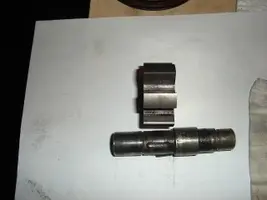
My rotor shaft may be modified. It has a collar on it immediately in front of where the rotor goes. this collar is too big to go in thru the seal from the front.
 

Attachments

  • shaft 005 (320 x 240).webp
    shaft 005 (320 x 240).webp
    8.1 KB · Views: 189
Uh, sorry, but what you have there is an input shaft with the front shaft bushing frozen on it. There is a bronze bushing in both the front and rear cases. That shaft has been run out of fluid and the front bushing has brazed itself to the shaft and pulled out of the housing.

Bushings are not available separately. You are going to need another input shaft and a front case half with a good bushing in it. If there is any roughness on the inner surface of the cam ring, or the rollers have any pitting or lines in them, you better find another pump.
 
Well, that explains it!!!

It's funny the hole in the front housing feels perfectly smooth, like you'd expect the inside of the bushing to feel. The rollers and cam ring are all smooth and clean. So, I guess I need a new shaft and front housing w/ bushing. Do you sell those?
 
None of the hard parts have been available for the Eaton pump for 10-15 years or so. There is hardly anything available for the Ford/Thompson pump that replaced it. All you can do is sustitute good used parts, when you can find them.

I am currently looking into a repair to fix the damaged input shafts and to having new bushings made, but it will be early next year before I get to that.
 
Would there be a big market for input shafts? I know a place that would be able to manufacture them. They were going to make one for me. But, mine was good enough that they were able to refinish it and make a new bushing for the housing.