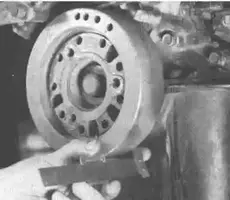
harmonic balancer

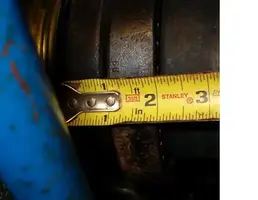
I've always been interested about this balancer, I've been around a lot of vintage stangs and I have never seen a STOCK 302 balancer this big, with the exception if the hi-po 289 which was around three inches wide. Does anybody think it has performance advantage over the thinner units?

Its the stock balancer from my 69 coupe, 302, auto
 

Attachments

  • balancer.webp
    balancer.webp
    14.5 KB · Views: 192
Good point about rotating mass, especially about switching a manual, iron flywheel for aluminum. The picture I included didn't show the opposite half of the damper which has less material. The picture shows the "counter weight"? But when it comes to the job of a damper, the more surface area to absorb vibration, the better. And that leads to less parasitic loss, better oil control, and a more stable valve train. Which is why the previously mentioned hi-po balancer is so wide, as well as most after market replacements.
 
Never thought of it that way. I always figured that the size of the balancer didn't matter; just that it balanced out the motor. I am wondering if the reason for the bigger dampaner (and you noted that you showed the counter weight side) is that the crank itself on the hi-po motors was made differently. That way, you would need more counter mass to balance out the motor.
 
but then again, the size of the balancer would be important with a more powerful motor wouldnt it? If its having to smooth out more "powerful" hits from each piston and the equivalant jerking that the balancer would have to deal with a smaller one would have its disadvantages. (btw, light flywheels only help really low torque motors)
 
Well, now that I think about it, the balancer is just the fine tunning of the engines balancing. The main counter force action is done by the counter weights on the crank itself, so all the balancer is doing is fine tunning that.
 
Actually, the hipo cranks were from the same production lines as the std crank, the only difference was they were checked for hardness. The main thing that makes a hipo bottom end better is the thicker main caps.

The hipos had a thicker damper to dampen the torsional stress better, and the counterweight to improve the high rpm balance.
 
another picture (stock balancer)

I'll see if I can't find another picture of the smaller type along with maybe a 289 hi-po style. There is this business called THE DAMPER DUDES, they rebuild dampers and they are supposed to be pretty good. Ever heard of them?
 

Attachments

  • 306.webp
    306.webp
    47 KB · Views: 123
Question:

1.
On the production line I doubt that ANY engine balance was performed. IF a proper balance of the rotating assembly is made, does the 'importance' of a specific HB go way down the priority list? Meaning, you simply need a good one, blance to that HB and your good. I'm guessing that a good balance of the rotatin assembly causes the "fine adjustment" factor to go away.

2.
On an auto-trans motor vs. a standard motor: i.e. flywheel vs torque converter. Unlike a manual motor that usually has tens of balanced pounds rotating on the engine, an auto-tranny motor does not. IF the HB is used to counter or fine tune balance within the motor, it would seem it's size (weight) could vary deopending on the transmission?
are there auto versus manual HBs?
 
blandq said:
2. On an auto-trans motor vs. a standard motor: i.e. flywheel vs torque converter. Unlike a manual motor that usually has tens of balanced pounds rotating on the engine, an auto-tranny motor does not. IF the HB is used to counter or fine tune balance within the motor, it would seem it's size (weight) could vary deopending on the transmission?
are there auto versus manual HBs?
Flywheel, Clutch, and Pressure-plate vs. Flexplate, Torque Converter, and Fluid. Weights are probably closer than you think. I'm not sure that either has any affect on the dampening of the engine assuming these assemblies are balanced anyway.