The smog pump has two vacuum operated valves. The first valve either dumps the pump output to the open air or directs it to the next valve. The smog pump dumps its output at full throttle to save horsepower. The second valve directs the air to either the passages in the heads or to the tube that runs to the cat converters. Both the tube for the head and the tube going to the cat converters have one way check valves to prevent the hot exhaust gas from backing up into the tube and the control valves.
See
http://www.veryuseful.com/mustang/tech/engine/images/88Stang5.0Vacuum.gif for smog pump vacuum line help
Here are some of the codes generated by faulty parts in the smog pump system and their fixes...
Codes 94 & 44 - Check vacuum lines for leaks, & cracks. Disconnect the big hose from smog pump: with the engine running you should feel air output. Reconnect the smog pump hose & apply vacuum to the first vacuum controlled valve: Its purpose is to either dump the pump's output to the atmosphere or pass it to the next valve. The next vacuum controlled valve directs the air to either the cylinder heads when the engine is cold or to the catalytic converter when the engine is warm. Disconnect the big hoses from the back side of the vacuum controlled valve and start the engine. Apply vacuum to the valve and see if the airflow changes from one hose to the next.
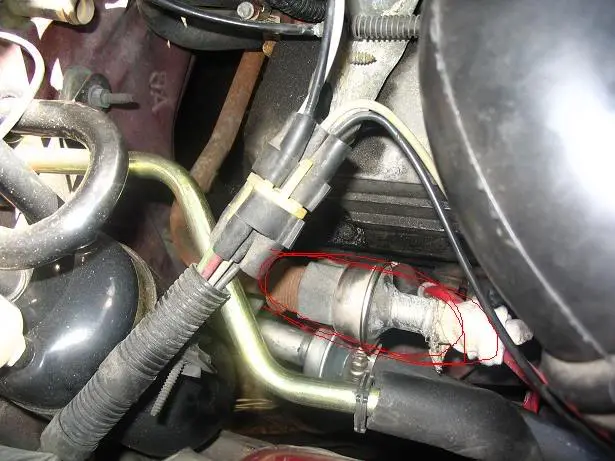
The two electrical controlled vacuum valves mounted on the rear of the passenger side wheelwell turn the vacuum on & off under computer control. Check to see that both valves have +12 volts on the red wire. Then ground the white/red wire and the first solenoid should open and pass vacuum. Do the same thing to the light green/black wire on the second solenoid and it should open and pass vacuum.
Remember that the computer does not source power for any actuator or relay, but provides the ground necessary to complete the circuit. That means one side of the circuit will always be hot, and the other side will go to ground or below 1 volt as the computer switches on that circuit.
See the following website for some help from Tmoss (diagram designer) & Stang&2Birds (website host)
http://www.veryuseful.com/mustang/tech/engine/images/fuel-alt-links-ign-ac.gif
http://www.veryuseful.com/mustang/tech/engine/images/88-91eecPinout.gif
Code 81 – Secondary Air Injection Diverter Solenoid failure AM2. The secondary air diverter solenoid valve isn’t working on the Thermactor Air System (smog pump). Look for broken or missing vacuum lines on the solenoid valve to the diverter valve. The solenoid valve is located on the back side of the passenger side wheel well. Check the solenoid valve for +12 volts at the Red wire and look for the Lt Green/Black wire to switch from +12 volts to 1 volt or less. The computer controls the valve by providing a ground path on the LT Green/Black wire for the solenoid valve.
Code 82 – Secondary Air Injection Diverter Solenoid failure AM1. The dump valve air diverter solenoid valve isn’t working on the Thermactor Air System (smog pump). Look for broken or missing vacuum lines on the solenoid valve to the diverter valve Check the solenoid valve for +12 volts at the Red wire and look for the Red/White wire to switch from +12 volts to 1 volt or less. The computer controls the valve by providing a ground path on the Red/White wire for the solenoid valve.
Putting the computer into self test mode will cause all the actuators to toggle. This can be done either with a jumper wire or code scanner.
How to pass emissions testing:
1.) Make sure all the emissions gear the car was made with is present and connected up properly. That includes a working smog pump and cats.
2.) Make sure that you have fresh tune up with spark plugs, plug wires, cap, rotor, fuel & air filters. An oil & filter change is a good idea while you are at it.
3.) Dump the codes and see what the computer says is wrong…
Here's the link to dump the computer codes with only a jumper wire or paper clip and the check engine light, or test light or voltmeter. I’ve used it for years, and it works great.
See
http://www.troublecodes.net/Ford/
OR
See
http://www.mustangworks.com/article...c-iv_codes.html
IF your car is an 86-88 stang, you'll have to use the test lamp or voltmeter method. There is no functional check engine light on the 86-88's except possibly the Cali Mass Air cars.
Codes have different answers if the engine is running from the answers that it has when the engine isn't running. It helps a lot to know if you had the engine running when you ran the test.
Trouble codes are either 2 digit or 3 digit, there are no cars that use both 2 digit codes and 3 digit codes.
For those who are intimidated by all the wires & connections, see
http://www.actron.com/product_detail.php?pid=16153 for what a typical hand scanner looks like. Normal retail price is about $30 or so at AutoZone or Walmart.
Or for a nicer scanner see
http://www.midwayautosupply.com/det...iption.asp?3829 – It has a 3 digit LCD display so that you don’t have to count flashes or beeps.. Cost is $33.
4.) Post the codes and get help to fix them. Don’t try to pass with codes not fixed. Clearing the computer just temporarily removes them from memory, it doesn’t fix the problem that caused the code to be set.
5.) Be sure to do the testing on a hot engine. Drive for 15-20 minutes prior to taking the test to get operating temps up into the normal range. Do not shut off the engine while waiting for your turn on the test machine. An engine up to full operating temperature puts out fewer emissions.



 ?


