
I bought this can from jegs and it can be used two different ways, as a recirculating can or as an overflow can. Are there certain applications you're supposed to use one or the other for? I have it set up as an overflow can right now. Also if I have it as an overflow can do I need to add some coolant into the can or do I leave it empty?? Thanks.
You are using an out of date browser. It may not display this or other websites correctly.
You should upgrade or use an alternative browser.
You should upgrade or use an alternative browser.
How to use Jeg's overflow tank?
- Thread starter 19stang66
- Start date

A froend & I were just speeking of how to do a recirculating tank. You will need to put the overflow fitting on the bottom so that when it filles the incoming water enters from the bottom. You will also need a different cap for the radiator, ths is what I am looking for now.
Mike
Mike

Stang_1973
Founding Member
I am interested in this thread as well. Hope to get some good info cause I have some similiar questions.

CornerCarvin67
New Member
- Dec 30, 2004
- 246
- 0
- 0
Do a search and find the Overflow vs. Resevoir thread I started... this has been a pain in my butt for awhile.

LMan
Founding Member

Yea I read that thread cornercarvin. Thats where I got the idea to get that Jegs overflow tank and a new rad cap. Now I have another problem. I have a huge leak somewhere but I can't see where its coming from. After school I went out to my car and there was a huge puddle of green/brown coolant all over the ground. The same thing happened last night after my dad drove it. It's coming from around where a hose connects to the engine. I can't really describe where, I might be able to get a pic. It empts the radiator though but I keep filling it back up. Could my new rad cap be the prob? I bought this one . I haven't hooked up the overflow can yet because I don't know what way I should hook it up.

Timmy
Founding Member
At the risk of getting slammed, I’ll tell you what I know.
When you say empties the radiator, do you mean ore or less than a quart? More and it’s a head gasket, less I would say is normal.
Putting on an overflow radiator tank is easy and really has no cons. All cars have them now(that I know of). The pro to this is, the radiator is always full to the maximum capacity. More coolant, more cooling ability. I had an over heating issue on my 74 Bronco with a 302. I added a cheap overflow tank for $10 and the problems went away.
It sounds like you have issues with a bad hose or a bad fitting. It could just be the overflow. All radiator have an overflow vent tub. As water gets hot, it expands and has to have somewhere to go. Once the pressure builds to more than the rating of the radiator cap, it’s vented out a tube which may or may not be hooked to an overflow tank. If there is no tank, it just leaks out to the ground.
Most of the time, the venting happens once you stop the car or truck. The temperature rises because there is no airflow and the water expands thus leaving a puddle under the car. This should stop once the radiator reaches a point where the water has ample room to expand. If you keep toping it off, it will keep pushing out the water you add.
Adding an overflow tank will capture the water being pushed out and then as the temperature goes down, it’s drawn back into the radiator keeping it full all the time.
My 69 Mach 1 has not overflow tank and it pushes water out till the radiator is about a quart(maybe less) low. It does drip from the overflow tube once an a while after I park. I have no over heating issues with my .040 over 390 at this time. Everything is new on the cooling system. My temp is between 184 to 200 at all times even if it in the high 90’s.
Hope this helps.
Tim
When you say empties the radiator, do you mean ore or less than a quart? More and it’s a head gasket, less I would say is normal.
Putting on an overflow radiator tank is easy and really has no cons. All cars have them now(that I know of). The pro to this is, the radiator is always full to the maximum capacity. More coolant, more cooling ability. I had an over heating issue on my 74 Bronco with a 302. I added a cheap overflow tank for $10 and the problems went away.
It sounds like you have issues with a bad hose or a bad fitting. It could just be the overflow. All radiator have an overflow vent tub. As water gets hot, it expands and has to have somewhere to go. Once the pressure builds to more than the rating of the radiator cap, it’s vented out a tube which may or may not be hooked to an overflow tank. If there is no tank, it just leaks out to the ground.
Most of the time, the venting happens once you stop the car or truck. The temperature rises because there is no airflow and the water expands thus leaving a puddle under the car. This should stop once the radiator reaches a point where the water has ample room to expand. If you keep toping it off, it will keep pushing out the water you add.
Adding an overflow tank will capture the water being pushed out and then as the temperature goes down, it’s drawn back into the radiator keeping it full all the time.
My 69 Mach 1 has not overflow tank and it pushes water out till the radiator is about a quart(maybe less) low. It does drip from the overflow tube once an a while after I park. I have no over heating issues with my .040 over 390 at this time. Everything is new on the cooling system. My temp is between 184 to 200 at all times even if it in the high 90’s.
Hope this helps.
Tim
It's leaving huge puddles of liquid on the ground. The fluid level gets so low that I can see the metal fins or whatever their called inside the radiator. I'm not a genious but I thought your not supposed to be able to see those metal fins inside, only fluid that is 1" below the neck.

65up2d8
Member
19stang66 said:It's leaving huge puddles of liquid on the ground. The fluid level gets so low that I can see the metal fins or whatever their called inside the radiator. I'm not a genious but I thought your not supposed to be able to see those metal fins inside, only fluid that is 1" below the neck.
You said you saw green and brown puddles of coolant. If so, at minimum you need to flush your radiator, but a new radiator may be in order. Insofar as whether a recirculating system or a catch can is better, I think that's a no-brainer (no offense meant).
Recirculating your coolant is obviously better than dumping it on the ground for both the cooling performance of your engine as well as the environment. Always check the operation of your thermostat whenever you're dealing with problems like you're describing. If you're in doubt, replace the $4 thermostat.
If you'd like to narrow down your problems without replacing the t-stat, however, you can always check your t-stat in boiling water on the cook stove in your house. If you have a 190 degree t-stat, drop it in water boiling above 190 in a pan on your stove and see if the t-stsat opens. If not, its bad.
First off, fix the leak, antifreeze is extremely toxic. You don't want to pollute the environment or kill animals do you?
Next get your system power flushed. That "brown" color is actually insulative and keeps your system from cooling to it's peak efficiency.
For street use you want to set it up as a recirculating system.
The over flow is strictly for racing applications.
Setting it up for recirculation will allow you to fill your radiator all the way up, and positively affects the cooling capacity. If you fill the system to the top, and leave just a 1/2 cup in the recovery bottle, you system will function correctly. Every new cap I have seen has the recovery valve built in (it's the little valve in the center).
Next get your system power flushed. That "brown" color is actually insulative and keeps your system from cooling to it's peak efficiency.
For street use you want to set it up as a recirculating system.
The over flow is strictly for racing applications.
Setting it up for recirculation will allow you to fill your radiator all the way up, and positively affects the cooling capacity. If you fill the system to the top, and leave just a 1/2 cup in the recovery bottle, you system will function correctly. Every new cap I have seen has the recovery valve built in (it's the little valve in the center).
Well I'm gonna sound mentally retarded but I'm pretty sure I don't have a thermostat. Where would I find it on the engine if I did? The PO said it's a new radiator, sooo  Also none of my gauges are working as of now because I'm awaiting a new instrument voltage regulator. I'm leaving her sit for this week though, don't wanna risk anything. Thanks 66Runt and 65up2d8 for finally answering my catch can question!
Also none of my gauges are working as of now because I'm awaiting a new instrument voltage regulator. I'm leaving her sit for this week though, don't wanna risk anything. Thanks 66Runt and 65up2d8 for finally answering my catch can question!
Here's how to find your thermostat. There is a small housing on the fron ot the engine extending out from the intake manifold. It has a large water hose comig off of it, this should be your upper radiator hose. There are two bolts, probably 1/2 inch, holding the housing to the front of the manifold, take them out and the thermostat should fall out unless it is held in by gasket/rtv.19stang66 said:Well I'm gonna sound mentally retarded but I'm pretty sure I don't have a thermostat. Where would I find it on the engine if I did? The PO said it's a new radiator, sooo
Since you are a student, try taking the old T-Stat into the kitchen and putting it in a pot of water on the stove. Heat the water up while watching it with a thermometer (if mom is a cook or dad makes homebrew they probably have a kitchen thermometer) and note when the T-Stat opens. This should happen between 160 and 200. If it opens before 155 or after 200 throw it away and go buy a new one. If it works you should be okay to re-instrall it and know that is not a problem. Might fix your leak too since the T-Stat area (plus heater/pump) is a common source for leaky hoses.
When you install the new one you need to make sure it faces the right way, look at it while you are at the parts store, there should be a word or arrow indicating correct direction, if there is not ask someone. I'd recommend drilling 2-4 small holes in the flange to allow some small amount of water to bypass the T-Stat since this can help avoid steam pockets. Seal her up well and wait a few hours before you drive it.
Hope this helps.
Asking questions is how we all learn
If you follow the upper radiator hose back to the engine, the piece that is attached to the radiator hose and bolted to the engine is your thermostat housing. The thermostat sits inside this housing, in a slightly recessed lip. The main body of the valve sits inside the block, and the tip faces the radiator. I don't know your weather, but I would think somewhere around 180* would be good for this winter.
Most places sell the thermostat seperately from the gasket (rip off artists ). make sure to clean both surfaces well. I like to cheat by hitting the gasket with some gasket tack, and using the tacky gasket to hold the thermostat in place while I position the thermostat housing. That way I don't worry that the thermostat will slip out of the recess, causing a leak, or worse a broken thermostat cover... yes that happened to me and I never forgot, so learn from my stupid mistake. If you can pressure test your cooling system when you are finished. If you don't have a tester, then get your engine and transmission up to operating temp, shut the car of, and wait a few minutes to let things heat soak. Carefully look around all the hoses and gaskets, along with the bottom side of the water pump for any signs of leakage.
Don't forget to get that thing power flushed!
Good luck,
Scott
If you follow the upper radiator hose back to the engine, the piece that is attached to the radiator hose and bolted to the engine is your thermostat housing. The thermostat sits inside this housing, in a slightly recessed lip. The main body of the valve sits inside the block, and the tip faces the radiator. I don't know your weather, but I would think somewhere around 180* would be good for this winter.
Most places sell the thermostat seperately from the gasket (rip off artists
). make sure to clean both surfaces well. I like to cheat by hitting the gasket with some gasket tack, and using the tacky gasket to hold the thermostat in place while I position the thermostat housing. That way I don't worry that the thermostat will slip out of the recess, causing a leak, or worse a broken thermostat cover... yes that happened to me and I never forgot, so learn from my stupid mistake. If you can pressure test your cooling system when you are finished. If you don't have a tester, then get your engine and transmission up to operating temp, shut the car of, and wait a few minutes to let things heat soak. Carefully look around all the hoses and gaskets, along with the bottom side of the water pump for any signs of leakage. Don't forget to get that thing power flushed!
Good luck,
Scott
WOW, I'm feeling pretty stupid now. I'll go check out the t-stat and see what I can find. For some reason I thought it would be external so you can read the temp on a gauge. Can you do that to these old cars (I think my brother did on his 88 GT)? Can I power flush the system or should I have a shop do it for me (is it expensive)? Oh and by the way I live in Minnesota, soo I'm pretty sure i'm not driving her this winter 
Well you've lost me on that one.
The thermostat is not the same as a temperature gauge sending unit (normally called a temp sender). This is a valve that sits in the path of the hot coolant exiting the engine towards the radiator. When the coolant is cooler then the rating on the thermostat it stays closed and blocks the pathway for the coolant from the engine to the radiator.
Could you mean your brother added a mechanical gauge in the engine compartment to monitor coolant temp while showing off all that underhood bling?
Anyways, power flushing, or back flushing, is different then just adding in chemicals and running the car, then flushing it all out.
Because your coolant system flows in one direction the scale will build up layered in that direction. Back flushing under pressure not only gets all the old coolant and gunky stuff (highly technical term ) out, but because of the pressure breaks away the mineral scaling that has "grown" on the surfaces. This really helps as that corrosion is insulative as well. Plus having it done at a station will hopefully insure that the old coolant is disposed of properly.
Here in the land of high prices I think I paid like $60.00, but I supplied the coolant and distilled water, cause I didn't trust the commie bastiges
Well, good luck with it.
Scott
The thermostat is not the same as a temperature gauge sending unit (normally called a temp sender). This is a valve that sits in the path of the hot coolant exiting the engine towards the radiator. When the coolant is cooler then the rating on the thermostat it stays closed and blocks the pathway for the coolant from the engine to the radiator.
Could you mean your brother added a mechanical gauge in the engine compartment to monitor coolant temp while showing off all that underhood bling?
Anyways, power flushing, or back flushing, is different then just adding in chemicals and running the car, then flushing it all out.
Because your coolant system flows in one direction the scale will build up layered in that direction. Back flushing under pressure not only gets all the old coolant and gunky stuff (highly technical term
) out, but because of the pressure breaks away the mineral scaling that has "grown" on the surfaces. This really helps as that corrosion is insulative as well. Plus having it done at a station will hopefully insure that the old coolant is disposed of properly. Here in the land of high prices I think I paid like $60.00, but I supplied the coolant and distilled water, cause I didn't trust the commie bastiges
Well, good luck with it.
Scott
Ha thanks runt. Well I don't know what the gauge is my brother added, I just remember it because he explained to me how it works but I forgot what he said. Well my discovery could be the problem. To say the least, the thermostat housing looks like a cave wall... I'm pretty sure that has something to do with it. I tried the boiling water thing but I'm not sure when I know that the t-stat opened. It didn't seem to do much though, a couple of bubbles. I put it in the pan with the pointed tip pointed up, if that matters any. Here are some pictures...not looking to good.
Attachments
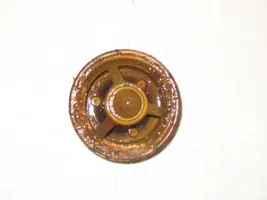
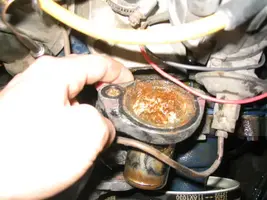
They are usually about $5.
Your coolant is trashed, get some antifreeze while you are there, and dispose of what you have. I know they take used motor oil for free but I don't know about the AF.
Looking at the buildup I'd say you DEFINITELY should back wash it out.
Your coolant is trashed, get some antifreeze while you are there, and dispose of what you have. I know they take used motor oil for free but I don't know about the AF.
Looking at the buildup I'd say you DEFINITELY should back wash it out.
Similar threads

- Replies
- 8
- Views
- 195


- Replies
- 7
- Views
- 281
- Replies
- 2
- Views
- 206

- Replies
- 32
- Views
- 734
- Replies
- 0
- Views
- 526