

You are using an out of date browser. It may not display this or other websites correctly.
You should upgrade or use an alternative browser.
You should upgrade or use an alternative browser.
HP per cubic inch
- Thread starter 90limited
- Start date


Dino Dino Bambino
15 Year Member
I always had the rule of thumb that if you can get 1 HP per cubic inch on a NA motor, you were doing pretty good. For example, NA 5.0 getting 302hp is great. Reason I am asking, is that when I see claims of a NA 5.0 getting 400 plus HP I tend not to believe it. Am I wrong?
That 1hp/ci from a NA motor was a benchmark back in the 70's before engines with double overhead cams per bank, 4 valves/cylinder, variable valve timing, and variable length intake manifolds became common.
The Ferrari 458 Italia has the highest specific HP and TQ of any production NA car engine with 562hp @ 9000rpm and 398lbft @ 6000rpm from just 4.5 liters (274.5ci). That's 125hp/liter (2.05hp/ci) and 88.5lbft/liter (1.45lbft/ci) so those are the current benchmarks, and the key to getting there is high rpm.

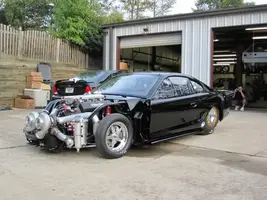
so does a 670" proline bullet with twin promod 98's hanging off the front making near 4000
Its amazing how far racing has come in 50 years. I still can't fathom how people begin to pay for these things.
Dino Dino Bambino
15 Year Member
The current 5.0L TiVCT does that and then some.
Most people would be very happy with a 5.0L engine that produces 412hp/390lbft and revs to 7000rpm but if the TiVCT engine had the same specific outputs as the 4.5L V8 in the Ferrari 458, it would be putting out 620hp/440lbft and rev to 9000rpm. That's a mouth-watering additional 200+hp and 2000rpm at a cost of a lot of additional $$$$.

That 1hp/ci from a NA motor was a benchmark back in the 70's before engines with double overhead cams per bank, 4 valves/cylinder, variable valve timing, and variable length intake manifolds became common.
The Ferrari 458 Italia has the highest specific HP and TQ of any production NA car engine with 562hp @ 9000rpm and 398lbft @ 6000rpm from just 4.5 liters (274.5ci). That's 125hp/liter (2.05hp/ci) and 88.5lbft/liter (1.45lbft/ci) so those are the current benchmarks, and the key to getting there is high rpm.
A cooler benchmark to me is if you divide the hp/L by the RPM @ peak. That to me would so how well engineered/matched the combination is. Measured that way, the Ferrari gets a score of 562/4.5/9000 = .013877 A 302 by that benchmark would be making .013877*4.951*7500=508hp @ 6000 RPM. Still pretty impressive when you consider a Boss 302 makes 444.
Conversely, the Z06 has a lot of room to improve considering it makes 505hp at 6300 rpm with a 7L motor. The Ferrari's benchmark would put that 7 L at 611hp.
I guess that's what you get for all the extra money. Spinning 9k on a motor is not easy to do with a street car.

foxbodymike87
Active Member
- Jul 12, 2011
- 739
- 35
- 39
Dino Dino Bambino
15 Year Member
A cooler benchmark to me is if you divide the hp/L by the RPM @ peak.
Yup I agree though ideally you should calculate the specific TQ of each engine across the rpm range and look at the area under the curve. You could use the specific torque at peak HP (just multiply HP/liter by 5252/rpm) as well as the specific torque at peak TQ (peak TQ/liter) to get a true reflection of the engine's power efficiency and power spread.
Here are some numbers for comparison:
Specific TQ at peak HP:
Porsche 911 GT3 RS 4.0: 78.7lbft/liter (peak HP 8250rpm)
Ferrari 458: 72.9lbft/liter (peak HP 9000rpm)
5.0 GT (new): 67.2lbft/liter (peak HP 6500rpm)
5.0 Boss: 63.6lbft/liter (peak HP 7400rpm)
Chevy LS7: 60.1lbft/liter (peak HP 6300rpm)
Specific TQ at peak TQ:
Ferrari 458: 88.5lbft/liter
Porsche 911 GT3 RS 4.0: 84.8lbft/liter
5.0 GT (new): 78.8lbft/liter
5.0 Boss: 76.8lbft/liter
Chevy LS7: 67.1lbft/liter
From those numbers I can draw these conclusions:
1. The Ferrari and Porsche engines represent the pinnacle of engineering at the moment.
2. The new 5.0 GT engine does very well and is more efficient than the Boss engine. Just adding a CAI/self-tuner and long tube headers/exhaust to the GT will bring its numbers close to those of the Porsche for a lot less $.
3. Chevy left a lot of power under the table with the LS7 though it's easy to find with the same mods that you'd do to the 5.0 GT.
Yeah, to me it's disappointing that the LS7 came out 6 years ago and has not had any performance increase considering what was left on the table.
Dino Dino Bambino
15 Year Member
Chevy probably didn't bother 'cause they already have the 640hp ZR1 as the flagship Corvette model.

Three50won
10 Year Member
- Jul 11, 2010
- 1,135
- 64
- 69
Agreed, but then again it took Ford over 20 years to get our GT up to 300hp. And more than half of that time was 215-225hp. And consider that 300hp was a 3V 4.6 when Maxima's were making 265 hp in their 3.5L. Side note that in 04 the Accord was making 20 less hp with a 3.0 than the Gt made. Of course our 3Vs made way more torque tho. It seems that now Ford is on track...but we had our Chevy LS7 periods, hahaha!!Yeah, to me it's disappointing that the LS7 came out 6 years ago and has not had any performance increase considering what was left on the table.
Oh, I know. I lived through that period horrified that Ford had nothing to compete with the chevies, but somehow still outsold them. Now, the mustang kicks the pants off of the Camaro in every performance category, but is losing in sales... ironic isn't it?
Similar threads
- Replies
- 8
- Views
- 289

- Replies
- 5
- Views
- 656
- Replies
- 14
- Views
- 2K

- Replies
- 4
- Views
- 1K
Progress Thread
Family member 1989 GT- Backstory and updates
- Replies
- 15
- Views
- 1K