I failed emissions

Like the others stated have it scanned or buy one they are pretty cheap. fixing the problem well be better for the car also. reset the timing to stock after and get it really warm before the test, then put it back after. good luck.
 
I think that alcahol **** works. My friend just told me about it like a week ago after he got his car smogged.

That might work, but not for what he failed for. People do that to bring down hc or co, I forget which one.

I failed once for the same thing. I changed the EGR valve and passed after that.

Yep.. High oxides of nitrogen are caused by excessive combustion temps. Period. An operating EGR valve will dilute the air charge with inert gas and bring down the No2 count by reducing combustion temps. Hence No2 will not be formed.

When I last went through inspection, I failed for No2 initially. I forgot I was playing with things in my Tweecer and had turned off the EGR valve. Drove around the block and turned it back on. Went back to the inspection station and retested. Passed easily. NJ has free inspections and reinspections, so I really wasn't bothered by that one. Fighting about whether I had catalytic converters or not was a much bigger pain in the ass.
 
Ok i found this thread and instead of starting a new one, i think i'll just continue.


I just failed for NOx.. My reading was 1321 and the standard was 970. I drove 35 mins to get to this inspection station.

When i built my car i DID NOT hook up the EGR system. I did not have all of the components, therefor i left it all off. The sensors are there but no vac lines are hooked up (i know the computer will shut it off if one of the 50 million vac lines are missing). I have a BBK Catted x pipe and smog pump hooked up, and i thought this would be sufficient. Anything short of installing ALLLLL of the EGR stuff, can i run higher octane or go to a really close inspection station to lower chamber temps? Maybe dump something in the gas just to get that number down? Everything else was fine, just the NOx
 
Ok i found this thread and instead of starting a new one, i think i'll just continue.


I just failed for NOx.. My reading was 1321 and the standard was 970. I drove 35 mins to get to this inspection station.

When i built my car i DID NOT hook up the EGR system. I did not have all of the components, therefor i left it all off. The sensors are there but no vac lines are hooked up (i know the computer will shut it off if one of the 50 million vac lines are missing). I have a BBK Catted x pipe and smog pump hooked up, and i thought this would be sufficient. Anything short of installing ALLLLL of the EGR stuff, can i run higher octane or go to a really close inspection station to lower chamber temps? Maybe dump something in the gas just to get that number down? Everything else was fine, just the NOx

No2 is tough to get down without an EGR. Maybe pulling timing might work. Lowering compression would also work, but that's not a viable option. If you richen the mixture up, the combustion temps should come down also, but hc will go up. I wish I remember how I hooked up the smog pump to dump air full blast down to the cats. It diluted the hell out of the mixture and came up ok for me on another car. At least that's what I think it did. What egr stuff are you missing? Seeing how most people want to get rid of the EGR system, it shouldn't be too bad to get the parts and lines to hook it up. You don't have a tweecer, do you?
 
Ok i found this thread and instead of starting a new one, i think i'll just continue.


I just failed for NOx.. My reading was 1321 and the standard was 970. I drove 35 mins to get to this inspection station.

When i built my car i DID NOT hook up the EGR system. I did not have all of the components, therefor i left it all off. The sensors are there but no vac lines are hooked up (i know the computer will shut it off if one of the 50 million vac lines are missing). I have a BBK Catted x pipe and smog pump hooked up, and i thought this would be sufficient. Anything short of installing ALLLLL of the EGR stuff, can i run higher octane or go to a really close inspection station to lower chamber temps? Maybe dump something in the gas just to get that number down? Everything else was fine, just the NOx

Hmmm...Try and get some of that EGR vacuum lines installed. I might be able to come up with SOME of it, if you can't get any of it. I would need pics and descriptions of the areas that you need the stuff in though. Some of that stuff gets brittle and broken, but I'll try.


BTW guys...I had a code once and I changed the EGR valve and one 02 sensor, because that's what it said it was, and everything went away right after...so any of you that get codes for EGR...do that and you'll be good.
 
No2 is tough to get down without an EGR. Maybe pulling timing might work. Lowering compression would also work, but that's not a viable option. If you richen the mixture up, the combustion temps should come down also, but hc will go up. I wish I remember how I hooked up the smog pump to dump air full blast down to the cats. It diluted the hell out of the mixture and came up ok for me on another car. At least that's what I think it did. What egr stuff are you missing? Seeing how most people want to get rid of the EGR system, it shouldn't be too bad to get the parts and lines to hook it up. You don't have a tweecer, do you?

The other thing I can think of is maybe run a vaccum line to the egr valve and restrict it somehow(pinch it down with a pair of vice grips or something) to get the exhaust gasses in there. Car will run like ****, but might be enough. I'll look into it and try to think of something else too.


OK here is what I got and the details.... As far as the EGR system goes, ALL i have is the EGR valve inplace, as well as the sensors on the shock tower. NO vac lines run from those sensors, and the vac line on the EGR is no longer there (the electrical plugs are there and hooked up, but i realize they are doing nothing since no vac lines are hooked up). Also the tubes behind the heads are no longer there, the tubes were removed, and a plug placed in the EGR ports in the back of the heads. The Smog pump is hooked up, and i have a rubber line running right from the pump to the cats so basically its dumping 100% air into the cats at all times. Adding a vac line to the EGR valve i don't think would do anything honestly. I drove 35 mins to the inspection station, maybe i should find a closer one (5 mins away) and get there when the car is generally colder???? :shrug: I was hoping i could run 93 octane and dump some type of fuel additive in or something to bring down the NOx


Hmmm...Try and get some of that EGR vacuum lines installed. I might be able to come up with SOME of it, if you can't get any of it. I would need pics and descriptions of the areas that you need the stuff in though. Some of that stuff gets brittle and broken, but I'll try.


BTW guys...I had a code once and I changed the EGR valve and one 02 sensor, because that's what it said it was, and everything went away right after...so any of you that get codes for EGR...do that and you'll be good.

Basically all i have is the EGR valve, and those sensors on the passenger fender. I am under the impression there are canisters i would also need to get, remove my passenger fender, and have vac lines coming off of that.. If any one part of that system is missing or not functioning, the computer will automatically shut down the EGR system. So its an all or nothing type of thing. What a pain in the ass....
 
How to pass emissions testing:

High NO - high combustion temps - retard timing, check EGR for operation.
High CO – Rich condition - fuel pressure too high, check O2 sensors, replace air filter, Clean MAF element.
High HC – Lean misfire, vacuum leak, common misfire due to worn or weak ignition system components. On rare occasions, an overly rich mixture may be the cause. Do the ethanol/E85 fill up as suggested.
High CO & HC - Cat converters, smog pump, and smog pump controls.

How to pass emissions testing:

1.) Make sure all the emissions gear the car was made with is present and connected up properly. That includes a working smog pump and cats.

2.) Make sure that you have fresh tune up with spark plugs, plug wires, cap, rotor, fuel & air filters. An oil & filter change is a good idea while you are at it.

3.) Dump the codes and see what the computer says is wrong…Codes may be present in the computer even if the Check Engine light isn’t on.

Here's the link to dump the computer codes with only a jumper wire or paper clip and the check engine light, or test light or voltmeter. I’ve used it for years, and it works great.
See Troublcodes.net Trouble Codes OBD & OBD2 Trouble Codes and Technical info & Tool Store. By BAT Auto Technical

B.jpg


F.jpg


If your car is an 86-88 stang, you'll have to use the test lamp or voltmeter method. There is no functional check engine light on the 86-88's except possibly the Cali Mass Air cars.

attachment.php


89 through 95 cars have a working Check Engine light. Watch it instead of using a test lamp.

attachment.php


Do not jumper anything to the single black connector. It is the power for the under the hood light. It is in another bundle of wires near the windshield wiper.

Codes have different answers if the engine is running from the answers that it has when the engine isn't running. It helps a lot to know if you had the engine running when you ran the test.

Trouble codes are either 2 digit or 3 digit, there are no cars that use both 2 digit codes and 3 digit codes.

For those who are intimidated by all the wires & connections, see Actron® for what a typical hand scanner looks like. Normal retail price is less than $30 or so at AutoZone or Wal-Mart.

Or for a nicer scanner see http://www.midwayautosupply.com/p-7208-equus-digital-ford-code-reader-3145.aspx– It has a 3 digit LCD display so that you don’t have to count flashes or beeps.. Cost is $30.


4.) Post the codes and get help to fix them. Don’t try to pass with codes not fixed. Clearing the computer just temporarily removes them from memory, it doesn’t fix the problem that caused the code to be set.

5.) Be sure to do the testing on a hot engine. Drive for 15-20 minutes prior to taking the test to get operating temps up into the normal range. Do not shut off the engine while waiting for your turn on the test machine. An engine up to full operating temperature puts out fewer emissions.

Some basic theory to clarify how things work is in order…

EGR System theory and testing

The EGR shuts off at Wide Open Throttle (WOT), so it has minimal effect on performance. The addition of exhaust gas drops combustion temperature, increases gas mileage and reduces the tendency of the engine to ping. It can also reduce HC emissions by reducing fuel consumption. The primary result of EGR usage is a reduction in NOx emissions.

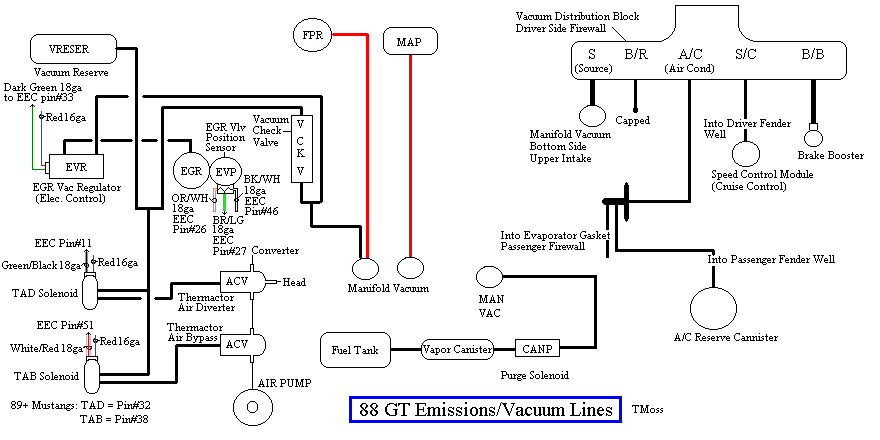
The EGR system has a vacuum source (line from the intake manifold) that goes to the EVR, computer operated electronic vacuum regulator. The EVR is located on the back of the passenger side shock strut tower. The computer uses RPM, Load. and some other factors to tell the EVR to pass vacuum to open the EGR valve. The EGR valve and the passages in the heads and intake manifold route exhaust gas to the EGR spacer (throttle body spacer). The EGR sensor tells the computer how far the EGR valve is open. Then computer adjusts the signal sent to the EVR to hold, increase or decrease the vacuum. The computer adds spark advance to compensate for the recirculated gases and the slower rate they burn at.


attachment.php


Troubleshooting:
There should be no vacuum at the EGR valve when at idle. If there is, the EVR (electronic vacuum regulator) mounted on the backside of the passenger side wheelwell is suspect. Check the vacuum line plumbing to make sure the previous owner didn’t cross the vacuum lines.

Diagram courtesy of Tmoss & Stang&2birds. (the diagram says 88 GT, but the EGR part is the same for 86-93 Mustangs)
88Stang5.0Vacuum.gif


The EGR sensor is basically a variable resistor, like the volume control on a radio. One end is 5 volt VREF power from the computer (red/orange wire). One end is computer signal ground (black/white), and the middle wire (brown/lt green) is the signal output from the EGR sensor. It is designed to always have some small voltage output from it anytime the ignition switch is the Run position. That way the computer knows the sensor & the wiring is OK. No voltage on computer pin 27 (brown/lt green wire) and the computer thinks the sensor is bad or the wire is broken and sets code 31. The voltage output can range from approximately .6-.85 volt.

The EVR regulates vacuum to the EGR valve to maintain the correct amount of vacuum. The solenoid coil should measure 20-70 Ohms resistance. The regulator has a vacuum feed on the bottom which draws from the intake manifold. The other vacuum line is regulated vacuum going to the EGR valve. One side of the EVR electrical circuit is +12 volts anytime the ignition switch is in the run position. The other side of the electrical circuit is the ground path and is controlled by the computer. The computer switches the ground on and off to control the regulator solenoid.


EGR test procedure courtesy of cjones

to check the EGR valve:
bring the engine to normal temp.
connect a vacuum pump to the EGR Valve
apply 5in vacuum to the valve.
if engine stumbled or died then EGR Valve and passage(there is a passageway through the heads and intake) are good.
if engine did NOT stumble or die then either the EGR Valve is bad and/or the passage is blocked.
if engine stumbled, connect vacuum gauge to the hose coming off of the EGR Valve
snap throttle to 2500 RPM (remember snap the throttle don't hold it there).
did the vacuum gauge show about 2-5 in vacuum?

if not, check for manifold vacuum at the EGR vacuum valve.
if you have manifold vacuum then connect vacuum gauge to the EGR valve side of the vacuum valve and snap throttle to 2500 RPM.
should read about 2-5 in vacuum

To test the computer, you can use a test light across the EVR wiring connectors and dump the codes. When you dump the codes, the computer does a self test that toggles every relay/actuator/solenoid on and off. When this happens, the test light will flicker.

Late Model Restoration has the Ford Racing M-12071-N302 kit with the EGR valve & sensor along with the ACT & ECT sensors for $45. See * * * N/A * * * 86-93 SENSOR KIT, 5.0L EFI, INCLUDES EGR VALVE & SENSOR, COOLANT TEMP SENSOR, & AIR CHARGE TEMP SENSOR MUSTANG for more details
 
OK here is what I got and the details.... As far as the EGR system goes, ALL i have is the EGR valve inplace, as well as the sensors on the shock tower. NO vac lines run from those sensors, and the vac line on the EGR is no longer there (the electrical plugs are there and hooked up, but i realize they are doing nothing since no vac lines are hooked up). Also the tubes behind the heads are no longer there, the tubes were removed, and a plug placed in the EGR ports in the back of the heads. The Smog pump is hooked up, and i have a rubber line running right from the pump to the cats so basically its dumping 100% air into the cats at all times. Adding a vac line to the EGR valve i don't think would do anything honestly. I drove 35 mins to the inspection station, maybe i should find a closer one (5 mins away) and get there when the car is generally colder???? :shrug: I was hoping i could run 93 octane and dump some type of fuel additive in or something to bring down the NOx

I could be wrong, but those tubes behind the head are for the smog pump, not the EGR. Hooking a vaccuum line up to the egr valve will open it. If you do straight manifold vaccuum to the egr valve, the car will not idle. I guess you could try reduced timing and the highest octane gas you can find. Might be enough to sneak through.