
Has anyone here done the mustang II front supspension etc conversion? If so how much did it cost you and what was involved? I know where a mustang II has been sitting for a few years. Would like to have the rack and pinion from it and all the other components. Or if you know where i can get more information. Thanks
You are using an out of date browser. It may not display this or other websites correctly.
You should upgrade or use an alternative browser.
You should upgrade or use an alternative browser.
Mustang II conversion
- Thread starter bswor
- Start date

1970 slantroof
Founding Member
I am just finishing up with my second M II conversion. The first one was a 1946 F-1 pickup and the current one is on a 1970 Mustang Sportsroof. I used Street Rod Engineering for the first one and Rod & Custom for this one.
By the time you buy the M II parts, rebuild them, buy the crossmember kit, new springs, shocks, etc. you will be around $800 to $900. If you deduct the cost of rebuilding your stock stuff from that it is not too bad.
I feel you need to have pretty good welding skills to do this conversion safely.
Good luck. If I can help send me an email.
Howard
By the time you buy the M II parts, rebuild them, buy the crossmember kit, new springs, shocks, etc. you will be around $800 to $900. If you deduct the cost of rebuilding your stock stuff from that it is not too bad.
I feel you need to have pretty good welding skills to do this conversion safely.
Good luck. If I can help send me an email.
Howard

that is a good point to remember. most shops reinforce the lower frame rail when they install a mustang ll suspension kit on early mustangs and falcons, so keep that in mind as there are several ways to do it. when looking at kits, best to find one that maintains the stock ford geometry. i would also use the style of lower control arm that allows you to eliminate the strut rod.
1970 slantroof
Founding Member
The shock towers are tied into the firewall thru the sheetmetal fender panels. With the M II conversion the 16 ga. panels that weld in place of the shock towers transfer that vertical load to the firewall in exactly the same way. You do not sacrifice any strength and end up with a suspension designed in the 70's instead of one designed in the late 50's. The early Mustangs had the same suspension design as the 1960 Falcon and Comet.
I modified the upper spring pockets on my conversion to change the camber curve. Whatever floats your boat
Howard
I modified the upper spring pockets on my conversion to change the camber curve. Whatever floats your boat
Howard
Fostang
Founding Member
I added tubular steal to reinforce the frame rail to the firewall. Then custom built myself a montecarlo/export brace.
One day I'll have it done.
One day I'll have it done.

Like slant roof said the suspension is suported the same. The mis-information that states that it is different is propaganda from manufacturers eh hem "Fatman" supporting their product. Want to realy numb your mind...the stock lower control arms were held in place by six spot welds. The MII kits available are seam welded and are substantialy superior in that respect.
I'm putting a kit on my 65 coupe now from Rod & Custom motorsports. It has everthing you need from power disk brakes to power rack all depends on what you want to spend. It welds up nice to your frame however you need to get the oil pan that does not come with the kit since the main cross bar is wider and a stocker won't fit. Willie is the owner and will answer any questions you have. Check out the web page rcmotorsports.net
It has the same parts list as the heidts but cheaper. cost total $3000 complete
steering linkage, power rack kit, tubular A-arm kit, motor mounts $2295 power booster disc brakes kit/porp valve $399,
oil pan $169
Shipping $155
It has the same parts list as the heidts but cheaper. cost total $3000 complete
steering linkage, power rack kit, tubular A-arm kit, motor mounts $2295 power booster disc brakes kit/porp valve $399,
oil pan $169
Shipping $155
hindle
New Member
I'm getting ready to do my '67 this summer. I'm pretty much sold on the Rod & Custom one as well. I like that they put everything you need together in the kit.
I also used the R & C kit on my '66 'vert. Still have a lot of other work to do, so I can't comment on the handling yet. I agree that Fatman is full of crap...like McPherson Struts are an IMPROVEMENT over double control arms...that is simply a way that manufacturers have saved $$ in recent years.
I bought the tubular kit with coilovers...$2500; my '89 efi motor fits quite nicely with the stock "double hump" oil pan. Also bought a stainless steering column, and rear disk brake kit. VERY reasonable prices, and Willie is a great guy.
You might also check out Martzchassis.com...I phoned and talked to Gary who is extremely knowledgable...has a sweet rear coilover conversion as well that is very reasonably priced.
As for chassis stiffening, we are adding a good bit of bracing so I am not in the least concerned about the frame rails.
I bought the tubular kit with coilovers...$2500; my '89 efi motor fits quite nicely with the stock "double hump" oil pan. Also bought a stainless steering column, and rear disk brake kit. VERY reasonable prices, and Willie is a great guy.
You might also check out Martzchassis.com...I phoned and talked to Gary who is extremely knowledgable...has a sweet rear coilover conversion as well that is very reasonably priced.
As for chassis stiffening, we are adding a good bit of bracing so I am not in the least concerned about the frame rails.

Red Barchetta
Founding Member
You sure about that? Doesn't the MII kit eliminate the Export brace since it removes the shock towers? If that is the case, then yes, you are sacrificing strength as the Export brace, in addition to the inner fender panels are what help locate the front end.1970 slantroof said:The shock towers are tied into the firewall thru the sheetmetal fender panels. With the M II conversion the 16 ga. panels that weld in place of the shock towers transfer that vertical load to the firewall in exactly the same way. You do not sacrifice any strength and end up with a suspension designed in the 70's instead of one designed in the late 50's. The early Mustangs had the same suspension design as the 1960 Falcon and Comet.
I modified the upper spring pockets on my conversion to change the camber curve. Whatever floats your boat
Howard
1970 slantroof
Founding Member
Stop and think about why the export brace is required in the first place. The stock suspension places the load up high in the shock tower where there is no transverse support. The braces are needed to the firewall to support that. With the M II suspension, the transverse loads from the suspension are kept low and carried by the heavy crossmember.
Yes, I'm sure about that. No car with conventional short/long arm suspension needs that bracing but you could make a bracket that bolts along the fender well above the suspension and triangulate that to the center of the firewall.
I have been considering that when I get the engine in because the front end structure needs to be as stiff as possible to let the suspension do it's job.
Realize, this is all just my opinion but it's based on over 50 years of rodding and racing and designing, fabricating, and driving race cars.
I don't know it all, that's for sure.
Howard
Yes, I'm sure about that. No car with conventional short/long arm suspension needs that bracing but you could make a bracket that bolts along the fender well above the suspension and triangulate that to the center of the firewall.
I have been considering that when I get the engine in because the front end structure needs to be as stiff as possible to let the suspension do it's job.
Realize, this is all just my opinion but it's based on over 50 years of rodding and racing and designing, fabricating, and driving race cars.
I don't know it all, that's for sure.
Howard
Red Barchetta
Founding Member
And what is that crossmember attached to? The front frame rails, which are not adequate alone to support the front suspension of the car. Remeber, the MII kits were designed for full frame vehicles, not a unibody like the Mustang. The reinforcement plate for the frame rail that is supplied in the kits that I have seen does not reinforce the frame all the way back to the firewall, which IMO is where it would be prone to flexing. The Mustang was designed to have the Export brace. I'm curious, do any of the MII kit guys have engineering calcs saying that the front end can properly function without it?1970 slantroof said:Stop and think about why the export brace is required in the first place. The stock suspension places the load up high in the shock tower where there is no transverse support. The braces are needed to the firewall to support that. With the M II suspension, the transverse loads from the suspension are kept low and carried by the heavy crossmember.
Yes, I'm sure about that. No car with conventional short/long arm suspension needs that bracing but you could make a bracket that bolts along the fender well above the suspension and triangulate that to the center of the firewall.
I have been considering that when I get the engine in because the front end structure needs to be as stiff as possible to let the suspension do it's job.
Realize, this is all just my opinion but it's based on over 50 years of rodding and racing and designing, fabricating, and driving race cars.
I don't know it all, that's for sure.
Howard
I understand that it's just your opinion and I have mine. And without any kind of factual, quantifiable data to back your side up, I am unable to believe that removing a structural component of a vehicle is acceptable. With that said, we can agree to disagree and move on.
But what about the other issues associated with the MII setup? I have no idea if these are real issues, but I've heard that the setup:
- raises the engine height up to 2"
- places the engine forward of it's original location
- has large amounts of roll center movement due to the short control arms
All of these issues, do nothing to improve your handling. Can anyone verify this?
With the R&C kit my engine is 1/4" lower then it was stock.
The engine is in the exaxt same position front to back. I could have moved the engine back a half inch if I wanted to, but I desided not to for ease of installing and removeing the engine.
As for the swing arm length. That is correct. The shorter arms do shorten the swing arm length in jounce, alot more then the stock suspension even with a Shelby drop. That is a necessary evil of having camber gain. Camber gain does help handleing.
The strength of the front structure, I had an engineer friend take a look and her thoughts were simular to slantroofs. I had her look at my stang before I bought the kit. I personaly plan to make a export brace to tie into the Monte Carlo bar that still can be retained. I also plan to seam weld my chassis to make it even stiffer.
The engine is in the exaxt same position front to back. I could have moved the engine back a half inch if I wanted to, but I desided not to for ease of installing and removeing the engine.
As for the swing arm length. That is correct. The shorter arms do shorten the swing arm length in jounce, alot more then the stock suspension even with a Shelby drop. That is a necessary evil of having camber gain. Camber gain does help handleing.
The strength of the front structure, I had an engineer friend take a look and her thoughts were simular to slantroofs. I had her look at my stang before I bought the kit. I personaly plan to make a export brace to tie into the Monte Carlo bar that still can be retained. I also plan to seam weld my chassis to make it even stiffer.
Red Barchetta
Founding Member
That's good info to know. Anyone know about the Heidts setup?Sundance said:With the R&C kit my engine is 1/4" lower then it was stock.
The engine is in the exaxt same position front to back. I could have moved the engine back a half inch if I wanted to, but I desided not to for ease of installing and removeing the engine.
Some camber is good, more is not necessarily better. The problem with a short control arm is the swing-arm length can be too short, causing the wheel movement to become erratic. At full jounce, you can end up producing too much camber gain, which could lead to riding on the inside edge of the tire, resulting in less grip. Once again, I'm just making assumptions as I don't have the MII to reference and I do not know how much camber you're getting in full jounce. Since camber gain is not a constant value as the suspension moves to full jounce, the better question to ask is do you know the camber change per inch of travel?Sundance said:As for the swing arm length. That is correct. The shorter arms do shorten the swing arm length in jounce, alot more then the stock suspension even with a Shelby drop. That is a necessary evil of having camber gain. Camber gain does help handleing.
Well this is where I go back to my original statement. I have discussed this with a friend who's also an engineer and he felt that the frame rails alone were questionable in beam strength. But the real issue is as far as torsionally, they're going to move like a wet noodle. So, without some kind of FEA modeling stating otherwise, I'm not buying it.Sundance said:The strength of the front structure, I had an engineer friend take a look and her thoughts were simular to slantroofs. I had her look at my stang before I bought the kit.
Then this will not be an issue for you. Hopefully, anyone who considers the MII swap will do something similar.Sundance said:...I personaly plan to make a export brace to tie into the Monte Carlo bar that still can be retained. I also plan to seam weld my chassis to make it even stiffer.

RogerC62
Founding Member
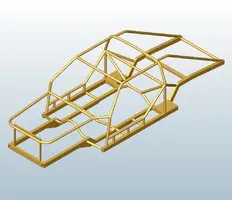
1970 slantroof
Founding Member
This is getting interesting but this is how we learn things.
1.Where is it stated that the frame rails alone over that short span are not adequate to support the suspension load? Is this opinion, urban legend or fact?
2.Where is it stated that these were designed only for full frame vehicles? Opinion, urban legend or fact?
3. The shock tower does not reinforce the frame all the way back to the firewall either. The load in both cases is transferred to the firewall thru the vertical sheetmetal fender panels. The export brace only handles lateral loads and provides no support for a vertical suspension load.
4.The only stock vehicles I have ever seen export type braces on are cars either with the early Mustang type suspension (coil over upper control arm) or Mcpherson strut cars. Both of these suspension types place the suspension load up high in the fender panels where there is no lateral support.
5.Like I stated in my earlier post, I plan to put a brace from the firewall to a flange on the fenderbolt area above the suspension. How many of these kits have been sold and installed on Mustang type cars and how many problems have occured because of no export brace? We don't know the answer to that but bad news travels fast and I have heard none.
6. the fore and aft position of the engine is not affected, by modifying the oil pan slightly the vertical height is virtually rhe same, certainly not 2" but maybe afraction of an inch as stated. One of the tricks you learn with years of fabricating and racing is that you always plot out the suspension and make sure what you are doing before you do anything. Lowering the upper control arm pivot point as in the Shelby mod or shortening the upper control arm will both increase the camber on the compression side when cornering and cause positive camber on the lifting side. Thes are both good to a point like you said. You have to plot it out and see what is going to happen within the limits of the travel in your application.
Like you said we can agree to disagree or whatever but with all the miles I have raced with my own designed and fabricated stuff(up to 304 MPH) I have no concern about doing it.
Howard
1.Where is it stated that the frame rails alone over that short span are not adequate to support the suspension load? Is this opinion, urban legend or fact?
2.Where is it stated that these were designed only for full frame vehicles? Opinion, urban legend or fact?
3. The shock tower does not reinforce the frame all the way back to the firewall either. The load in both cases is transferred to the firewall thru the vertical sheetmetal fender panels. The export brace only handles lateral loads and provides no support for a vertical suspension load.
4.The only stock vehicles I have ever seen export type braces on are cars either with the early Mustang type suspension (coil over upper control arm) or Mcpherson strut cars. Both of these suspension types place the suspension load up high in the fender panels where there is no lateral support.
5.Like I stated in my earlier post, I plan to put a brace from the firewall to a flange on the fenderbolt area above the suspension. How many of these kits have been sold and installed on Mustang type cars and how many problems have occured because of no export brace? We don't know the answer to that but bad news travels fast and I have heard none.
6. the fore and aft position of the engine is not affected, by modifying the oil pan slightly the vertical height is virtually rhe same, certainly not 2" but maybe afraction of an inch as stated. One of the tricks you learn with years of fabricating and racing is that you always plot out the suspension and make sure what you are doing before you do anything. Lowering the upper control arm pivot point as in the Shelby mod or shortening the upper control arm will both increase the camber on the compression side when cornering and cause positive camber on the lifting side. Thes are both good to a point like you said. You have to plot it out and see what is going to happen within the limits of the travel in your application.
Like you said we can agree to disagree or whatever but with all the miles I have raced with my own designed and fabricated stuff(up to 304 MPH) I have no concern about doing it.
Howard
Red Barchetta
Founding Member
Where is it stated that it is? Ever read "Chassis Engineering" by Herb Adams? Some of the modeling he did with frames was very interesting. Everyone should read that book if they're considering any type of suspension modification.1970 slantroof said:This is getting interesting but this is how we learn things.
1.Where is it stated that the frame rails alone over that short span are not adequate to support the suspension load? Is this opinion, urban legend or fact?
Where is it stated that it was ever designed for a unibody car? The fact is that Heidts first built these kits for use on full frame vehicles. It is only recently that this application is being used on early model Mustangs.2.Where is it stated that these were designed only for full frame vehicles? Opinion, urban legend or fact?
I disagree. If that were the case, then why have an export brace at all? Why not just use a Monte Carlo bar? Provide data that shows the export brace handles no vertical suspension load and I will gladly concede.3. The shock tower does not reinforce the frame all the way back to the firewall either. The load in both cases is transferred to the firewall thru the vertical sheetmetal fender panels. The export brace only handles lateral loads and provides no support for a vertical suspension load.
How long have people been installing these kits into Mustangs? It's not going to fail overnight. And with the reinforcement, you shouldn't have any problems. But it's the people who won't reinforce the suspension that are potentially at risk. There have already been several failures with different Heidts kits that have been well documented on the internet, but those were lower control arm failures.4.The only stock vehicles I have ever seen export type braces on are cars either with the early Mustang type suspension (coil over upper control arm) or Mcpherson strut cars. Both of these suspension types place the suspension load up high in the fender panels where there is no lateral support.
5.Like I stated in my earlier post, I plan to put a brace from the firewall to a flange on the fenderbolt area above the suspension. How many of these kits have been sold and installed on Mustang type cars and how many problems have occured because of no export brace? We don't know the answer to that but bad news travels fast and I have heard none.
I think you said it best with "One of the tricks you learn with years of fabricating and racing..." It shouldn't be a "trick" but an essential part of planning any kind of modification. How many people who buy these kits are actually going to take that much time to model the suspension? Or are they just going to take the word of someone who says "I've been doing it for XX number of years and I know it works"? You know what you're doing, but you're not explaining that you don't just cut one part out and weld the other part in. The How-To articles you see in the mags sure make it look easy, but they don't talk about camber curves, modifying oil pans, etc. It's far more involved than what most are letting on and people need to know about it.6. the fore and aft position of the engine is not affected, by modifying the oil pan slightly the vertical height is virtually rhe same, certainly not 2" but maybe afraction of an inch as stated. One of the tricks you learn with years of fabricating and racing is that you always plot out the suspension and make sure what you are doing before you do anything. Lowering the upper control arm pivot point as in the Shelby mod or shortening the upper control arm will both increase the camber on the compression side when cornering and cause positive camber on the lifting side. Thes are both good to a point like you said. You have to plot it out and see what is going to happen within the limits of the travel in your application.
Like you said we can agree to disagree or whatever but with all the miles I have raced with my own designed and fabricated stuff(up to 304 MPH) I have no concern about doing it.
Howard
Similar threads
- Replies
- 3
- Views
- 311


- Replies
- 5
- Views
- 141
- Replies
- 0
- Views
- 192
- Replies
- 1
- Views
- 206

