I am currently in the middle of a 4 year long project that started out as a head swap, and has now evolved into a complete transformation of a 1983 Mustang Hatchback. I am building my first Pro-Street car (if that's what this monster is called). It's not being built for any drag racing class, and I know this is complete overkill for a street car. But that is the whole point. Basically, I have almost cut away everything except the outer shell of the car. It has a new 4-link back half and it will soon have a completely new frame from there all the way to the radiator support. I am replacing the sheet metal strut towers with round tubing and some other bracing. Basically, from the firewall on forward the only sheet metal will be the hood and fenders. So far it all seems to be going ok, but I have never done anything remotely this drastic to a car before. And I really don't have a clue what I am doing (really). So I was wondering if anyone here has done this to a car before and maybe could toss me a few ideas or advice. Here are a few pics of what I have so far...
The car is on a rotisserie that I made for this job. My brother is helping with finishing up some welds on the bottom side. You can see there is not much Mustang left in this car.
View attachment 361485
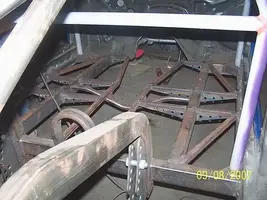
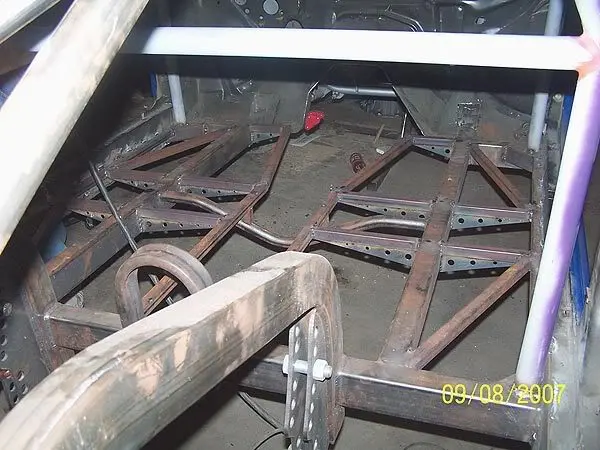
The design for the floor bracing was something I was unsure of, so I came up with using 1"x1"x1/16" wall tubing which was used around the entire perimeter of the passenger compartment, as well as for framing in the transmission tunnel and additional bracing. Below these are some triangulated pieces I made at work to stiffen things up in the seat area, and at the front of the tranny tunnel. Each side of the tranny tunnel framing is strong enough to hold me up at 250lbs. And it's not tied in to the firewall yet.
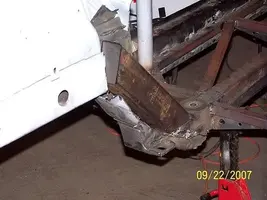
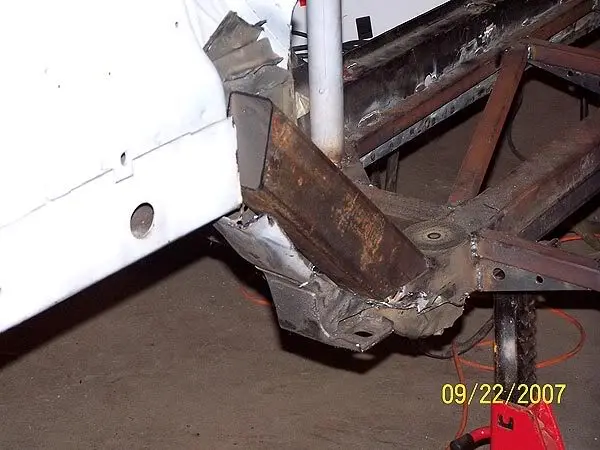
Here is the area of the frame that ran under the firewall and up to the doghouse. I cut a piece of 2"x3" tubing and tacked it in place where the original frame was. The rest of the front frame is also being replaced with the same tubing. The strut towers are being replaced with 1-1/4" round tubing and a 1/4" piece of plate steel that will all tie into the front roll bar struts that will go through the firewall.
So what do you think so far? I have some more pics if anyone would like to see them or comment on more of the work I have done so far. Like I said, I really don't know if this is the right way to brace everything up, but it seems to be pretty strong. I've had a few gear heads over that have all said it looks great so far, but I was wondering what you guys thought.
Thanks,
Kevin
The car is on a rotisserie that I made for this job. My brother is helping with finishing up some welds on the bottom side. You can see there is not much Mustang left in this car.
View attachment 361485
The design for the floor bracing was something I was unsure of, so I came up with using 1"x1"x1/16" wall tubing which was used around the entire perimeter of the passenger compartment, as well as for framing in the transmission tunnel and additional bracing. Below these are some triangulated pieces I made at work to stiffen things up in the seat area, and at the front of the tranny tunnel. Each side of the tranny tunnel framing is strong enough to hold me up at 250lbs. And it's not tied in to the firewall yet.
Here is the area of the frame that ran under the firewall and up to the doghouse. I cut a piece of 2"x3" tubing and tacked it in place where the original frame was. The rest of the front frame is also being replaced with the same tubing. The strut towers are being replaced with 1-1/4" round tubing and a 1/4" piece of plate steel that will all tie into the front roll bar struts that will go through the firewall.
So what do you think so far? I have some more pics if anyone would like to see them or comment on more of the work I have done so far. Like I said, I really don't know if this is the right way to brace everything up, but it seems to be pretty strong. I've had a few gear heads over that have all said it looks great so far, but I was wondering what you guys thought.
Thanks,
Kevin