

Well so far I have replace the door actuator, power window switch and now the ac is on the fritz. It blows semi cold then puts out warm air. At least it runs great. Guess it needs to go in and have the air looked at. Thanks for letting me vent, hope everyone had a good 4th.
You are using an out of date browser. It may not display this or other websites correctly.
You should upgrade or use an alternative browser.
You should upgrade or use an alternative browser.
One Issue After Another
- Thread starter USCGunner
- Start date


Nice and quiet till about 7 tuesday night!
Check your blend door to make sure it closes all the way too.
Check your blend door to make sure it closes all the way too.


Never ends man. AC work is always expensive if you have to pull the gas out. Look under the hood and see how often the compressor is cycling on and off. If it cycles with only short periods on (like a few seconds), it's usually low gas pressure. Doesn't sound like your problem though if it's blowing cold for a period of time. It's a very simple system, almost everything is controlled by one electric cycle switch mounted on the drier cannister. That switch serves as both the low and high pressure trigger for the AC clutch. If the AC compressor clutch shuts off and doesn't turn back on a for a long period of time, start with the cycle switch. Unplug the pigtail from the cycle switch and bypass the switch with a paperclip. If the compressor kicks back on and the low line gets cold (getting good cold air), it's just a bad cycle switch. Once the line gets cold, pull the paperclip out, because with the switch bypassed, you have no overpressure protection. Unfortunately, I don't think Ford put that switch on a shraeder valve until the SNs, so changing it on a Fox means draining the entire system, and replacing the switch.
Kurt
Kurt

mikestang63
SN Certified Technician
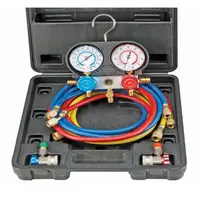
If you can, get a cheap set of AC gauges from HF. They will be invaluable to you in diagnosing the AC system. These cars are notorious for leaks and it is not uncommon to sea around 5% per year loss in refrigerant. In addition to what Kurt said, look at the lines around the condensor, evap, and also at the compressor for signs of leakage- normally the O rings tend to deteriorate over time.
Never ends man. AC work is always expensive if you have to pull the gas out. Look under the hood and see how often the compressor is cycling on and off. If it cycles with only short periods on (like a few seconds), it's usually low gas pressure. Doesn't sound like your problem though if it's blowing cold for a period of time. It's a very simple system, almost everything is controlled by one electric cycle switch mounted on the drier cannister. That switch serves as both the low and high pressure trigger for the AC clutch. If the AC compressor clutch shuts off and doesn't turn back on a for a long period of time, start with the cycle switch. Unplug the pigtail from the cycle switch and bypass the switch with a paperclip. If the compressor kicks back on and the low line gets cold (getting good cold air), it's just a bad cycle switch. Once the line gets cold, pull the paperclip out, because with the switch bypassed, you have no overpressure protection. Unfortunately, I don't think Ford put that switch on a shraeder valve until the SNs, so changing it on a Fox means draining the entire system, and replacing the switch.
Kurt
Ok seems the compressor is operating normal. I put a gauge on the low side no high side gauge, pressure shows about 45psi. I put the thermometer in the center vent and it read 60 deg. outside air temp 100. I believe it should be lower than that. I checked it on ac max, fan on high top down. No oily spots around any of the connection points. I think I will take it to an AC expert and have them evac the system and re-fill it. Thanks for the info everyone.
mikestang63
SN Certified Technician

I do believe there is an error in the chart. Don't just take it for granted that whatever fancy chart you saw is correct.
If the high side orifice or expansion valve is clogged, you will have higher than normal pressure on the high side and lower pressure than normal on the low side.
See http://www.agcoauto.com/content/news/p2_articleid/257 for more explanation.
Any doubt about me - I have both EPA 608 and EPA 609 MVAC certifications. and I can prove that.
@jrichker, you are such a show off
Specifically when he is right, and I if I'm reading between the lines he may be hinting around at taking it to a pro, at the shop I hang at, I say 'hang' because they only let me hold a flashlight and a phillips screwdriver, they only charge $30 or $40 bucks to check your system.
Specifically when he is right, and I if I'm reading between the lines he may be hinting around at taking it to a pro, at the shop I hang at, I say 'hang' because they only let me hold a flashlight and a phillips screwdriver, they only charge $30 or $40 bucks to check your system.

I need help with my 91 mustang gt ac. It worked before and now it wont. Bot a used compressor, new switch, new hoses. The compressor clutch came on when I hooked it straight to battery. Jumped switch, no clutch engagement. The compressor worked and blew like cloudy air inside car. It soon stop working. Tried putting freon in it and it wouldnt take it so i flushed the thing under dash with ac flush and air. flushed condensor with flush and air. Still wont take freon 134. Try putting freon in and gauge shoots up to retard. Even noticed one line getting extremly hot. I vacummed it with a big vacumme for two days and tried another remanufactured compressor, still same out come. Im in sc and need my air. Any help is appreciated.
Your problem description is useless without both high side and low side pressure readings that you get with a charging gauge set.I need help with my 91 mustang gt ac. It worked before and now it wont. Bot a used compressor, new switch, new hoses. The compressor clutch came on when I hooked it straight to battery. Jumped switch, no clutch engagement. The compressor worked and blew like cloudy air inside car. It soon stop working. Tried putting freon in it and it wouldnt take it so i flushed the thing under dash with ac flush and air. flushed condensor with flush and air. Still wont take freon 134. Try putting freon in and gauge shoots up to retard. Even noticed one line getting extremly hot. I vacummed it with a big vacumme for two days and tried another remanufactured compressor, still same out come. Im in sc and need my air. Any help is appreciated.
Here's some more help in the A/C arena...
Currently, I am running Enviro-Safe R12 substitute, and it works very well. eBay has 3 can package for $25 + shipping. It does not require any vacuuming or purging of the system, and is a real aid to the DIY guy looking to save some $$. The warning say it is flammable, but so is gasoline...
no matter what refrigerant you use, you will need to replace the accumulator/dryer; cost is about $55-$95
Try eBay for some R12, it is running $20-$30 a can. You need 3 each 12 oz. cans and 6-8 oz. of R12 compatible mineral oil. The R12 compatible oil is like $20 a quart when you can find it. You may be able to find a combination can of R12 and oil together which may be cheaper than buying a quart of oil..
It is illegal for a company to sell any refrigerant other than R134 to a person who does not have an EPA 608 or 609 certification. That includes Freeze 12. However, individual sellers like those on eBay and, not affiliated with a store often do not ask for any certification information, they just want prompt payment.
See http://www.epa.gov/Ozone/title6/608/overlap.html for more details
R134a Air Conditioner Conversion and recharge instructions
Revised 14-Jul-2013 to add Low Pressure Cutout Switch adjustments for R134 & Freeze 12
Color Legend:
R134 specific items and instructions are in red text
Freeze 12 specific items instructions are in orange text
Note: R12 is available on eBay. Use the Freeze 12 instructions except use the R12 36 oz refrigerant charge with R12 refrigerant
Items and instructions common to both R134 and Freeze 12 are in black text
Tools and materials you will need:
Gauge set for recharging = $20-$120 – check out the pawn shops for a bargain before you pay retail.
See Harbor Freight Tools for an inexpensive gauge set.
Vacuum pump – I use an old refrigerator compressor = $20- $40 at used appliance stores, or go to the Dump and get one for free. Be sure to have some R12 compatible oil handy to keep it lubed up properly.
O ring seal kit = $8.
Replacement accumulator/dryer assembly with hose $55-$75
Alternative refrigerant – Freeze 12 – it will allow you to skip flushing the system and reuse the original accumulator/dryer under certain conditions:
1.) If the A/C system has not been open to air for more than an hour or so.
2.) Or if it hasn’t out of refrigerant for more than 5-7 days and the system is till sealed up with no open or disconnected lines. You need to be able to hear the hiss when depress the valve core in either one of the service ports. That tells you that there is still pressure in the system, which keeps out moisture and contaminants.
If either of the above is not true, you must replace the accumulator/dryer assembly.
Freeze 12 refrigerant: $15-$16 per 12 Oz can on eBay. Get 3 cans, 2 for the initial charge and 1 spare for a top off charge.
Use R12 compatible mineral oil, 6-8 Oz. This may be difficult to find or expensive (~$20 a quart). Sometimes eBay will have the oil/R12 combination cans, which have about 4 oz. R12 and 2 oz. oil in them. If you go this route, add the R12/oil charge first, then add the cans of R12.
Do not use PAG oil in a Freeze 12 system without flushing it first.
Freeze 12 refrigerant charge= 26-28 Oz plus 6-8 Oz R12 mineral oil on an empty system. A recharge may only require 2-4 OZ of R12 mineral oil if you only replaced a line, hose or seals.
A/C systems that have had a compressor failure must be flushed. Failure to do so will result in the floating trash left behind from the compressor failure destroying the replacement compressor.
R134a = $11-$16 a can – takes 2 cans.
R134a PAG or Ester compatible oil = $7-$12 for an 8 oz bottle .
Pump to force cleaning fluid through the system $20-$50 (may use compressed air to do the same thing).
R134a charging adapter = $13 (I cut mine up to use it with the R12 gauge set that I have had for a long time).
Plastic tools to disconnect refrigerant lines - 1/2" & 5/8" = $4 each.
Flushing agent - Discount Auto Parts has some flushing solvent in a 1 gallon plastic bottle - try that first. Or use Mineral spirits = $4-$5 a gallon, tetrachloroethylene =$5-$10 a gallon, takes 2 gallons of either one.
Miscellaneous hoses and fittings to adapt the flushing pump to the system, and the R134a adapter to the R12 gauge set = $15.
R134 Refrigerant charge is 26-28 Oz plus 6-8 Oz of PAG 100 oil.
R134 Conversion Instructions:
I did a R134a conversion on my 89GT, and used all stock parts. You will need to replace the dryer/receiver (about $75 if you get the one with the hose made as part of the unit), and should replace all of the rubber "O" ring seals as well. You will need to drain all of the oil out of the compressor and replace it with new R134a compatible oil.
R134 instructions (skip this if you use Freeze 12)
Keep in mind that to fulfill the requirements of the EPA, you are required by law to recover any refrigerant that still remains in the system. How (or wither or not) you accomplish this is up to you. Connect the charging gauge hoses to the service ports on the A/C (red gauge = high pressure, blue gauge = low pressure) and open the valves on the gauges to dump the remaining refrigerant (if any) into your "Freon recovery system", whatever it may be. Disconnect the charging gauges since you are finished with them until you are ready to fill the system with R134a. Next comes the nasty part – in order to get all the old oil out of the system, you will need to flush it with special flushing solvent, or mineral spirits (ok) or tetrachloroethylene (better, but may be hard to get). If you leave the old oil in place it will congeal and reduce the heat transfer in the condenser and evaporator (read that it won’t cool good) and possibly damage the compressor.
Disconnect the compressor and remove it from its mount to flush it with cleaning solvent. Pour about a cup of solvent into the suction port and turn the compressor center hub about 10 turns while shaking the compressor to move the solvent around inside the compressor sump. Drain the flushing solvent out and continue to turn the center hub by hand to force out any remaining solvent. Then fill it with oil: add about 6-8 oz of the new oil to the compressor large suction fitting. Turn the compressor center hub about 20 turns as you turn the compressor face up and face down to distribute the new oil inside the compressor. Catch and replace any oil that comes out of the compressor.
Connect the pump (I had an electric sump pump I bought for $20) to the hose from the high-pressure side of the compressor. Alternately, you could use compressed air to force the cleaning fluid through the system. I didn’t like to do this since compressed air has lots of moisture in it, which is death to A/C systems. Pump the cleaning fluid through the system and let it come out the hose that was attached to the old dryer/receiver. I used 2 gallons of mineral spirits and pumped it all through the condenser and evaporator. The expansion valve is located near the firewall in the high-pressure line of the evaporator, and may cause the cleaning fluid to trickle through the lines at a very slow pace. You may want to pump cleaning fluid through the evaporator and condenser separately to speed up the process.
All refrigerant types
Next comes the changing of all the old "O" rings so that the chances for leaks is minimized. The new R134 compatible O rings are green colored, so be sure that the replacement O rings are green. Use the plastic connector tools to separate the lines, place the extended collar part of the tool so that it faces the large part of the connector and push inwards: this expands the spring so that you can pull the tube apart. You may need a helper to push on the tool while you pull on the tubes to separate them. Install the new "O" rings: be sure to coat them with new oil when you put them in. Install the new dryer/receiver, refrigerant service port adapter on the compressor, add about more 4oz of oil to high pressure line and tighten up all the lines. You may have to add more oil when you do a system that has been flushed or new R12 installation. The total oil charge should be 6-8 oz. for all types of refrigerants. Close the hood, start the engine, let everything get warm under the hood, but don’t add the refrigerant or turn the A/C on. Connect the charging gauge hoses to the service ports on the A/C (red gauge = high pressure, blue gauge = low pressure) and open both valves, then connect the center hose to the vacuum pump. The purpose of this exercise is to heat up the system so that when you vacuum it all down (yes, you will need a vacuum pump- mine is an old refrigerator compressor), that all the air, vapor and moisture from the cleaning fluid vaporizes and is removed from the system. Vacuum it down for about 30 minutes, this should give you about 28" of vacuum or more inside the A/C system. I have a vacuum gauge "T" connected into the vacuum pump line so that I can accurately watch the vacuuming process. This is a good time to take a soda and sandwich break since it doesn’t go faster if you watch it.
the R134a service fittings on the system: the red goes on the high side and the blue on the low side. This will help others identify that a R134a conversion has been done on the system.
Typical low pressure side R134 coupling
Typical high pressure side R134 coupling

Charging instructions for all refrigerant types:
Remove the electrical connector from the dryer/receiver and jumper the two connections inside the wiring harness side of the connector together: this allows the compressor to engage in spite of low pressure/no gas in the system. Close both charging gauge valves, and then disconnect the center hose of the charging gauges from the vacuum pump and connect it to the refrigerant can tapper. Put the refrigerant can in the can tapper and screw it down with the can tapper valve closed, then open the valve. Loosen the hose at the center connection of the charging gauge set until the refrigerant squirts out: this purges the line of air and moisture. The refrigerant is added through the low pressure side of the system, so open the low pressure gauge valve to add the refrigerant. Start the car and take note of the idle speed, then set the idle speed up to about 1200-1500 rpm, and turn the A/C on inside and set the fan speed on high. Watch for the pressure on the low side to drop off as you are filling, and the refrigerant can will get warm and stay warm. This tells you the current can is empty and needs to be changed for a fresh one. Before you disconnect the can, be sure to close the valve on the refrigerant can tapper.
Watch the high side pressure on the charging gages and regulate the adding of gas to keep the high side pressure under 350 psi. You will probably need a fan in front of the car to keep the readings below 350 psi. I had to put the refrigerant can in hot water while I was charging the system with it, or else the can got so cold that it quit flowing. Use caution when you do this so that you don’t get water in the charging adapter when you change the cans.
R12 Pressures when charging is complete
When you have added the 32-36 oz. of gas, the high side will read about 250-300 psi and low side about 28-38 psi. No adjustments need to be made to the low pressure cutout switch.
Freeze 12& R134 Pressures when charging is complete.
When you have added the 24-28 oz. of gas, the high side will read about 250-300 psi and low side about 18-28 psi.
Freeze 12 & R134 Low pressure cutout switch adjustment.
The low pressure cutout switches are adjustable. They should be set with the low limit about 18-21 PSI, the stock setting is about 25 PSI. Remove the wiring connector and there is a screw slot in between the connector pins. Turning it clockwise increases the trip pressure where it cuts off and counterclockwise decreases the trip pressure. I believe that each 1/4 turn counterclockwise lowers the cutoff pressure by 1 PSI.
After Charging refrigerant instructions, all refrigerant types
Turn the idle speed back to where it was, turn the A/C off, disconnect the charging gauges, and re-install all the caps on the service ports. Remove the jumper from the low pressure switch harness and plug it back on the switch connectors.
R134 only
Then put the R134a Service Sticker on, secure all the loose wiring on the system and you are done.
The typical sticker looks like this, yours may be different.

I hope it cools good, mine doesn’t get quite as cold as it used to driving around town.
Thanks go to WWW.ACKITS.COM for some of the graphics.
Check out their website for parts and the Auto AC Forum.
The above technical note is for informational purposes only, and the end user is responsible for any damages or injury. The end user bears all responsibility for proper recovery/disposal of any R12 refrigerant.
I have EPA 608 and EPA 609 MVAC certification. And yes, you can shortcut the process, but there are negative factors if you do. Sooner or later, something will cease to function like it should. Shoddy work is a time bomb ticking away, waiting to explode.
]
Attachments
Similar threads
- Replies
- 0
- Views
- 66
- Replies
- 5
- Views
- 243

- Replies
- 20
- Views
- 643
- Replies
- 10
- Views
- 952
