Please help with PIA alternator issue...

LEAVNYA

Member
Sep 12, 2000
21
0
12
Memphis, TN
Please help with alternator issue...UPDATE

Someone help please! Here's the breakdown. Went to start the 93LX and the battery was dead, I replaced it with a new battery after work. The next morning new battery was dead figured I had a short in the alternator as I've experienced in the past. Had the new battery charged and put a new alternator on. The new alternator reads 12.25V max at the battery, solenoid, and the rectifier harness at the alternator. I swap the alternator from the 92GT with the new alternator from the 93LX. The new alternator shows 14.40V at the battery on the 92GT. The alternator from the 92GT still only reads 12.25V on the 93LX.

I had a buddy from the dealership check it out this morning and the ground is good, the wiring continuity checks out. He had a spare battery so we put it in the 93LX and it showed 12.9-13.2V when revving. We think the new battery may be the culprit, he unplugs the pos lead from the batt and the car dies. He performed a couple more tests and concluded the Alt. shows bad even though it works fine on the 92GT. Now at this point the alternator on the 93LX is the one from the 92GT, not the brand new one. He said trade it for a new alt and be wary of the battery also.

At this point I am at a loss. I drove 25 miles home,checked the voltage with the car off and it's at 11.79V. The harness with BK/O, BK/O, WHT/BK is new, just put it on because my old alternator was hard wired. Could the original factory harness to the built in regulator be a problem?

Any/all suggestions are apprieciated.

UPDATE: I ran new wire and fuselinks in place of the 2 blk/o wires on the battery side of the alt and a the y/wht wire on the d-plug side. When I disconnect the terminal, the car still dies. :bang:

Here's the run down:

New alternator, new battery, new wire and fuselinks in place of blk/o and y/wht wires.

Is there any chance a short in the starter would cause this? I've had to disconnect and reconnect the battery when going to-coming home from work since this started.

Thanks for any/all help...
 
Do not disconnect a battery cable while the car is running unless you want to take a chance on frying electrical equipment on your car.

I couldnt begin to follow the chain of events with what does what on your car (I'm tired). I would have the battery and alternator bench tested at the parts store - that way you have a 'second opinion'. There's a possibility that your battery cables, motor ground or reg/rec wiring have issues still. Does the A terminal on the regulator show the same voltage as that at one of the charge wires at the back of the alt?

Good luck.
 
I hear you my brother but thats the way myself and many others have been checkin alternators for years with optimal success and no electrical failures. :flag:

Auto Electrics 101: Generators will run without a battery. The iron core for the field coils will retain enough magnetism to create the magnetic field required to make electricity.

Alternators like the ones used on Mustangs require a battery to power the rotating field windings. That's because the AC current they generate internally demagnetizes the iron core for the field coils when there is no battery current to power them. The diodes inside the alternator turn the AC current into DC current. There are 3 phases to the alternator’s internal circuitry & 6 diodes to rectify the AC current into DC current. The battery acts like a big sink or capacitor to smooth out the remaining pulses

Never disconnect the battery from an alternator. The electrical spike produced before the alternator output drops to zero can damage things like the computer, radio and even the alternator itself.

There are some self exciting alternators, but I have never seen one on a Ford or GM car. The last self exciting alternator I worked on was a 200 amp 110 volt one in a Convar 580 twin turboprop airplane. That was over 30 years ago…
 
I'm going to go check this again in about 30 minutes. Where do you suggest I go from here if there is a difference? (How much of a difference do you need for it to be considered a problem?)

Thanks...

Look for less than 1/2 volt, though I find anything over 100 mV (0.1 volt) unacceptable.

If there's a larger difference (but the A terminal reads a fair amount of voltage; it's not open), checking fusible links is a place to start. The A terminal has it's own dedicated link as I recall (and 94-95's use a fuse). If necessary, a little more rewiring to restore the OEM pathway with a clean conduit could be needed for that particular fix.

BTW, that was a nice synopsis by Jrichker. :nice:
 
Never, never disconnect an alternator from the battery with the engine running. The resulting voltage spike can
damage the car's electronics including the alternator.

Do all of these tests in sequence. Do not skip around. The results of each test depend on the results of the previous
tests for correct interpretation.


Alternator troubleshooting for 86-95 5.0 Mustangs:
Engine off, ignition off, battery fully charged.
1.) Look for 12 volts at the alternator output. No 12 volts and the dark green fuse link between the orange/black
wires and the battery side of the starter solenoid has open circuited.
2.) Look for 12 volts on the yellow/white wire that is the power feed to the regulator. No 12 volts, and the fuse link
for the yellow/white wire has open circuited.

Engine off, ignition on, battery fully charged.
1.) Alternator warning light should glow. No glow, bulb has burned out or there is a break in the wiring between the
regulator plug and the dash. The warning light supplies an exciter voltage that tells the regulator to
turn on. There is a 500
ohm resistor in parallel with the warning light so that if the bulb burns out, the regulator still gets
the exciter voltage.
Disconnect the D connector with the 3 wires (yellow/white, white/black and green/red) from the voltage regulator.
Measure the voltage on the lt green/red wire. It should be 12 volts. No 12 volts and the wire is broken, or the 500 ohm
resistor and dash indicator lamp are bad. If the 12 volts is missing, replace the warning lamp. If after replacing the warning lamp,
the test fails again, the wiring between the warning lamp and the alternator is faulty. The warning lamp circuit is part of
the instrument panel and contains some connectors that may cause problems.

2.) Reconnect the D plug to the alternator
Probe the green/red wire from the rear of the connector and use the battery negative post as a ground. You should see
2.4-2.6 volts. No voltage and the previous tests passed, you have a failed regulator. This is an actual measurement taken
from a car with a working electrical system.

Engine on, Ignition on, battery fully charged:
Probe the green/red wire from the rear of the connector and use the battery negative post as a ground. You should see
battery voltage minus .25 to 1.0 volt. If the battery voltage measured across the battery is 15.25 volts, you should see 14.50 volts

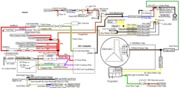
Diagram courtesy of Tmoss & Stang&2birds
fuel-alt-links-ign-ac.gif


See the following website for some help from Tmoss (diagram designer) & Stang&2Birds (website host) for help on 88-95 wiring http://www.veryuseful.com/mustang/tech/engine/ Everyone should bookmark this site.

Ignition switch wiring
http://www.veryuseful.com/mustang/tech/engine/images/IgnitionSwitchWiring.gif

Fuel, alternator, A/C and ignition wiring
http://www.veryuseful.com/mustang/tech/engine/images/fuel-alt-links-ign-ac.gif

Complete computer, actuator & sensor wiring diagram for 88-91 Mass Air Mustangs
http://www.veryuseful.com/mustang/tech/engine/images/88-91_5.0_EEC_Wiring_Diagram.gif

Vacuum diagram 89-93 Mustangs
http://www.veryuseful.com/mustang/tech/engine/images/mustangFoxFordVacuumDiagram.jpg

HVAC vacuum diagram
http://www.veryuseful.com/mustang/tech/engine/images/Mustang_AC_heat_vacuum_controls.gif

TFI module differences & pinout
http://www.veryuseful.com/mustang/tech/engine/images/TFI_5.0_comparison.gif

Fuse box layout
http://www.veryuseful.com/mustang/tech/engine/images/MustangFuseBox.gif
 

Attachments

  • fuel-alt-links-ign-ac.gif
    fuel-alt-links-ign-ac.gif
    83.1 KB · Views: 125
Never, never disconnect an alternator from the battery with the engine running. The resulting voltage spike can
damage the car's electronics including the alternator.

Do all of these tests in sequence. Do not skip around. The results of each test depend on the results of the previous
tests for correct interpretation.


Alternator troubleshooting for 86-95 5.0 Mustangs:
Engine off, ignition off, battery fully charged.
1.) Look for 12 volts at the alternator output. No 12 volts and the dark green fuse link between the orange/black
wires and the battery side of the starter solenoid has open circuited.
2.) Look for 12 volts on the yellow/white wire that is the power feed to the regulator. No 12 volts, and the fuse link
for the yellow/white wire has open circuited.

Engine off, ignition on, battery fully charged.
1.) Alternator warning light should glow. No glow, bulb has burned out or there is a break in the wiring between the
regulator plug and the dash. The warning light supplies an exciter voltage that tells the regulator to
turn on. There is a 500
ohm resistor in parallel with the warning light so that if the bulb burns out, the regulator still gets
the exciter voltage.
Disconnect the D connector with the 3 wires (yellow/white, white/black and green/red) from the voltage regulator.
Measure the voltage on the lt green/red wire. It should be 12 volts. No 12 volts and the wire is broken, or the 500 ohm
resistor and dash indicator lamp are bad. If the 12 volts is missing, replace the warning lamp. If after replacing the warning lamp,
the test fails again, the wiring between the warning lamp and the alternator is faulty. The warning lamp circuit is part of
the instrument panel and contains some connectors that may cause problems.

2.) Reconnect the D plug to the alternator
Probe the green/red wire from the rear of the connector and use the battery negative post as a ground. You should see
2.4-2.6 volts. No voltage and the previous tests passed, you have a failed regulator. This is an actual measurement taken
from a car with a working electrical system.

Engine on, Ignition on, battery fully charged:
Probe the green/red wire from the rear of the connector and use the battery negative post as a ground. You should see
battery voltage minus .25 to 1.0 volt. If the battery voltage measured across the battery is 15.25 volts, you should see 14.50 volts


Engine off, ignition off, battery fully charged.
1.)I replaced this entire run yesterday including fuselink. Tested again, 12 volts.
2.)I replaced this entire run yesterday including fuselink. Tested again, 12 volts.

Engine off, ignition on, battery fully charged.
1.) No light at the dash but I have 12V on the plug with it removed from the alt.
2.) With the d plug reconnected I see 11.92V, not 2._V at the back of the plug at the green/red. Could this be hint at something wrong?

Engine on, Ignition on, battery fully charged.:
Green/red with car on shows 13V at idle to 14V at about 2500.
Measuring the battery at idle shows 13.20V at idle and 14.3V at about 2500.

I hope I was thorough enough with my answers.
Thanks for your help!
 
UPDATE!

Ok, I think I have found the problem, I will need some help in trying to find where exactly the problem is though. I noticed that there was a steady draw on the battery when the car was off. It was dropping .01V every 15-20 seconds or so. I removed the d-plug from the alternator and the voltage started to climb. So I believe I have isolated the problem.

Now of the 3 wires on the d-plug, I have replaced the yellow/white wire, the white/black wire runs straight to the rectifier plug, then we have the ol green/red wire, the only wire I haven't replaced or modified. Now assuming it's the green/red wire and not the plug, what is a good sure fire way to test that? If it's the wire, would I just perform a continuity test, if so where to?


Thanks again...
 
Ok, I think I have found the problem, I will need some help in trying to find where exactly the problem is though. I noticed that there was a steady draw on the battery when the car was off. It was dropping .01V every 15-20 seconds or so. I removed the d-plug from the alternator and the voltage started to climb. So I believe I have isolated the problem.

Now of the 3 wires on the d-plug, I have replaced the yellow/white wire, the white/black wire runs straight to the rectifier plug, then we have the ol green/red wire, the only wire I haven't replaced or modified. Now assuming it's the green/red wire and not the plug, what is a good sure fire way to test that? If it's the wire, would I just perform a continuity test, if so where to?


Thanks again...

Battery voltage tends to float a little bit. A better test:

Disconnect the negative battery cable. Put your DMM (set to measure current draw. Most meters require moving the red lead into the 3rd port). Ensure all lights and accessories on the car are off (including an underhood light, if applicable). Put the meter in series between the disconnected neg battery cable and the negative battery post. Note the draw (in amps or mA).

Here's a nifty site that shows how this is done (site courtesy of Saleen0679, whom posted it awhile back. That's much better than me trying to explain it).

Now while measuring the draw, disconnect the D plug again and if your hypothesis is right, the reading will drop. This can indicate a bad diode in the alternator. Have it tested.
 
I wasn't getting a reading yesterday and it was approaching dark. I worked late tonight and had enough time when I got home to check the DMM fuses and they are both blown. I will grab a couple fuses tomorrow and get back to it.

thanks
 
Battery voltage tends to float a little bit. A better test:

Disconnect the negative battery cable. Put your DMM (set to measure current draw. Most meters require moving the red lead into the 3rd port). Ensure all lights and accessories on the car are off (including an underhood light, if applicable). Put the meter in series between the disconnected neg battery cable and the negative battery post. Note the draw (in amps or mA).

Here's a nifty site that shows how this is done (site courtesy of Saleen0679, whom posted it awhile back. That's much better than me trying to explain it).

Now while measuring the draw, disconnect the D plug again and if your hypothesis is right, the reading will drop. This can indicate a bad diode in the alternator. Have it tested.


Ok, without the d plug connected I'm getting a reading of .006. With the dplug connected I'm getting 4.5 Is the second new alternator dead(Diode?)?

Thanks again...
 
I would take the alt in for a bench test. Part of a proper bench test is to test the diode packs. Explicitly ask them to check the diodes.

Good luck.
 
I would take the alt in for a bench test. Part of a proper bench test is to test the diode packs. Explicitly ask them to check the diodes.

Good luck.

Well, I had the alternator checked at two different stores and it passed all tests at both locations. Diodes/warning lamp, rectifier, and regulator...

Where should I go from here? BTW alternator warning light works.

Thanks
 
I would take the alt in for a bench test. Part of a proper bench test is to test the diode packs. Explicitly ask them to check the diodes.

Good luck.

Ok, not sure what's going on here. While I was at it I decided to replace my negative terminal because with all this testing I noticed the clamping power was much of nothing with the old terminal(I could shake it a bit and it would come loose completely tightened.

I just went out and tested it, I don't have but a .06 ma draw now. Here's what's freaking me out. I started the car and put the volt meter to it, at idle I'm getting 14.5v and at 2500-3000 I'm getting up to 18.8V. What's going on here, I checked the meter on the dash and it's up to almost 18 when revving the car up. With the lights on and the defrost on high the car is at 13.3v idle and 16.5v at 2500. Is the voltage supposed to be that high?
 
I'd confirm that the A terminal on the reg is seeing very close to the same voltage reading that you see at the alt's charge stud.

Otherwise, the voltage should not be that high. It sounds like a regulator issue if your wiring is sound and the alt passes bench tests. A bad neg cable connection could have harmed the alternator (going back to what was discussed earlier). Stability in electrical systems is very important.
 
I'd confirm that the A terminal on the reg is seeing very close to the same voltage reading that you see at the alt's charge stud.

Otherwise, the voltage should not be that high. It sounds like a regulator issue if your wiring is sound and the alt passes bench tests. A bad neg cable connection could have harmed the alternator (going back to what was discussed earlier). Stability in electrical systems is very important.

Thanks again for sticking with me here!

I decided to take the car up to o'reilly's so they could check the alternator and battery on the car. Half way to the store the meter went from a steady 18V to a drop of 12v and never made back past 12V whether idle or revving. I got to o'relly's and the alternator machne was now down but they did a load test on the battery and it tested fine. I explained that I thought a diode was bad at the beginning of the day but the alternator bench tested fine at two other locations. He said it sounded like a diode problem since I replaced all of the wire and connectors. He asked me to come back Monday afternoon because the machine should be fixed monday morning and he'll have me a new alternator by then.

I believe what you're saying about the regulator being damaged by the ground could be the issue. It just seems so sporadic now. The guy at the store said it like I have the classic case of having a problem, then by the time you get to the place for it to be diagnosed or checked out, it's mysteriously disappeared or you can't duplicate the problem.

I should have an update Monday, thanks so much again for your help.

-Matt
 
I'd confirm that the A terminal on the reg is seeing very close to the same voltage reading that you see at the alt's charge stud.

Otherwise, the voltage should not be that high. It sounds like a regulator issue if your wiring is sound and the alt passes bench tests. A bad neg cable connection could have harmed the alternator (going back to what was discussed earlier). Stability in electrical systems is very important.

UPDATE: Tested the alternator this morning verdict was in fact bad diode, but it took testing it while on the car to find that. I put the new alternator on this morning. The new alternator is charging good.

Now, I got work around 8:30, went out at 12:00 to make sure all was good, started right up. Just went out to the car to leave work 5:00, battery is dead. The draw is back. It has to be something in the green/red wire/circuit on the d-plug, that's the only wire that isn't new. I'm not sure where the wire goes after it enters the firewall, I know there is a 500 resistor and the charge bulb, not sure the best way to hunt this down.


thanks again HISSIN...
 
UPDATE: Tested the alternator this morning verdict was in fact bad diode, but it took testing it while on the car to find that. I put the new alternator on this morning. The new alternator is charging good.

Now, I got work around 8:30, went out at 12:00 to make sure all was good, started right up. Just went out to the car to leave work 5:00, battery is dead. The draw is back. It has to be something in the green/red wire/circuit on the d-plug, that's the only wire that isn't new. I'm not sure where the wire goes after it enters the firewall, I know there is a 500 resistor and the charge bulb, not sure the best way to hunt this down.


thanks again HISSIN...

That wire is just there to let the alternator know to excite.

You could put your DMM on the grn/red wire with the key off. It should read zero volts. I suppose the ignition switch could be bad, causing it to stay hot at all times but you should see other circuits staying hot when they should be off.

I would also do current-draw testing again. This time get a baseline. Then disconnect the rectifier plug and see if the draw changes. If not, disconnect the regulator plug and see if it changes. If neither change, the issue should not be in the alternator circuit.