Question about new carb and intake

19mustang68

New Member
Apr 9, 2007
8
0
0
Well first off i have a 1968 mustang, 289 2bbl and everything is stock. I've done some researched and found that it is producing about 195hp at the motor, which is about 150 rwhp maybe? Anyways, i want to upgrade to a 4bbl carb and a new intake, could anyone be so kind as to recommend a good carb for street use and a new intake please. Also does anyone know what horsepower gain this would possibly add? Oh, almost forgot, i am getting some Hedman Hedders (HED-88300), anyone know a possible horsepower increase this would add? Thanks so much in advance for your help. Sorry if these are obvious questions, I am new at all of this and this is my first mustang. Thanks again!
 
Nothing to apologize about at all. For a stock or near stock motor, a good dual plane manifold , a 600cfm carb and tri-y headers is worth about 20-40hp. I personally like Edelbrock manifolds and Holley model 1850, vacuum secondary carbs, but there are several choices of each, and as long as you get a dual plane manifold and a vacuum secondary carb, you'll be fine. As for the headers, I prefer tri-y headers over long tubes for a couple reasons, first great low-end torque and second, lots and lots of clearance around everything, including the ground.
 
Those are great headers, and will likely pull more horsepower out of the motor should you swap to a bigger cam or more compression, or better heads later on. I didn't mean to imply that tri-y headers were the last word in headers, it's just that I prefer them due to space and clearance advantages. Long tube headers can be a little more work to install, and you may even have to unbolt one of the motor mounts and jack up the motor slightly to get them in, but they have more power potential, period. As far as needing to swap cams to gain full advantage of your new intake and carb, no way. Cams and such will add power, but you'll be very happy with the power gains (and maybe even mileage) of a small 4 barrel carb and aluminum intake over your stock 2 barrel. If you've never swapped intakes before, try to read up on it a little before you ever open the hood. It's very simple and very straight forward, but there are a few tricks to make it go easier. There is tons of information on this, but just go slow and be thorough and keep everything clean and you'll be fine.
 
I just re-checked your header link, and I gotta tell you, you are going to thrilled with those headers, if for no other reason than they have the modern ball-and-socket collectors. That is sooooooo much better than the old three-bolt, constant-leak type collectors. Good choice, no two ways about it.
 
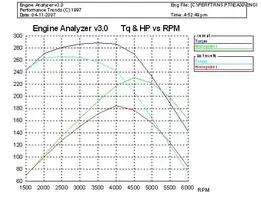
I ran your stuff through my engine analyzer program, that I like very much and is fairly accurate, and came up with:

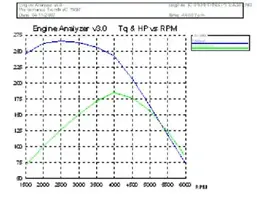
Bone stock (possibly more stock than what you have now;) )
185 fwhp @ 4000 rpm
266 fwtq @ 2500 rpm
With average over entire band (very important for streetability)
210 tq/134 hp
With volumetric efficiency peaking at 83%
(please remember that these are close approxamations from a modeling program that works in 500 rpm increments)

I added my favorite, tried and true mild street/stock upgrade combo:
Weiand Stealth dual plane intake
Holley Street Avenger 570 carb
LT headers... The ones you bought!
That was it... EXCEPT, one has to expect that you will upgrade to a dual exhaust and mufflers that flow a little better than stock... I put that in too.
227 fwhp @ 4500 (+42)
283 fwtq @ 3500 (+17)
Avg hp: 166 (+32)
Avg tq: 245 (+35)
Volumetric efficiency: 92% (+9%)

What you can't see here is the graph.
It goes from weak and peaky in stock form, to very flat and long.
Power is up from idle on. But the best news is torque is very flat from 1500 to 4500. HP peak gains about 500 rpm, and the peak is much smoother. Even though the peak is 500 rpm higher, don't let it scare you because power is higher than stock peak from 700 rpm sooner than stock.
Even though peak TQ is 1000 rpm higher than stock, the band is so flat that it beats stock from idle on and is over stock peak 600 rpm sooner.
The curve is so flat. Very good, especially for an auto tranny.
So an average of 32 hp and 35 tq across the rpm range is not unlikely.

This would equate to (auto tranny) roughly:
26 hp and 28 tq at the rear wheels, throughout the rpm range.
OR
34 rwhp peak
OR
340# weight loss
OR
.34 second faster quarter mile

One thing to note, the EA shows the need for good ignition.
On pump gas, the modeled engine detonated (under load) from idle to 2500 rpm.
On a modeled engine, this is good because it is an indicator of what rpms the engine is really shining.
So a Duraspark conversion or Pertronix 1 and good coil would be a plus.
 
Just for giggles, I blocked the intake manifold heat passage...
I do that to all my cars... heat is the enemy. That is one reason headers are so good...

Anyway, your engine model gained 10 HP and TQ!
A lot...
The other effects were not as impressive, but still good:
7 HP and TQ avg in the power band.
1% added VE
More spark timing available.
The only place that lost tq was below 1500 rpm.
Still higher than stock though.
One thing I have learned, proper carb tuning will make or break throttle response, so this is not devastating IMO.


Edit:
Flex fan is good for 4 of everything... peak and avg TQ and HP.
93 octane fuel is good for 1 of everything due to increased timing available.

Also gotta remember that there are effective power gains:
-10#s = +1 hp
-100#s = +10 hp
-100#s = +.1 second quarter

If you lose a net of 10# with these changes, which may or may not be the case... That effectively adds another HP...
Every little bit helps! :D
Probably not the case though. You are adding some lighter components, but then you are adding a heavier carb and another muffler, unless you were to use a pair of Dynomax bullets.
 
wow ratio thanks for those specs, what program are you using?

Performance Trends Engine Analyzer v3.0

I downloaded it for free from a Stang site, forgot which one.
I used Desktop Dyno before that, but I like this one much better.
There are probably better versions by now, but for free, I don't complain.
One complaint I have about this version is that I can't show anyone the dyno graphs. No way to copy-paste, save as, or anything...
I suppose I could print and scan back into the puter, but I am too lazy for that. ;)
 
One complaint I have about this version is that I can't show anyone the dyno graphs. No way to copy-paste, save as, or anything...
I suppose I could print and scan back into the puter, but I am too lazy for that. ;)
Have you tried using Prnt Scrn and then pasting into paint? It'll show everything that is on your monitor, but you should be able to see the graph.
 
Have you tried using Prnt Scrn and then pasting into paint? It'll show everything that is on your monitor, but you should be able to see the graph.

Print Screen didn't do anything.
Hitting the print icon prints it out.
I did get into the properties of the printer and force a print preview, then moved it to paint.
Came out crappy and small.
I did the stretch/skew to double the size, then did save as.
Still alot of work.
I can sit on the EA and change things over and over, so every little change would require all this to save each graph.
Just as an example, this is a stock 2v 302 with 8.5:1 compression and single exhaust.
 

Attachments

  • Stock302dyno.webp
    Stock302dyno.webp
    20.8 KB · Views: 135
Carb/ Intake

Hi:
I am doing precisely the same thing as we speak. I looked at a ton of different intake and carburetor combinations. I like the Edelbrock Performer RPM intake manifold, not the Performer. The Performer is just an overprices stock intake. I believe the Performer will give you the powerband to match the headers, but not enough so that you are wasting money. It should cost you $ 160- 170, but can go over $ 200. I also like the Holley Avenger 80570. You can get 570CFM, which is a good match to your other stuff. There is no sense wasting gas. It will go about $ 310 - 330.
Frank
 
That sucks that print screen won't work. I've been looking for that program, but so far I haven't been able to find that version. Looks like it is a fairly accurate program though.

Yeah, it comes out real close IMO.

The program was pre-loaded with dozens of engines already programmed in, as well as cams, heads, intakes, etc so-on from various aftermarket companies.
You just open the library of engines, pull out a stock version of the engine you want to model, then tell it what parts you want to swap onto it.
You can pull down menus with many to choose from.
If you want a Performer RPM, Blue Racer cam, and Canfield heads on your .030" over 302... You got it with just a couple of clicks. No trying to find out port sizes, flow numbers at mercury or H2O, and figuring port lengths... It's already there.
 
Hi:
I am doing precisely the same thing as we speak. I looked at a ton of different intake and carburetor combinations. I like the Edelbrock Performer RPM intake manifold, not the Performer. It should cost you $ 160- 170, but can go over $ 200. I also like the Holley Avenger 80570. You can get 570CFM, which is a good match to your other stuff. There is no sense wasting gas. It will go about $ 310 - 330.
Frank

I don't know if you're in a hurry to do this, but consider looking online for used parts. The above prices are accurate for new parts--would run you $470-530+ based on that. I was able to get a used Weiand Stealth (just needs to be cleaned up) from a fellow stangnet member, and a Holley 600 (only used <2 months, he needed more cfm after head porting and cam swap) on ebay for $190 total (+$30 total shipping).

If you're not in a rush, and look carefully, you could save a lot of money.

Good luck! I am just waiting for the weather here to warm up so I can get started working on mine!