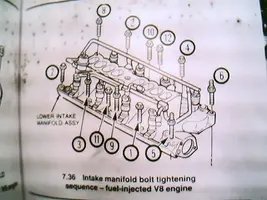
Retorque on the lower intake

DMAN302

My mom says thanks for the pearl necklace.
Nov 8, 2003
2,120
2
59
windsor, Canada
Silly question but I was out putzin in the garage when I decided to throw a torque wrench on a few of the lower intake bolts..the two inners I checked were near perfect so I jumped to the outer corners..they did take some tigtening to make torque. My question is being this is my third torque on the lower bolts, once at 100 miles and second at 300miles...can any harm result from not using the torque pattern secified and just doing the outer corners in the X patern?
 
i doubt it lol if you said the inner ones were ok, they are usually the first ones you do anyway, and they didn't move, so you went onto the outward ones right? than it's "close enough" to torque pattern lol good enough for government work!
 
That is the logic I used as well.The two checked were the most central two on the passenger side..one was maybe 2 lbs off, and the other clicked imediately. Following the intial sequence is critical I know for a good seat..but I'm curious as to how important following the correct sequence is for retorques..Just don't feel like pulling that upper again for the third time if really not required.
 
The proper torque pattern on the lower intake has the 4 most central bolts torqued LAST in the sequence, not first. Perhaps you used the wrong torque pattern in the first place -- if you did, my experience has been that they will keep loosening up on you.

Do you know the proper pattern?
 
Actually Mike I did follow the correct pattern on the first two torques at 100 and 300 miles. This thread is only asking about what occured today..I was just checking torque on the bolts...I tried the #1 bolt and was off by maybe a pound or two..then only out of curiosity I put the wrench on the outer most bolt passenger side...found the torque to be under spec more than I did like. Then I decided to "try the #11 bolt..and hit torque right away. So finding the inner most bolts to be at or close to torque I found all the outter bolts to be under torque and did torque them to 18 lbs...in an X pattern. I chose only to torque the outter bolts and my question is can you RE torque out of sequence the third or fourth time.
 
He said -- "the inner ones... are usually the first ones you do anyway..."

You replied - "That is the logic I used as well..."

I took that to mean you think the inner most bolts are the first ones in the proper sequence. They aren't the first ones in the proper sequence. From that I concluded the sequence you used was incorrect.

It's hard to describe the proper sequence without a picture. But I'll try.

There are 12 bolts for the lower. The 4 middlemost bolts (2 each side), the 4 corners (2 front, 2 back) and the OTHER 4.

The proper torque pattern is to tighten the OTHER 4 first in an X pattern; then the 4 corners in an X pattern; then the middlemost 4 in an X pattern.

If they're not staying tight, I'd pull the upper, lightly back off the bolts one at a time, and retorque them in the proper sequence.
 
Thanks Mike...the cars away for the season as of today..but come next yr after a few trips I will again check the bolt torque. Shoud I find they've lightened up again I will go through them all as you've stated. I was just thinking out loud if this would be an issue. I was curious after wiping my hand across the back of the lower intake where it seals to the block and found a trace of oil residue on the excess RTV between the block and intake. I thought I might check the torque just to see the situation with them. Not convinced the lower torque on the outters was the cause of the oil found..with 600 miles on the motor and only trace oil found I am not really considering it even a possible leak that would need attention.
Thank you very much for your time.
 
What torquing pattern did you use? If the rtv seals at the ends turn out ultimately to leak -- I'd put the factory rubber seals in there if you have to replace them.

Putting the car away? Too bad. We're just getting into the most beautiful weather of the year. We might have a day or two of snow, but for the most part, I can drive mine year round down here. Don't know how you do it up there....I couldn't handle it.
 
good to know, i'll admit i did mine wrong, - i think i'll back them all off and do it in that sequence... i don't feel like pulling my upper off more than once after it's done - i think i'll prob have to adjust my roller rockers when we get the car running anyway, so when i adjust my RR's, i'll also retorque the lower intake, heads, and header bolts - nething else i should torque? lol glad i read that
 
torquesequence4gk.webp
 

Attachments

  • torquesequence4gk.webp
    torquesequence4gk.webp
    32.1 KB · Views: 1,704
Believe it or not, if you re-torque the lower intake over and over again past the factory reccomended steps, it WILL pull the heads off the block over time and cause a head gasket failure. You will put an uneven load on the head gaskets and pull the top of the heads up off the block. DO NOT keep going over the intake. If there's a problem, replace the gaskets. Ask me how I know....
 
By the way - 'retorque' is actually a bit of a misnomer in my opinion. The problem is friction. If you torque a fastener to 60 ft-lbs. and then try to retorque it -- you have to apply something on the order of 70-80 ft-lbs. of torque to overcome the friction on the threads and get the fastener moving again. So, putting your torque wrench on the fastener with it set to the proper torque and pulling til it 'clicks' (or til the pointer is at the torque for a beam-type) doesn't tell you you're at the proper torque. It only tells you that what ever you had the torque wrench set at isn't high enough to overcome the friction between the threads. The fastener has to be quite loose (well below the rating you were looking for) to move with the wrench set at the desired level. They don't usually loosen that much - although it does happen occasionally.

You usually have only 2 choices. One is to assume everything is ok and not do anything at all. The other is to simply decide you're going to go through the procedure again by slightly backing off each fastener (enough to drop below the friction threshold) one at a time, and then simply pulling back up to the pre-set torque level.