Rocker Adjustment

97fxdwg

New Member
May 7, 2004
105
0
0
Hi Guys-
I've looked at previous threads and am unable to find my "exact" answers. So can I get a little help? I'm a definite MM mechanic but I'm trying and having to deal with the PO's issues at the same time.
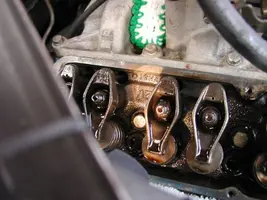
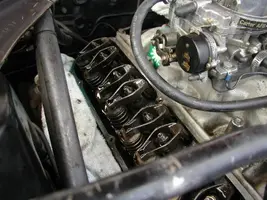
Just recently a ticking has started under the right valve cover. So I removed the valve cover and tried to find which rocker was the culprit, thinking that one of them would be an obvious. It's not at all obvious to me. When I started the car, they all have some degree of looseness and no one seemed more noisy than the others but with the engine running in my face, narrowing down the noise was impossible for me.
I'm attaching some pix (2 in this message and then 2 more), in the hope that someone out there can help me: 1) Tell me what my configuration is (roller?, pressed or threaded?, etc.) & 2) How to adjust these guys? If you tell me to turn the engine over to a certain location, how do I determine that? Feeler gauge???
Sorry for the ridiculously basic questions but I appreciate the help!
AJR
 

Attachments

  • P1010228.webp
    P1010228.webp
    42 KB · Views: 146
  • P1010229.webp
    P1010229.webp
    33.1 KB · Views: 144
They look stock to me. Easiest adjustment method is to do it while the engine is warm and running. Slowly loosen the big nut in the middle until you notice a change in idle or hear a tick. Slowly re tighten it up until it smooths out. Allow time for the lifters to catch up, half turn or so at a time. Then add another 1/2 to 3/4 of turn to finish.
 
Chances are that you have a hydrualic flat tappet cam, hydrauic lifters, press in studs, and those are definately "rail" rockers. The rocker has lips on either side to keep it aligned on the valve tip. They are not supposed to be adjusted. If clearance (lash) is incorrect, the proper way to fix it is by switching to a different lenght pushrod. If you're in a pinch, you can remove the exisiting "one time use" rocker nut, install a new grade 8 washer over the ball pivot or fulcrum (to prevent the nut from bottoming out on the threads), then install a new locknut and torque it until proper lash is obtained. Technically, zero lash is correct for a hydraulic valvetrain. Basically, there should be some sideplay on the valve tip, but if the rocker is loose enough to wobble on the fulcrum, or if it has vertical clearance on the valve tip, its too loose.
 
97fxdwg said:
2) How to adjust these guys? If you tell me to turn the engine over to a certain location, how do I determine that?

You appear to have pressed-in studs and I'll assume you also have a hydraulic flat tappet cam. They are definitely adjustable, but should only need to be adjusted very rarely, if ever. There is a sequence and it should be outlined even in a lame Haynes manual(I have two, hehe). Just make sure you are at the top of the compression stroke on the cylinder getting adjusted.

For the adjusting, all you need to do is back off the rocker nut until its loose, tighten it until you only just put drag on the pushrod, then tighten it another 1/2 to 3/4 turn to preload the lifter.

If you do all this and a rocker keeps loosening up, make sure the nut isnt backing off by itself ir that one of your press-in studs is not pulling out.
 
They are pressed in studs and before you adjust try a quart of Risolone available anywhere here in az. Run it for about a half hour and they should quiet down.
Next oil change use 4 quarts and one of Risolone. If this doesnt solve it then I would look to put some nuts in with poly locks the pressed in studs definetly a weak link in any engine.
 
The early rail rockers were adjustable, then Ford switched the pressed in studs to the positive stop studs, in which case you simply torque the rocker nut down and forget about it. Rail rockers started in april 1966, the positive stop studs first appeared sometime in the 68 model year.
 
If adjusting the valves does not solve the tapping noise, try using a stethoscope to listen for piston slap. Piston slap sounds alot like a loose rocker arm. The best way to check is to pull pan and visually inspect the cylinder bores and piston skirts.