
You are using an out of date browser. It may not display this or other websites correctly.
You should upgrade or use an alternative browser.
You should upgrade or use an alternative browser.
RPM's and max HP output
- Thread starter VEE EIGHT
- Start date


scupking
Active Member
With my stage II cams I make peak power at 5260RPM. I think stock is around 5500RPM. I see no reason to rev more then 6,000-6,200rpm.

deftsound
Please ask me how much my supercharger cost

MaxedGT
Member

Flghtmstr1
Member
What are you guys talking about? The original question wasn't clear, but for a factory engine, peak horsepower is 260 at 5250 rpm.
What are you guys talking about? The original question wasn't clear, but for a factory engine, peak horsepower is 260 at 5250 rpm.
I believe that 5250 is where the HP and TQ lines cross but isn't exactly where peak HP is made

Flghtmstr1
Member
I believe that 5250 is where the HP and TQ lines cross but isn't exactly where peak HP is made
You are correct in general; 5250 rpm is where the torque and horsepower curves intersect. This is true for all piston engines, as horsepower is nothing more than a figure calculated from the torque produced at a given rpm. Specifically, horsepower = torque X RPM / 5250.
However, our engines also happen to make peak horsepower at 5250 rpm.

You'll want to shift slightly higher than that. While 5250 is where peak hp is, when you change to the next gear, the effective gear ratio is worse and you can't put as much power to the wheels. You may do slightly better shifting at 5500. Another point you'll want to consider is the gearing jump between gears. The jump between 1st and 2nd is much bigger than the other gears, so it is worth running 1st out a little further. I'd probably make the 1-2 at 5700-5800 and the other gear changes at 5500.
40oz
Member
^ for starters.
Ideally, you want to use dyno numbers to calculate shift points to include a curve with the largest area under it. But the torque multiplication of gears is a factor here. There is no point in shifting to second, giving up the advantage of staying in first longer, simply because the power starts to fall off after 5250 rpms.
On a stock car, shifting at 5300 rpms will put you down to ~3200 rpms in 2nd, where a stock car makes ~245 torque. Had you held on to 6000 rpms, you'd land in second at ~3600 rpms, where stock torque is ~260 lb/ft. And you've given up all the torque available through the end of first at the superior 3.37/3.38 gear ratio vs. the 2nd gear 1.99/2.0 ratio (T45/3650). Torque at 6000 rpms would have to fall off to under ~145 lb/ft to make it worthwhile to shift early.
In second, shifting at 5300 rpms puts you back to 3600 rpms in 3rd at 260 lb/ft, with a gear ratio of 1.33. If you wait until 6000 rpms to shift to third you land at 4000 rpms, your torque peak. Torque would have to fall below 200 lb/ft by 6000 rpms to make it better to shift early.
Basically, it is better stay in each gear as long as possible to take advantage of torque multiplication. One would have to analyze their own dyno graph to determine if shifting early would be an advantage. And most of the graphs I've seen from 2V engines don't show torque falling off fast enough to warrant shifting at 5300 rpms. Consider that from 4000 rpms to 5250 it only falls off ~40 lb/ft.
Ideally, you want to use dyno numbers to calculate shift points to include a curve with the largest area under it. But the torque multiplication of gears is a factor here. There is no point in shifting to second, giving up the advantage of staying in first longer, simply because the power starts to fall off after 5250 rpms.
On a stock car, shifting at 5300 rpms will put you down to ~3200 rpms in 2nd, where a stock car makes ~245 torque. Had you held on to 6000 rpms, you'd land in second at ~3600 rpms, where stock torque is ~260 lb/ft. And you've given up all the torque available through the end of first at the superior 3.37/3.38 gear ratio vs. the 2nd gear 1.99/2.0 ratio (T45/3650). Torque at 6000 rpms would have to fall off to under ~145 lb/ft to make it worthwhile to shift early.
In second, shifting at 5300 rpms puts you back to 3600 rpms in 3rd at 260 lb/ft, with a gear ratio of 1.33. If you wait until 6000 rpms to shift to third you land at 4000 rpms, your torque peak. Torque would have to fall below 200 lb/ft by 6000 rpms to make it better to shift early.
Basically, it is better stay in each gear as long as possible to take advantage of torque multiplication. One would have to analyze their own dyno graph to determine if shifting early would be an advantage. And most of the graphs I've seen from 2V engines don't show torque falling off fast enough to warrant shifting at 5300 rpms. Consider that from 4000 rpms to 5250 it only falls off ~40 lb/ft.

sneaky98gt
10 Year Member
^ for starters.
Ideally, you want to use a dyno numbers to calculate shift points to include a curve with the largest area under it. But the torque multiplication of gears is a factor here. There is no point in shifting to second, giving up the advantage of staying in first longer, simply because the power starts to fall off after 5250 rpms.
On a stock car, shifting at 5300 rpms will put you down to ~3200 rpms in 2nd, where a stock car makes ~245 torque. Had you held on to 6000 rpms, you'd land in second at ~3600 rpms, where stock torque is ~260 lb/ft. And you've given up all the torque available through the end of first at the superior 3.37/3.38 gear ratio vs. the 2nd gear 1.99/2.0 ratio (T45/3650). Torque at 6000 rpms would have to fall off to ~145 lb/ft to make it worthwhile to shift early.
In second, shifting at 5300 rpms puts you back to 3600 rpms in 3rd at 260 lb/ft, with a gear ratio of 1.33. If you wait until 6000 rpms to shift to third you land at 4000 rpms, your torque peak. Torque would have to fall below 200 lb/ft by 6000 rpms to make it better to shift early.
Basically, it is better stay in each gear as long as possible to take advantage of torque multiplication. One would have to analyze their own dyno graph to determine if shifting early would be an advantage. And most of the graphs I've seen from 2V engines don't show torque falling off fast enough to warrant shifting at 5300 rpms. Consider that from 4000 rpms to 5250 it only falls off ~40 lb/ft.
This makes a lot of sense.
 Do you need to look at the HP curve or torque curve when doing this? I ask b/c I'm about to get my car tuned and I'm gonna change the shift points (auto). Thanks for the info.
-Will
40oz
Member
I'd look at the torque curve.
Generally speaking, more torque means more acceleration, so you want more torque at the wheels (including gear multiplication) to maximize acceleration.
Generally speaking, more torque means more acceleration, so you want more torque at the wheels (including gear multiplication) to maximize acceleration.
sneaky98gt
10 Year Member
I'd look at the torque curve.
Generally speaking, more torque means more acceleration, so you want more torque at the wheels (including gear multiplication) to maximize acceleration.
So, assuming the dyno was done in a gear w/ a 1:1 ratio, you would just multiply the torque on the dyno curve by the transmission gear ratio? (And technically by the differential gear ratio and the axle:tire ratio?) Even though the last two are the same all the time and thus don't matter.
Sorry for the jack, but I'm about to tune my car and gonna be doing all this stuff soon. Good info anyway. I think I get this now.
-Will
It is possible to graph the rear wheel torque in each gear vs speed. You have to calculate the speed in each gear at each rpm, and then multiply the torque number on the dyno by the gear ratio for each rpm. After each gear is plotted out, you should see where the graphs of each gear cross. The graph of 1st gear should cross the graph of 2nd at some point, and that rpm is where your ideal shift is for that gear is.
Does all that make sense?
I did that for my 97 GT once. Basically, the results are that you have to run out 1st and 4th longer, because the difference between 1st and 2nd and 4th and 5th is steep. Then, I went to the track and ended up going fastest by shifting at 5k on the nose. The poor syncros didn't like power shifting faster than that.
Does all that make sense?
I did that for my 97 GT once. Basically, the results are that you have to run out 1st and 4th longer, because the difference between 1st and 2nd and 4th and 5th is steep. Then, I went to the track and ended up going fastest by shifting at 5k on the nose. The poor syncros didn't like power shifting faster than that.
sneaky98gt
10 Year Member
MaxedGT
Member
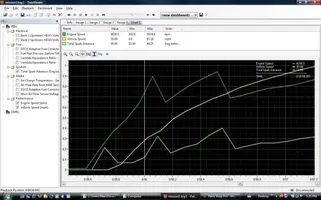
This is a snapshot of a run i made on the strip. If you look at the slope of vehicle speed line you can see how it gradually flattens out after each shift. This shows what 40oz was talking about, and why you don't want to shift too soon. Unfortunately the data rate was set too slow by an error on my part, when I took the snapshot and dosn't show everything precisely. But my shifts were at 6000 rpm.
Attachments

Stan Weiss
Member

40oz
Member
So, assuming the dyno was done in a gear w/ a 1:1 ratio, you would just multiply the torque on the dyno curve by the transmission gear ratio? (And technically by the differential gear ratio and the axle:tire ratio?) Even though the last two are the same all the time and thus don't matter.
Sorry for the jack, but I'm about to tune my car and gonna be doing all this stuff soon. Good info anyway. I think I get this now.
-Will
Yes. The trans gear ratio x the engine torque at rpm is all you need, since as you stated, the other variables won't change.
I use this link for gear and speed: http://www.f-body.org/gears/
I used cars.com to find out the numerical values for each gear, but numerous sites have the data you need.
I use the chart to match the speed in each gear to the find the rpm in the next gear. IOW, shift at 6000 rpms in first at ~42 mph puts me at ~3600 in 2nd. Be sure and do a sanity check on the road to make sure the chart matches your actual speeds and rpms in gear.
A key point to remember is that 200 lb/ft at 6000 rpm is going to accelerate harder than 200 lb/ft at 3000 rpm, as you are exerting the same energy at twice the rate at the higher rpm. Kind of like hitting a nail with a hammer once a second or twice a second - same energy each blow, but if the blows are delivered twice as fast, the nail goes in twice as fast.
I guess in view of that, horsepower might be the relevant number, as that is a measure of the *rate* of force, not just the force. Does anyone else have any thoughts on this?
MaxedGT
Member
Don't forget that unless the torque converter clutch is locked, the rpm values per gear are not quite right due to the torque converter slip
Similar threads
- Replies
- 5
- Views
- 221

- Replies
- 11
- Views
- 505

- Replies
- 4
- Views
- 505
- Replies
- 8
- Views
- 273
