You are ignoring the fact that you accelerate harder in 2nd than 3rd because 2nd is a lower gear.
No I'm not. You will not be accelerating harder in 2nd gear if you're making less power than you could be making by shifting to 3rd. Work out the calculations your way and you'll see what I mean.
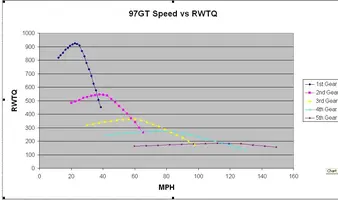
It doesn't matter if the horsepower number is falling or not, the amount of torque from the engine * transmission gear ratio is the relevant number.
While relevent, you're wasting your time with extra math that isn't necessary to arrive at the exact same conclusion. HP is equally as relevent, but it's also a more efficient approach.
I'm not saying you are wrong, I'm saying your method isn't necessarily correct.
It is exactly correct and also identical to your method... try it out for your self if you need justification. All you want to do is maximize average hp over the entire run. So you shift when hp at the shift point in one gear is identical to hp in the next gear, or when you reach your RPM limit, whichever comes first. If you're unclear about the method, I'll try to explain more articulately.
Horsepower is simply torque times rpm. 200 lb-ft is 200 lb-ft, but 200 lb-ft at 3000 rpm is only 114 hp, while 200 lb-ft. at 6000 rpm is 228 hp.
If your shift was actually going to drop you from 6k to 3k, which is in itself unrealistic, then by my method you wouldn't shift because you're still making more power at 6000 than you are at 3000. I don't need the details of the amount of torque you're making or what the multiple of that by your tranny gear is.
Despite what I stated in an older post on this thread, you will accelerate the same at 3000 rpm and 6000 rpm if the torque is the same at both rpms. Regardless of the horsepower number.
I know, in the same gear, of course.
More interestingly and to my point, if you're making 220hp at 6000 RPM in 1st gear (say, 3:1), and by shifting to second (say, 2:1) you'd be at 220hp at 4000 RPM, then you'd have equivalent acceleration in either gear, thus it would be your optimum shift point, assuming as in any normal engine going beyond 6000 would hurt your power output while going above 4000 would increase power output. Those gear ratios are not just arbitrary, they are pretty close to a T5's actual ratios, and they would result in that exact drop in RPM.
And because of the multiplication of torque by your transmission, you will accelerate harder at 6000 rpms in 2nd than you will at 3000 rpms in 3rd.
In your specific example, yes.
IOW, stay in gear as long as possible as a rule of thumb. Use a dyno chart and your transmission gear ratios to verify this.
Bad rule of thumb. It doesn't apply to the anemic stock 5.0 HO pushrod motors, for example, which ran out of breath and had an optimum shift point of about 5500 in 1st, 5250-5300 in 2nd, around 5150 in 3rd, and around 5300 again in 4th, even though redline was upwards of 6000 rpm and the limiter was at 6250. I could spin my billet internaled 331 to 7k+ RPM all day, but my street cam causes a rapid drop off after 6300 RPM. Spinning it over 7k would be senseless.
Chris




 that's freaking awesome

