Resolved Stumble issue upon acceleration (1987 GT)

Hello everyone. I'm new to StangNet, so I hope I can find a solution to my driving issue.

I have a stock 1987 GT convertible Automatic 5.0 (speed density) car. I've owned it for more than 12 years with my fair share of ups and downs and I love this car.

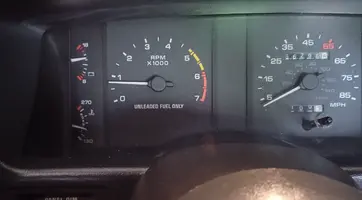
It has 66-67,000 original miles on the clock and I'm having an acceleration issue. It seems to stumble (maybe misfire?) On moderate acceleration right around the 1500-1800 rpm range.
It does this when the engine is cold or warmed up. If I get on it, the rpms will drop up and down just slightly, Then she will smooth out.

Recently a New distributor, cap, rotor, motorcraft TFI module, plug wires, motorcraft copper spark plugs (gapped .054), Ignition coil, 3G Alternator, starter + starter solenoid, IAC, TPS (set to under 1 volt , about 0.72 volts. WOT is 4.25 volts)
EGR valve w/ EGR position sensor, PCV valve + grommet at rear of engine, ACT sensor, ECT sensor (coolant temp sensor), NTK oxygen sensors (no catalytic converters), fuel tank, fuel pump, fuel pump relay and filter.

Checked for vacuum leaks with a smoke machine and didn't find any leaks.

Idles good at around 750 rpm in drive. Idle is close to 900 rpm in park.
Timing is set to 10° TDC and it was set when the mechanic installed the new distributor, IAC and TPS.


It seems to have good fuel pressure when I checked it last. It does this almost every time I drive it now. If I'm steady on the gas, it's less likely to do it. And I've noticed it will stumble a bit more if I'm giving it more gas driving up a hill or inclined road.

Any ideas on where I should go next?
FPR ? Injectors? Transmission ? Lol
 
Last edited:
You’ve done replaced almost everything it could be. At this point I would probably have the injectors cleaned.

When I’ve done it I’ve had to send them out since there’s no shops locally they offer this service. Both times I’ve used High Performance Injectors. It’s $12.50 an injector.

They do sell a cleaner you put in the tank, though I’m not sure how well it works. May be worth a try.
 
I will have to check the vacuum at idle and fuel pressure at idle. The timing was set when the mechanic replaced the distributor, So I do think he unplugged the spout connector when setting the timing.

I am going to do a certain type fuel pressure test soon to see how much fuel is being pumped during a specific amount of time using a fuel pressure gauge.

I'm leaning towards fuel pump going bad or clogged injectors or the fuel pressure regulator at the moment.
 
Last edited:
Fuel pressure during these events is probably what I'd check next, along with performing a vacuum smoke test. Speed density cars are very sensitive to vac leaks.


Ideally if you could fine a way to hook a gauge up to the fuel rail and see what the pressure is as you get on it, that would be ideal. A little difficult to pull off i realize without buying parts and spending $$
 
  • Like
Reactions: Mcmahst
Fuel pressure during these events is probably what I'd check next, along with performing a vacuum smoke test. Speed density cars are very sensitive to vac leaks.


Ideally if you could fine a way to hook a gauge up to the fuel rail and see what the pressure is as you get on it, that would be ideal. A little difficult to pull off i realize without buying parts and spending $$
Thank you for your response and input. Much appreciated.

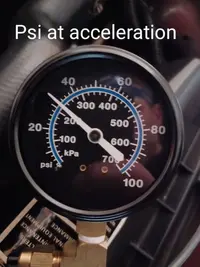
Alright, so I have a fuel pressure gauge that I hooked up to the fuel rail.

I started the engine and let it idle for a bit. I'm getting 33 or 34 psi at idle. I let it warm up some more.... Still roughly the same psi. I decided to hold the throttle open (about 2k rpm) for about 3 to 5 seconds and it was still at 33 psi.

I'm not sure if this is good indication of improper fuel pressure for a bone stock fuel pump?
factory stock fuel pumps are 88lph ?

Finally, I did a quick fuel pump volume test. I got about 75 grams in gasoline weight for just over 15 seconds using a stopwatch. Not sure if this helps any.
 

Attachments

  • 20240917_160941~2.webp
    20240917_160941~2.webp
    169.4 KB · Views: 105
  • 20240917_161754~2.webp
    20240917_161754~2.webp
    186.6 KB · Views: 110
  • 20240917_161828~2.webp
    20240917_161828~2.webp
    177.2 KB · Views: 106
Last edited:
That would mean your regulator is good but it will not rule out a weak fuel pump. If a buddy can monitor the fuel pressure under load and wide open throttle that will tell you if the fuel pump can keep up. Absolute best way is a wide band oxygen sensor but like Mustang5L5 mentioned that costs $$$.
 
That would mean your regulator is good but it will not rule out a weak fuel pump. If a buddy can monitor the fuel pressure under load and wide open throttle that will tell you if the fuel pump can keep up. Absolute best way is a wide band oxygen sensor but like Mustang5L5 mentioned that costs $$$.

If my regulator turns out to be good and a vacuum test turns out good, then I guess a new fuel pump would suffice in "potentially " solving the issue?

it's a bit difficult to test the fuel pressure while driving under load lol.
So , I'd bite the bullet for a new fuel pump if need be + have the injectors cleaned.
 
As stated that just tests the pressure regulator. It’s easy to do so that’s why I suggested it. You can have good pressure but low volume. Did you do your volume test from the vent on your gauge? I saw a video where they did it that way and got ~160 grams.

The correct way would be to disconnect the feed line from the rail and fill a bucket for a minute. Spec is 1.5 liters. 1.5x60=90 (88lph, stock pump).

So, fuel pump size/60 = liters per minute. Use this if you have a larger than stock pump.
 
  • Like
Reactions: Mcmahst
As stated that just tests the pressure regulator. It’s easy to do so that’s why I suggested it. You can have good pressure but low volume. Did you do your volume test from the vent on your gauge? I saw a video where they did it that way and got ~160 grams.

The correct way would be to disconnect the feed line from the rail and fill a bucket for a minute. Spec is 1.5 liters. 1.5x60=90 (88lph, stock pump).

So, fuel pump size/60 = liters per minute. Use this if you have a larger than stock pump.
When I did my vent valve test from the pressure gauge for 15 seconds, I got 75 grams of gasoline weight. Nowhere near the 160 grams they got. Unless they were using a larger volume pump?

I have a stock pump , so I could try disconnecting the feed line from the fuel rail and fill a bucket for 1 minute.
If I don't end up with 1.5 liters, then I definitely have an issue with the pump

What's the step by step to try the fuel rail bucket volume test?
 
Last edited:
Before I try another volume test, I'll do some math with the results of my first volume test.


I got 75 grams of gasoline in 15 seconds.

Multiply by 4 = ~300 grams of gas per minute

300 grams of gas per minute x 60 minutes = 18,000 grams per hour.

18,000 grams of gasoline converted to liters = 24 liters per hour

Not anywhere close to the 88lph. Lol
 
Maybe a dumb question, but have you verified the available voltage at the pump during the test? Not, what does it read with you test it static, but the running voltage? I found an insufficient ground problem testing a pump that way. Since these vehicles are so ground sensitive, I offer that as a test input that might point to a different problem. Just another thing to test before replacing the pump.
 
  • Like
Reactions: FoxDude87