

so, car was running fine. I shut it off for about 10 minutes, restarted it and now its idle is funny. Upon start up it runs up to 1800 or so, then slowly drops down to 1000-1100 and won't come down any lower. It will occasionally drop to 800 or so after stopping at a light for a moment but for the most part is favoring 1000-1100 ... Any ideas? I reset the computer with no luck, unplugged the MAF and it just idled up and down and stalled itself.
You are using an out of date browser. It may not display this or other websites correctly.
You should upgrade or use an alternative browser.
You should upgrade or use an alternative browser.
sudden idle problems..
- Thread starter QUIKSVT
- Start date


DTT92LX
New Member
facemelter71
New Member
most of the time on mustangs it is the tps sensor and the iac valve.take the iac valve off the tb on the majority of the iac valves there are two philips head screws that hold the stepper motor on.remove those two screws so the electronic motor comes off and set it aside so now you only have the bare iac valve.spay the bajeses out of it with carb cleaner let dry assemble the little motor back on it.before you install on tb make sure tps voltage is between .997and .999.after all is finished reset comp and let idle for about 15 minutes.
OK. I found the problem, it appears to be the EGR. The bladder deal inside of it doesn't move regardless of vacuum. If I push the bladder in with a screwdriver, the idle settles down. There is no vacuum coming from the green vac line connected to the EGR. Where does the green vac line run to? All I see is it goes under the manifold elbow along with the red vac line that goes to the main vac off the manifold.

Some basic theory to clarify how things work is in order…
The EGR shuts off at Wide Open Throttle (WOT), so it has minimal effect on performance. The addition of exhaust gas drops combustion temperature, increases gas mileage and reduces the tendency of the engine to ping. It can also reduce HC emissions by reducing fuel consumption.
The EGR system has a vacuum source (line from the intake manifold) that goes to the EVR, computer operated electronic vacuum regulator. The EVR is located on the back of the passenger side shock strut tower. The EGR valve and the passages in the heads and intake manifold route exhaust gas to the EGR spacer (throttle body spacer). The computer uses RPM, Load. and some other factors to tell the EVR to pass vacuum to open the EGR valve. The EGR sensor tells the computer how far the EGR valve is open. Then computer adjusts the signal sent to the EVR to hold, increase or decrease the vacuum. The computer adds spark advance to compensate for the recirculated gases and the slower rate they burn at.
Diagram courtesy of Tmoss & Stang&2birds.
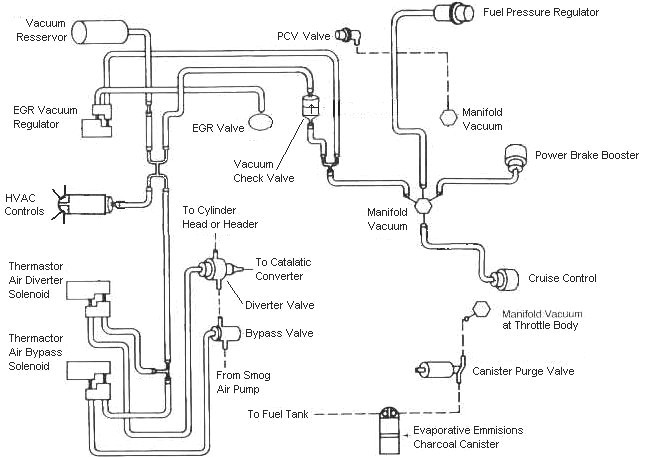
The EGR sensor is basically a variable resistor, like the volume control on a radio. One end is 5 volt VREF power from the computer (red/orange wire). One end is computer signal ground (black/white), and the middle wire (brown/lt green) is the signal output from the EGR sensor. It is designed to always have some small voltage output from it anytime the ignition switch is the Run position. That way the computer knows the sensor & the wiring is OK. No voltage on computer pin 27 (brown/lt green wire) and the computer thinks the sensor is bad or the wire is broken and sets code 31. The voltage output can range from approximately .6-.85 volt.
EGR test procedure courtesy of cjones
to check the EGR valve:
bring the engine to normal temp.
connect a vacuum pump to the EGR Valve
apply 5in vacuum to the valve.
if engine stumbled or died then EGR Valve and passage(there is a passageway through the heads and intake) are good.
if engine did NOT stumble or die then either the EGR Valve is bad and/or the passage is blocked.
if engine stumbled, connect vacuum gauge to the hose coming off of the EGR Valve
snap throttle to 2500 RPM (remember snap the throttle don't hold it there).
did the vacuum gauge show about 5in vacuum?
if not, check for manifold vacuum at the EGR vacuum valve.
if you have manifold vacuum then connect vacuum gauge to the EGR valve side of the vacuum valve and snap throttle to 2500 RPM.
should read about 5in vacuum
Remove the EGR valve and clean it with carbon remover. Prior to re-installing see if you can blow air through the flange side of the EGR by mouth. If it leaks, there is carbon stuck on the pintle valve seat, replace the EGR valve ($85-$95). This usually trips code 34.
PS: if you had checked out the "Help me create the Surging Idle Checklist" at the top of the forum, you would have found that the EGR is one of the items in the checklist.
The EGR shuts off at Wide Open Throttle (WOT), so it has minimal effect on performance. The addition of exhaust gas drops combustion temperature, increases gas mileage and reduces the tendency of the engine to ping. It can also reduce HC emissions by reducing fuel consumption.
The EGR system has a vacuum source (line from the intake manifold) that goes to the EVR, computer operated electronic vacuum regulator. The EVR is located on the back of the passenger side shock strut tower. The EGR valve and the passages in the heads and intake manifold route exhaust gas to the EGR spacer (throttle body spacer). The computer uses RPM, Load. and some other factors to tell the EVR to pass vacuum to open the EGR valve. The EGR sensor tells the computer how far the EGR valve is open. Then computer adjusts the signal sent to the EVR to hold, increase or decrease the vacuum. The computer adds spark advance to compensate for the recirculated gases and the slower rate they burn at.
Diagram courtesy of Tmoss & Stang&2birds.
The EGR sensor is basically a variable resistor, like the volume control on a radio. One end is 5 volt VREF power from the computer (red/orange wire). One end is computer signal ground (black/white), and the middle wire (brown/lt green) is the signal output from the EGR sensor. It is designed to always have some small voltage output from it anytime the ignition switch is the Run position. That way the computer knows the sensor & the wiring is OK. No voltage on computer pin 27 (brown/lt green wire) and the computer thinks the sensor is bad or the wire is broken and sets code 31. The voltage output can range from approximately .6-.85 volt.
EGR test procedure courtesy of cjones
to check the EGR valve:
bring the engine to normal temp.
connect a vacuum pump to the EGR Valve
apply 5in vacuum to the valve.
if engine stumbled or died then EGR Valve and passage(there is a passageway through the heads and intake) are good.
if engine did NOT stumble or die then either the EGR Valve is bad and/or the passage is blocked.
if engine stumbled, connect vacuum gauge to the hose coming off of the EGR Valve
snap throttle to 2500 RPM (remember snap the throttle don't hold it there).
did the vacuum gauge show about 5in vacuum?
if not, check for manifold vacuum at the EGR vacuum valve.
if you have manifold vacuum then connect vacuum gauge to the EGR valve side of the vacuum valve and snap throttle to 2500 RPM.
should read about 5in vacuum
Remove the EGR valve and clean it with carbon remover. Prior to re-installing see if you can blow air through the flange side of the EGR by mouth. If it leaks, there is carbon stuck on the pintle valve seat, replace the EGR valve ($85-$95). This usually trips code 34.
PS: if you had checked out the "Help me create the Surging Idle Checklist" at the top of the forum, you would have found that the EGR is one of the items in the checklist.
At idle the EGR is supposed to be completely closed. Appling vacuum directly to it should cause the engine to stuble and possibly die. This is because appllying vacuum opens the EGR full blast. That tends to make the engine gasp and die - just like a big vacuum leak.
I would look closely at the rest of your vacuum plumbing. The hard plastic lines tend to crack, and the previous owner may have misconnected something.
I would look closely at the rest of your vacuum plumbing. The hard plastic lines tend to crack, and the previous owner may have misconnected something.
I'm not sure what is considered 'all the way in'. If you remove the vac line to the EGR valve, it should be closed (or near closed, barring being held open by a chunk of carbon, etc). If you have a Mitivac you can apply a little vacuum to the valve and watch it open. As you do, the car will start to stumble (as yours did - mine doesnt stall either). Be careful if you use engine vac to do this, as it slams the valve open pretty hard (you can apply enough vacuum with your lungs if you dont have a Mitivac type pump).QUIKSVT said:So, with the red bladder deal inside of the EGR pushed all the way in, it is open, correct?
JRichker has you going in the right direction with the testing. Be careful while testing for vac to the EGR valve - I've not snapped the throttle quite right before and had the test be invalid.
Good luck.

302RollinHard
New Member
I don't know if this helps, but I had the same idle problem and killed myself with vac leaks, tps, iac, etc. I cleaned the MAF one day, and started it back up and it idled like a champ. right where I set it. then I noticed the CEL was on. Went and looked, and left the MAF unhooked. Bought a new one, and problem solved.
As with most things, Jrichker, and HISSIN know their stuff so i would follow their leads first, but if all else fails....
As with most things, Jrichker, and HISSIN know their stuff so i would follow their leads first, but if all else fails....
Similar threads
- Replies
- 9
- Views
- 670
- Replies
- 4
- Views
- 220

- Replies
- 1
- Views
- 136

- Replies
- 16
- Views
- 949
- Replies
- 6
- Views
- 438
