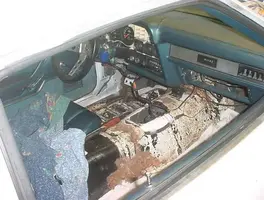
T-5 conversion

Vince

Vince the Fabricator
Founding Member
Feb 22, 2000
623
0
16
Vancouver, Canada
I'm in the process of swapping out the RAD4 for a T-5...well, actually my mechanic is in the process of doing this (I decided to farm out this project). Since I'm using the Mustang II bellhousing I had my T-5 customized with the longer 94-95 Mustang input shaft. But even with this extra length, the input shaft will still be roughly 3/8" shorter than with the 4-speed. Those of you that have done this, did you just install it as-is? My mechanic is going to take some more accurate measurements in the next day or so, then we'll see what needs to be done. But it sounds like the input shaft isn't going to fit very far into the pilot bushing.
 
If you use the correct roller pilot bearing, the sleeve that it is pressed into can be removed, and a new sleeve with the additional length added turned on a lathe. Press together, and should take care of the length issue.

I believe a351must2 (Darryl) did this with the "short" pre-94 input as well.
 
Yeah, I think that's what we'll have to do. Some previous postings here suggested that using the 94-95 input shaft removes the need for the sleeve, but I'd be nervous running it this way. I'll keep you guys posted.
 
Cool combo; small bell and T5. Plenty of header room. I did it once, years ago, but I can't remember the details.
Two bad things about this combination; The obvious limit enforced by the tiny II bellhousing on clutch diameter, causing you to run a pressure plate with a higher spring pressure, which means harder pedal and increased wear on the engine's thrust bearing.
And the *WEIGHT* of that stock II flywheel. That thing weighs something like 60 pounds by itself. If I recall correctly, I weighed the flywheel and clutch assembly and the total was 72 pounds. If you ever want to get back at someone, just drop a II flywheel on his foot.
If you could find a lightweight racing steel or aluminum flywheel that fit inside the II bell, that would kick ass. Or possibly have the stock unit machined to lighten it. I was always nervous when the tach read 7000 RPM knowing 72 pounds of iron was flying around down there waiting for a chance to break out of the bellhousing and pay me an unfriendly visit.
 
Blue Thunder mentioning lightening the flywheel made me think of Smokey Yunick.
NASCAR wouldn't allow lightweight flywheels so his solution was to remove the ring gear and drill holes from the outer edge into the center and reinstalled the ring gear. He got a lightened flywheel and NASCAR was none the wiser. Sharp guy, that Smokey. And yes, a flywheel that becomes a grenade will quickly remove a foot. Ghastly thought and a good argument for scattershields.
 
D&D transmission in Detroit told me the minimum the shaft should go into the crank was 1/2 inch.

The roller bearing is designed to have the input shaft ride evenly on the bearings. In my case the rollers didn't even start until about 1/8 inch into the bearing/crank. Based on my measurements the end of the input shaft would just be riding on the outer edge of the rollers. I didn't imagine that with that minimual contact the bearing would last long.

Since the bell had to be machined to have the retainer fit into itl (your mechanic did take that into consideration) I had 1/16 shaved off the front and back of the bell housing. Not enough to screw anything up like the starter spacing. That coupled with the fact that in my case the input shaft would have made it 3/8 into the crank without that gave me my 1/2 inch minimum.

To solve the roller bearing issue I just went old school and used a brass bushing from the old days. It solved the issue with the rollers and yes created more friction, but with a street car I doubt you could measure it.

Dave
 
I just got off the phone with my mechanic. He got the bellhousing machined and took some more accurate measurements. What he's going to do is get a machine shop to fabricate an extended bronze pilot bushing (just over 1" long). I asked about going with a roller bearing & longer sleeve and he said there's nothing wrong with bushings and that they last forever. I'm not quite sure why I need the extended bushing and you didn't. Maybe I could have done without one, but I have full confidence in this guy's judgement.

I also doubt the difference in friction between a bushing and bearing is noticeable.
 
Vince said:
I also doubt the difference in friction between a bushing and bearing is noticeable.

The only time the bushing works anyway is when you have the clutch pedal pressed. When you're off the pedal, any extra friction provided from that little bushing is simply additional clutch holding power. haha
 
From what I understand if you use the T-5 bellhousing headers become a customization or you have to stay with the stock manifolds.

I used the stock II bell so I could stay with the un-modified headers, Hooker 6120's, which dropped in without any modifications.

You get to pick one option or the other.

Maybe someone else has successfully used the T-5 bell and dropped headers in?

Dave
 
Correct Bellhousing

I went with a T5 and used the bell from same engine '89
Since I am staying pretty stock I did not worry
about header clearance. It's a pretty tight fit using
stock manifolds. I used a late model flywheel and had
it rebalanced and was able to use my original c4 starter.
so far it seems to be working, I am in the process of shortening
driveshaft. With this setup you don't have to worry about pilot bearing.
 
For me the main reason to use the Mustang II bellhousing was the shifter position. With the T5 & II bell the shifter will be 1-2" forward (?), with the T5 and T5 bell it will be more like 3" forward. Being able to fit headers without modifications is a bonus.

The downside of using the II bell is being forced to use the Mustang II 10" clutch and small (and heavy) flywheel.
 
shifter position

It wasn't as bad as I thought.
I only took about an 1.5" of metal
out. After I bend the arm back alittle
should be OK. I am having problems with
the full console, looking for a mini with ashtray.

andy
 

Attachments

  • shifter-position.webp
    shifter-position.webp
    47.3 KB · Views: 251
I would definitely take that 60 pounder to the machinist and see if he can lighten it (a LOT).
The in-neutral revving difference between the manual and automatic is insane, because of that flywheel weight on the motor. It was designed that heavy because the stock 136hp 302 in the IIs was a smog wus and needed the extra momentum to launch off the line. Hell, you could shut off the key and still leave rubber on the ground. haha.
 
I think Detroit was thinking of superb freeway economy when they designed that hefty Flywheel. If you think about it, once that bad boy is spinnin it won't take much to keep it going when you're bombing down the highway. :nice:

Is the stock II V8 a 9.5" or a 10" clutch? I thought it was a 9.5" for some reason... If it is a 10", look into the early- mid 80s Mustangs that used the junk-o T-5s and they were using a 10" clutch aswell. Could be another source for a flywheel/bell housing combo, but would have to re-balance for the pre-80 302s. I've got an E4 bell and a corresponding flywheel, just another round-to-it once I get the inside of the shop squared up a bit.

Just some thoughts... :shrug:
 
Dano78 said:
I think Detroit was thinking of superb freeway economy when they designed that hefty Flywheel. If you think about it, once that bad boy is spinnin it won't take much to keep it going when you're bombing down the highway. :nice:

Is the stock II V8 a 9.5" or a 10" clutch? I thought it was a 9.5" for some reason... If it is a 10", look into the early- mid 80s Mustangs that used the junk-o T-5s and they were using a 10" clutch aswell. Could be another source for a flywheel/bell housing combo, but would have to re-balance for the pre-80 302s. I've got an E4 bell and a corresponding flywheel, just another round-to-it once I get the inside of the shop squared up a bit.

Just some thoughts... :shrug:

You can change the weight of a 50 oz flywheel to a 28 oz?