top 3 gauges

deadlast

New Member
Mar 30, 2005
495
0
0
Belmont, MA
I want to invest in some gauges, even though i am fairly stock for now. what are the 3 most effective gauges that could help me out? I was thinking oil pressure, and tranny temp. anythign else i should consider and why?
 
M.Y. is correct...

Oil Pressure
Oil Temp
Coolant Temp

Then
Voltage
A/F ratio
Fuel Pressure


Good luck finding a place to put them... One day I want one of those radio bezels that puts them under the radio (helps to keep my stock look)
 
I'm glad to see you guys are telling him oil temp. I never had this until one day I drove a friends car. 10 minutes of driving hard and the oil temp was way high and did a dyno on this and lost 25-35 rear wheel hp. I was like WOW.

The oil pressure is a must and water temp.
 
Contemporary electrical gauges/senders are reliable and accurate -- I use all VDO electrical gauges in mine. With the exception of a custom gauge we made to display how fast my electric cooling fans are spinning, all are the factory Volvo-VDO gauges -- reliably working as the factory intended. I have factory tach and speedo, factory fuel and coolant temp (un-marked gauge); voltmeter, oil pressure (0-5 bars), oil temperature (300F), vacuum gauge (great for obtaining good fuel mileage) and my 'cooling fan' tach. You can see in the pics the tach, speedo, steering wheel hides fuel gauge and temp gauge, then left to right across the top - vacuum, oil temp, oil pressure, volts; and lone gauge on the bottom is the fan tach.

http://www.stangcity.com/showphoto.php/photo/2357/cat/500/page/3

http://www.stangcity.com/showphoto.php/photo/2356/cat/500/page/3
 
The electrical ones are just as good as the mechanical. There might be a slight edge in accuracy for the mechanical gauges, but not enough to justify plumbing all of that tubing (but then again I am lazy)

Dead Last: The link you posted, do they have that radio bezel for the 87 - 93 models? I really want one and can't remember where I saw it.
 
srothfuss said:
The electrical ones are just as good as the mechanical. There might be a slight edge in accuracy for the mechanical gauges, but not enough to justify plumbing all of that tubing (but then again I am lazy)

Dead Last: The link you posted, do they have that radio bezel for the 87 - 93 models? I really want one and can't remember where I saw it.


yea, i wonder why yours is $10 less tho, lucky
http://www.cp-e.com/2010.html
 
I would say that I prefer mechanical gauges just for the full sweep. On a narrow sweep temp gauge, for instance (there are full sweep electric gauges for $$), the needlewidth can be worth 20*F on some gauges. Not good.
 
JT - During the first Joe Frazier fight, Ali complained in his corner to Angelo Dundee that he was seeing double. Dundee told him to 'hit in between them'. Same advice for those 'poor' limited sweep electric gauges with 20 degree needles -- look at the middle of the pointer. :)

With ANY gauge -- it's not the instant reading that's the issue. It's the TREND we should be watching. If your vehicle has been consistently registering 180F on the coolant gauge, and you notice it's running at 210F -- even though 210F isn't a problem -- the upward trend contrasted with the history of a solid 180F IS a problem. You should get the car off the road til the problem is identified and solved.

So the question is -- will the gauge you select show you the trend quickly enough to help you avoid harming something? For me, either electric or mechanical will do that just fine.
 
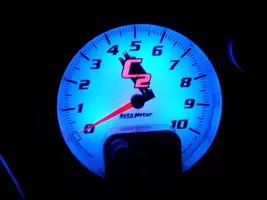
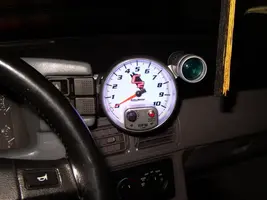
Alot of people also put in tachs I put mine in yesterday.

Mustang014.webp


Mustang012.webp
 

Attachments

  • Mustang014.webp
    Mustang014.webp
    13.4 KB · Views: 71
  • Mustang012.webp
    Mustang012.webp
    32.1 KB · Views: 81
I bought autometer 2 5/8" white faced gauges in the spring for the GT and put them in a center vent delete "gauge cage."

I chose oil pressure (electrical), water temp (mechanical), and vacuum. I'm w/ Michael on the tranny temp - probably not necessary.

The oil temp is cool, but really what are you gonna do if the oil gets hot? I guess you could determine that you want an oil cooler, but that's about it isnt' it?

Just a little install info from my install:

I chose to route my stuff through the firewall via the steering shaft boot; slit a hole and poke it through.

I tapped into the lighting for the AC backlights for the lighting on the gauges.
 
Dbeck - have you measured yours? If not, perhaps you should before you conclude that. My stock HO engine was consistently registering oil temps in the 250-270F range -- much higher than I'd like. The cooler took it down into the 210-230F range. Regardless of HP level, if you're working the car hard -- oil temp is a very useful measure of engine health and a great warning for potential problems.
 
Michael, what are the negative effects of hotter oil as opposed to cooler oil?

Lets construct a scenario: My engine makes 350 FWHP, runs 10W40 valvoline durablend and i run it hard.


Even with an oil cooler, in the end what will it accomplish?
 
In the research I have done, conventional oil starts to break down at sustained temps around 250-270*F. So knowing the temps, no matter what the HP output, can tell you whether you would reap the benefits of a cooler. Given that the EFI 302 seems to run the oil hot, a stacked plate cooler is a nice addition. Otherwise, a synthetic oil can help with regard to heat abuse.

Michael's thoughts might differ, but that is my take.

Good luck with the decision.
 
dbeck - In addition to JT's comments about break-down of the lubricating properties of the oil, as oil temperature increases, viscosity drops, and almost always oil pressure drops with decreasing viscosity. I saw significant increases in oil pressure with reduced temperatures as well. Lastly, the higher the oil temp, the more thermal expansion engine components see. That impacts wear in the engine, and also shortens the life of gaskets and seals.

There are also challenges with oil running too cool - so some sort of t'stat for the oil cooling system is usually a requirement, especially for street cars that see winter duty with low ambient temps. Ideally, you'd like to see oil temps in the 210-220F range. There's a reason the high temp viscosity rating temp (the one that applies to the second number on a multi-vis oil) is set at 100C degrees = 212F. That's an ideal hot operating temp for the oil. Warm enough for the oil to be at a viscosity the engine can deal with for the long term and to boil off condensation in the crankcase; cool enough to allow for longer oil life (less breakdown), less wear and tear on the engine and gaskets.

By the way, all of this is independent of HP output of an engine. It doesn't matter how much HP the engine makes -- there's an ideal oil operating temp -- and 250-270F ain't it. And it's amazing how the oil temp will climb when you work the engine hard. On my dyno pulls, you could see the gauge start at about 180F-190F, and it would climb into the 220F range just with one pull (WITH the cooler). Typically, however, a higher output engine is capable of putting more heat INTO the oil more quickly when it's running under high load.

What are your oil temps running dbeck?