kpack5982 said:
I'm just baffled about the whole mechanics of the heads, everything else in the engine I get but headers still confuse me.
Apparently you're baffled about more than just the heads, as you seem to not successfully distinguish between heads and headers.
What do you mean by help you? If by help you, you mean will freshening the valvetrain with new valve springs and rockers aid in longevity, than yes. If by help you, you mean will replacing the valve springs and rocker arms result in more power, than no. You can gain more power from rocker arm swaps, but only from upgrading to Roller Rockers (and even then, dyno tests have shown roller rockers to only offer marginal horsepower gains even compared to stock stamped rockers) from stock stamped rockers. Any possible power you might gain by replacing worn high mileage stock rockers with fresh stock-style rockers would only come from removing slop and inaccurate ratios in the rockers themselves.
For a 5.0L mustang, there are 3 types of Rocker Arms worth talking about.
*Note, these pictures are just to point out the differences in types of Rocker Arms, they are not necessarily 5.0 specific*
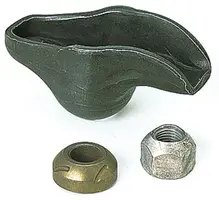
Stock stamped rockers look something like this:
They tend to be mass produced factory pieces, whose ratios can sometimes be less than totally accurate.
Roller Tip Rocker Arms can be of better quality, typically Chromemoly steel and generally have accurate rocker ratios, they look something like this :
While they are less expensive than "real" Roller Rocker Arms, the main benefit of reducing friction in a Roller Rocker arm comes from the roller fulcrum, not at the tip.
Roller Rocker Arms can be made of steel or aluminum, have both a roller tip and fulcrum, typically weigh less "at the valve", and have strong bodies and accurate ratios. These are the most expensive type of Rocke Arm, with the only exception being Shaft mounted roller rockers being more expensive than individual roller rockers. These sexy beasts look something like this:
The way Rocker arms are fastened to the heads are various. They can be bolt down, or stud mounted, adjustable or non-adjustable, and if they are stud mount they are commonly either for 7/16" or 3/8" studs.
Lift is the distance the valve is pushed off of the valve seat, the more lift, the more airflow can enter the cylinder. However, it is not so simple as more lift = more horsepower. You wouldn't want .550+ lift on an otherwise bone stock 5.0, nor would you want the stock rated lift on a radical 347. Many aspects of a camshaft dictate how well it will perform in a specific motor combination, including not only lift, but advertised duration, duration at .050 lift, lobe separation angle, etc.
Headers are the two pieces of tubing (typically with 4 tubes each that merge into a collector) that bolt to your cylinder heads and direct exhaust flow from your cylinders to your midpipe and the rest of the exhaust system.


.jpg)