Mr. Gasket Thermocap Questions

No.11

10 Year Member
Oct 13, 2009
614
10
48
Los Angeles
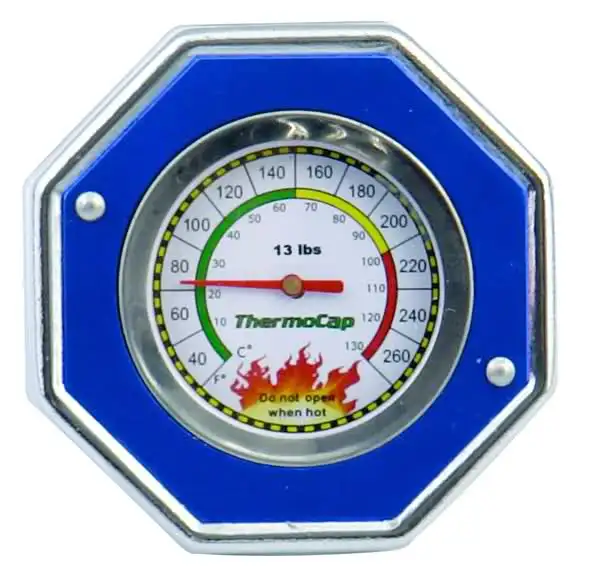
I got the 16 psi version, although the pic shows a 13. Here's a pic for reference:
c7rdt.webp


1. Ok, first, where does it actually measure, say, 180? Does it measure that right in the middle of where it says 180? Or does it measure on one of the lines? Trying to get an accurate reading. EDIT: OK i just answered this question for myself by converting the celcius readings to farenheit. It does indeed indicate the temperature right where it says it, and the lines are increments of 10.

2. Is this an accurate reading of engine temperatures, or is there a large difference between temperatures at the intake and at the radiator? Is this a good alternative to a temp gauge?

3. 2471B fits a 90 fox radiator, right? Seems like this screwed on tight in much less of a turn than the stock cap. Is that right?

4. Last question: At what temperature would you say it is safe to open up the cap?


Thank you!!!
 

Attachments

  • c7rdt.webp
    c7rdt.webp
    19.3 KB · Views: 237
Alright, I myself have wasted money of one of these, so I'll try to help answer your questions. :)

1. Ok, first, where does it actually measure, say, 180? Does it measure that right in the middle of where it says 180? Or does it measure on one of the lines? Trying to get an accurate reading.

I don't think it's meant to be super accurate. It's probably close to 180 when the needle is right in the middle of the 180 section. That's what makes the most sense, anyway.

2. Is this an accurate reading of engine temperatures, or is there a large difference between temperatures at the intake and at the radiator? Is this a good alternative to a temp gauge?

I really don't think it's a very good means of reading ECT, and certainly shouldn't be considered a good alternative to a good aftermarket in-car gauge. Consider that the coolant the radiator cap sees has left the engine, traveled through the upper hose, and across the radiator before it gets to the cap. So, it's going to read lower temps than what the ECT sensor sees, which is of course in the intake manifold.

Also, for times when you'd really like to be able to see ECT, like when you're stuck in traffic, it's not exactly convenient to get out of the car and pop the hood to see exactly what the engine temp is.

3. 2471B fits a 90 fox radiator, right? Seems like this screwed on tight in much less of a turn than the stock cap. Is that right?

Idunno.

4. Last question: At what temperature would you say it is safe to open up the cap?

Whenever steam doesn't rush out while you open it. :D

I'm a tard and I just stick a big rag over the cap and turn it slowly. If I hear it hissing, I tighten the cap back up and let it sit and cool off longer. But that's how people get burnt so...
 
I got the 16 psi version, although the pic shows a 13. Here's a pic for reference:
c7rdt.webp


1. Ok, first, where does it actually measure, say, 180? Does it measure that right in the middle of where it says 180? Or does it measure on one of the lines? Trying to get an accurate reading. EDIT: OK i just answered this question for myself by converting the celcius readings to farenheit. It does indeed indicate the temperature right where it says it, and the lines are increments of 10.

2. Is this an accurate reading of engine temperatures, or is there a large difference between temperatures at the intake and at the radiator? Is this a good alternative to a temp gauge?

3. 2471B fits a 90 fox radiator, right? Seems like this screwed on tight in much less of a turn than the stock cap. Is that right?

4. Last question: At what temperature would you say it is safe to open up the cap?


Thank you!!!


IMHO toss it in the garbage. get a stock cap and an aftermarket gauge if you want more accurate readings. installl the new aftermarket gauge sensor in the oem sensors spot at the front of the intake and if you want the stock gauge to work then move it to the rear where the plug is ( also do a search Jricker gave a diagram for an aftermarket inline temp sensor install also in tech not long ago).


you will be getting lower temp readings for one and for two if it is getting too hot how the heck are you going to know :shrug: it's under the hood. again get a gauge so you can read it from inside the car while you driving/idle, etc and know what is going on.
to answer 4, no good answer for actual temp is safe..right after the car is started :shrug:. once it is up to operating temp and climbing towards it not a good idea. I have run the car with it off to check coolant flow once it reached operating temp, and you can pull the cap warm but I'm going to skip it. you can get a nasty burn and the coolant sticks to you and keeps burning until you finally wash it off or get enough water on it.

Damn NikwoaC you where posting while I was typing, beat me again :flag:
 

Attachments

  • c7rdt.webp
    c7rdt.webp
    19.3 KB · Views: 654
hahaha now that you guys mention it, it does seem kind of silly. and also now that i think about it, they do advertise the temperature as a safety thing, to know when to pull the cap, not as a reading of coolant temps. Thanks to all! I will look into the aftermarket coolant temp gauge.
 
Well the temp at the cap damn better be much lower than operating tempratures or you have a problem. After the coolant (or just water for us hardcore guys) passes through the radiator, you want it to be as cold as possible.

skunk21 said:
IMHO toss it in the garbage. get a stock cap and an aftermarket gauge if you want more accurate readings.

:stupid: Best advise so far.
 
also, is this normal operation for a stock water temp gauge? I know stock ones suck, but should it be fluctuating like this? it did it after a drive during which it was reaching the O, hasn't been getting there lately. I have a cracked lower intake (already got a replacement) and I check and/or refill Whenever I leave the car off long enough to cool down. got a new motorcraft sender on it so that thing is ok.
http://i260.photobucket.com/albums/ii28/no-11/a7aceeaa.mp4
 
Your car drips coolant? I'd be extremely cautious with that, antifreeze is very very lethal even in small doses for animals and humans. Get that fixed ASAP.

As for the video, I can't see it. Won't play for me.
 
Nik, really? crap, not too long ago I got a facefull of antifreeze being stupid and loosening the lower radiator hose to drain coolant. glad I didn't die lol...

I'll upload to YouTube.

thanks 90. I will check the wiring too.
 
Nik, really? crap, not too long ago I got a facefull of antifreeze being stupid and loosening the lower radiator hose to drain coolant. glad I didn't die lol...

I'll upload to YouTube.

thanks 90. I will check the wiring too.

Well, you have to ingest it, AKA, drink it. It's a gruesome process, your body tries to metabolize it as if it's alcohol, so you get a drunk feeling, but what happens is that it forms microscopic crystals in your bloodstream which shred your kidneys and you eventually die.

The funny thing is, the antidote to antifreeze poisoning is... Alcohol. The body will ignore the antifreeze and focus on digesting the alcohol and the antifreeze just kind of passes through and you piss it out. Haha.

Humans can survive larger doses of antifreeze than dogs and cats. For dogs and cats, it literally only takes a few tablespoons worth of fluid for a lethal dose. So keep Lassie away from that puddle.


Yea, that isn't right. Something is wrong with the gauge or the wiring.
 
I had the thermo cap on my stock rad and now on the Mishimoto rad, and I don't
see were the problem is.

I like knowing the temp in my radiators.

No one really stated it was a problem, but there are much better more reliable options. knowing the radiator temp is limited info, a good qaulity temp gauge will provide enough info on what is going on. it can get more technical from there but that isn't what we are discussing.


do search in tech on this but like stated check the ground or add one, common issue and there are alot of fix topics on it. still the stock gauge provides limited info. a good aftermarket gauge like autometer is so very simple to install a monkey could do it.
 
Well, I read someone advice to dump it in the garbage....

I may be alone on this, but I've had all types of cars BMW, Corvettes, T/A, IROC, 4 Mustangs GT, over 40 cars in all. I never had the need for an after market temp gauge.

I'm well aware that the stock gauge on the Mustang is not all that great, but when the car's overheating that gauge will let you know that.
My .02 cents.
 
Well, I read someone advice to dump it in the garbage....

I may be alone on this, but I've had all types of cars BMW, Corvettes, T/A, IROC, 4 Mustangs GT, over 40 cars in all. I never had the need for an after market temp gauge.

I'm well aware that the stock gauge on the Mustang is not all that great, but when the car's overheating that gauge will let you know that.
My .02 cents.

Not looking to get into a back and forth but I'm the one who stated to chuck it into the garbage. I also stated get an aftermarket gauge if "you wanted" a more reliable reading. He can fix the stock the gauge but that cap really doesn't mean or do much of anything. I liked it better when they made stock gauges that displayed the degrees vs this stupid normal range, they even used to give a good amp gauge at one time.

nothing wrong with a good aftermaket gauge though, personal choice but I like to know before it overheats and my stock gauge was running near the red when the car was totally fine or around 205-210* on the aftermarket gauge. so the stocker wasn't something I was betting my money on.

My .02.

:flag: