
I wanna start by saying I dont need a checklist just an opinion of what might be wrong I'm already aware of and am using the checklists for any and all issues. My original issue was an idle of about 2500 that would slowly rise. This occurred after my car suddenly shut off and needed a bit of a battery charge. The alternator tests fine and the battery does as well. It was starting the other day if given gas and now it will only come very close to starting even with gas. My first thought is the TFI or distributor. Do these issues point to anything else to any of you? I tried adjusting the idle as well but it would only rise not fall and I've just had the fuel pump,transmission,clutch,starter, and radiator replaced. Radiator being because it overheated when I first got it. Any help that isn't a link to a checklist would be greatly appreciated.
You are using an out of date browser. It may not display this or other websites correctly.
You should upgrade or use an alternative browser.
You should upgrade or use an alternative browser.
Engine 1988 gt crank no start
- Thread starter Crexun
- Start date

I am the author of the checklists; I am a old guy and have been fixing cars for 52 years. Out of those 52 years the last 26 of have been with 5.0 Fox fuel injected Mustangs. The checklist were written because of several things.
1.) I have no accurate way to measure your capabilities and knowledge as an automotive technician. You maybe someone who should never be allowed near car with any kind of tool, or you may be a skilled hobbyist that just needs some extra guidance and knowledge.
2.) You may overlook something that is the essential clue towards finding and fixing your problem. The checklist procedure helps to reduce that to a minimum.
3.) I am not there to see, hear, inspect, and test what is happening. That means you are the eyes, ears, mind, and hands that will see, test, and diagnose the problem. I have been fixing these cars via the Internet long enough that I can observe and then shorten the checklist considerably. I don't do that because of reason #1; I have no way of measuring you level of competency and no way of eliminating something important that you overlooked or didn't consider important.
I have read your problem description and I can assure you that the answer is in there. Read the checklist. observe, test, diagnose, and eliminate all the things it can't be. Then what is left is what the malfunctioning component can be. Next think about what they do and how they do it.
Sir Joshua Reynolds' famous quotation: "There is no expedient to which a man will not resort to avoid the real labor of thinking."
Good troubleshooting takes time. Everyone seems to be looking for the magic tip that says replace this $13 part and your problems are cured. You don't have to think, dig or diagnose, just buy the part and install it. Unfortunately, it doesn’t work that way 99% of the time.
Thinking is hard work and educated thinking requires much more effort than simple parts swapping. The complexity and age of these 5.0 Mustangs works against that, as well as the number of hands that have “modified” the original design. Sometimes that modification is well done with good workmanship and other times it is mechanical road kill. It is very easy to become the victim of the previous owner’s efforts.
I spend a great deal of time trying to communicate the methodology of structured troubleshooting principles. For those who haven’t been beaten with this stick before, here they are again:
1.) Understand the system. That involves reading some books to get an overall picture of how it works. For 5.0 Mustangs, that list starts with the Chilton shop manual and the Probst book, Ford Fuel Injection & Electronic Engine Control 1988-1993 by Charles Probst :ISBN 0-8376-0301-3.
It's about $32-$45 new, a used copy will be about $20+, see http://www.amazon.com. Select books and then select search. Use the full name or SBN number (without dashes or spaces) to do a search. Use the ISBN number and your local library can get you a loaner copy for free for 2 weeks or so.
For free automotive electrical training, see http://www.autoshop101.com/ . I have personally reviewed the material and it is very good.
Another resource is the following website by Tmoss (diagram designer) & Stang&2Birds (website host) for help on 88-95 wiring: http://www.veryuseful.com/mustang/tech/engine. Study the diagrams and tech articles. There is an amazing amount of good stuff in one place for FREE.
2.) Isolate the problem. You need to be able to break the system down into functional blocks or subsystems. Once you know what subsystem has failed, it is much easier to troubleshoot. Group problem symptoms according to what system controls them.
Don’t look for a fix for ignition problems by adjusting the fuel pressure. Have an organized, step by step, approach to work your way through a subsystem before you quit and go off wildly chasing rabbits. You have three tools to use in your efforts: measure, observe and think!. Use these three tools to narrow down the list of possible failure points into a small, easily managed list of items.
3.) Install the fix. Now that you have a short list of suspected villains, plan your repair efforts so that you do the easy things first. If an item from the easy list didn’t fix your problem, then look at the high failure rate items. Spend some time here on Stangnet and you’ll get an idea of what the most commonly replaced parts are, things like TFI modules, ignition switches and fuel pumps.
If you make a change and it doesn’t relieve the problem symptoms, put it back the way it was. I have a stack of parts from where I swapped a part and it didn’t fix the problem. I put the old part back on the car and the new part went on the shelf. Someday I will either use them or trade them for something else.
1.) I have no accurate way to measure your capabilities and knowledge as an automotive technician. You maybe someone who should never be allowed near car with any kind of tool, or you may be a skilled hobbyist that just needs some extra guidance and knowledge.
2.) You may overlook something that is the essential clue towards finding and fixing your problem. The checklist procedure helps to reduce that to a minimum.
3.) I am not there to see, hear, inspect, and test what is happening. That means you are the eyes, ears, mind, and hands that will see, test, and diagnose the problem. I have been fixing these cars via the Internet long enough that I can observe and then shorten the checklist considerably. I don't do that because of reason #1; I have no way of measuring you level of competency and no way of eliminating something important that you overlooked or didn't consider important.
I have read your problem description and I can assure you that the answer is in there. Read the checklist. observe, test, diagnose, and eliminate all the things it can't be. Then what is left is what the malfunctioning component can be. Next think about what they do and how they do it.
Sir Joshua Reynolds' famous quotation: "There is no expedient to which a man will not resort to avoid the real labor of thinking."
Good troubleshooting takes time. Everyone seems to be looking for the magic tip that says replace this $13 part and your problems are cured. You don't have to think, dig or diagnose, just buy the part and install it. Unfortunately, it doesn’t work that way 99% of the time.
Thinking is hard work and educated thinking requires much more effort than simple parts swapping. The complexity and age of these 5.0 Mustangs works against that, as well as the number of hands that have “modified” the original design. Sometimes that modification is well done with good workmanship and other times it is mechanical road kill. It is very easy to become the victim of the previous owner’s efforts.
I spend a great deal of time trying to communicate the methodology of structured troubleshooting principles. For those who haven’t been beaten with this stick before, here they are again:
1.) Understand the system. That involves reading some books to get an overall picture of how it works. For 5.0 Mustangs, that list starts with the Chilton shop manual and the Probst book, Ford Fuel Injection & Electronic Engine Control 1988-1993 by Charles Probst :ISBN 0-8376-0301-3.
It's about $32-$45 new, a used copy will be about $20+, see http://www.amazon.com. Select books and then select search. Use the full name or SBN number (without dashes or spaces) to do a search. Use the ISBN number and your local library can get you a loaner copy for free for 2 weeks or so.
For free automotive electrical training, see http://www.autoshop101.com/ . I have personally reviewed the material and it is very good.
Another resource is the following website by Tmoss (diagram designer) & Stang&2Birds (website host) for help on 88-95 wiring: http://www.veryuseful.com/mustang/tech/engine. Study the diagrams and tech articles. There is an amazing amount of good stuff in one place for FREE.
2.) Isolate the problem. You need to be able to break the system down into functional blocks or subsystems. Once you know what subsystem has failed, it is much easier to troubleshoot. Group problem symptoms according to what system controls them.
Don’t look for a fix for ignition problems by adjusting the fuel pressure. Have an organized, step by step, approach to work your way through a subsystem before you quit and go off wildly chasing rabbits. You have three tools to use in your efforts: measure, observe and think!. Use these three tools to narrow down the list of possible failure points into a small, easily managed list of items.
3.) Install the fix. Now that you have a short list of suspected villains, plan your repair efforts so that you do the easy things first. If an item from the easy list didn’t fix your problem, then look at the high failure rate items. Spend some time here on Stangnet and you’ll get an idea of what the most commonly replaced parts are, things like TFI modules, ignition switches and fuel pumps.
If you make a change and it doesn’t relieve the problem symptoms, put it back the way it was. I have a stack of parts from where I swapped a part and it didn’t fix the problem. I put the old part back on the car and the new part went on the shelf. Someday I will either use them or trade them for something else.
Last edited:


I will say that every word the 'wizard' has said is true, My self inflicted problems were resolved using the 'surging idle checklist', thats how I came to be a regular here, I jumped around and tried every suggestion that even competent mechanics were sure was the problem and only made things worse and costly, if you are paying a mechanic to fix this then give him the checklist and explain that it will save them time and you money.
I've narrowed it down to the TFI ignition coil or distributor/ cap and rotor I believe. As I said I've been using the checklist to my best ability but without a second set of hands to hold items or press the clutch it's been a slow going and limited process I was just hoping that someone would have had a similar issue. Iger's been unsuccessful at pulling codes as were the mechanics I took it too last year I'm unsure as to why. Other than that I've tested ever electrical system I could and have been combing through every ignition related thread to find if anyone else has issues. I appreciate the responses and the checklists you've made as they are obviously invaluable resources but I'm currently at my limit without another physical body as far as I'm aware. So I'll just be replacing the cap, rotor, and tfi today and hoping for a change.
You say you have not been able to get the computer to spit out codes?
Go back to the section of the checklist that deals with checking for codes, make sure you are using the correct procedure, if you still can't get codes you may have a problem with the computer it self.
Go back to the section of the checklist that deals with checking for codes, make sure you are using the correct procedure, if you still can't get codes you may have a problem with the computer it self.
I'm fairly certain there is a computer issue as I've not only followed the instructions I also found a video to insure I was not crazy and all the lest light does is stay on no flashing whatsoever.

Boostedpimp
20+ Year Stangneter 
I don't think these things going bad or being defective would cause an idle of 2500 and cause it to slowly rise.I've narrowed it down to the TFI ignition coil or distributor/ cap and rotor I believe.
Nah I'm sure that's a different problem that I'll have to figure out once I can start it again. That's how this  box likes to treat me.
box likes to treat me.While I'm at it would you guys reccomend a MAF conversion if I do have to replace the computer? I'm not sure whether speed density is less reliable or not.
Boostedpimp
20+ Year Stangneter
While I'm at it would you guys reccomend a MAF conversion if I do have to replace the computer? I'm not sure whether speed density is less reliable or not.
I personally would leave it alone right now and focus on ironing out the issues you currently have. Also if the car is pretty much stock no need to swap to mass air, speed density is fine unless you are going to be swapping in a non speed density friendly cam in the future.
The maf swap depends on what your plans are with this car. Get it to run correctly before you add stuff, then we can help you with the go-faster stuff.
Alright cool. I'm pretty sure I have an aftermarket cam as when it's running right it idles at about 1500 steadily and happily with a big ol lump a lump sound. Kinda like a 65 but way louder. Will update when I put on TFI and new cap and rotor

That's exactly how I feel. Tried to get as much info as I could from the kids I bought it from but they were either clueless or just plain assholes. Either way they've been of no help so I've been tinkering and swearing for about a year now pretty much blind as a bat.
@Crexun
The first step is to get the computer to dump the codes. Without the diagnostic information that is stored in the computer, you are just shooting in the dark trying to hit a moving target.
If you are positive that you have the test light or Eqqus scanner connected up properly and you get no codes, the next step is to check the computer & wiring.
Computer will not go into diagnostic mode on 86-90 models 5.0 Mustangs .
Revised Dec 23 2107
1.) To clarify signal ground connections on the engine mounted fuel injector wiring harness and add diagram for the engine mounted fuel injector wiring harness
2.) To add warning about using an automatic transmission O2 sensor wiring harness with a A9L manual shift transmission computer.
]b]Disconnect the battery positive terminal before making any resistance checks.
The voltage drop in the ground cable will cause incorrect resistance readings.[/b]
How it is supposed to work:
The black/white wire (pin 46) is signal ground for the computer. It provides a dedicated ground for the EGR, Baro, ACT, ECT, & TPS sensors as well as the ground to put the computer into self test mode. If this ground is bad, none of the sensors mentioned will work properly. That will severely affect the car's performance. You will have hard starting, low power and drivability problems. Since it is a dedicated ground, it passes through the computer on its way to the computer main power ground that terminates at the battery pigtail ground. It should read less than 1.5 ohms when measured from any signal ground on the engine mounted fuel injector harness with the battery pigtail ground as the other reference point for the ohmmeter probe.
Engine mounted fuel injector wiring harness sensors for a 5.0 mustang
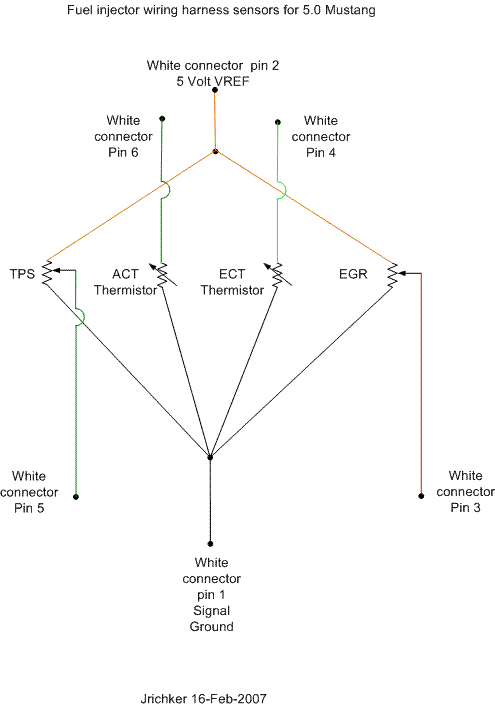
What sometimes happens is that the test connector black/white wire gets jumpered to power which either burns up the wiring or burns the trace off the pc board inside the computer. That trace connects pins 46 to pins 40 & 60.
OR
If an O2 sensor harness from an automatic transmission Mustang is used with an A9L manual shift transmission computer. The 12 volts from the automatic transmission starter circuit will damage the A9L computer.
The STI (Self Test Input) is jumpered to ground to put the computer into test mode. Jumpering it to power can produce unknown results, including damage to the computer. The ohm test simply verifies that there are no breaks in the wiring between the test connector and the computer input.
How to test the wiring:
With the power off, measure the resistance between the computer test ground (black/white wire) on the self test connector and battery ground. You should see less than 1.5 ohms.

If that check fails, remove the passenger side kick panel and disconnect the computer connector. There is a 10 MM bolt that holds it in place. Measure the resistance between the black/white wire and pin 46 on the computer wiring connector: it should be less than 1.5 ohms. More than 1.5 ohms is a wiring problem. If it reads 1.5 ohms or less, then the computer is suspect. On the computer, measure the resistance between pin 46 and pins 40 & 60: it should be less than 1.5 ohms. More than that and the computer’s internal ground has failed, and the computer needs to be repaired or replaced.
While you have the computer connector disconnected from the computer, turn the ignition switch to the Start position and look for 12 volts on pin 46 of the computer wiring harness. If you see 12 volts then you have an automatic transmission O2 sensor harness. That will damage the A9L manual shift transmission computer.
See http://www.stangnet.com/mustang-forums/749974-computer-issue.html#post7490537 for Joel5.0’s fix for the computer internal signal ground.
If the first ground check was good, there are other wires to check. Measure the resistance between the STI computer self test connector (red/white wire) and pin 48 on the computer main connector: it should be less than 1.5 ohms. More than 1.5 ohms is a wiring problem
The following is a view from the computer side of the computer wiring connector: it is for an A9L, A9P computer.
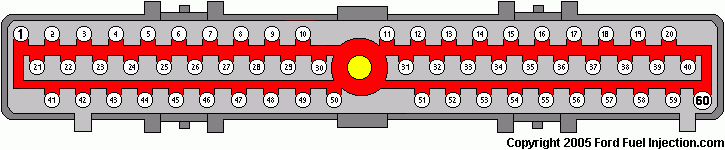
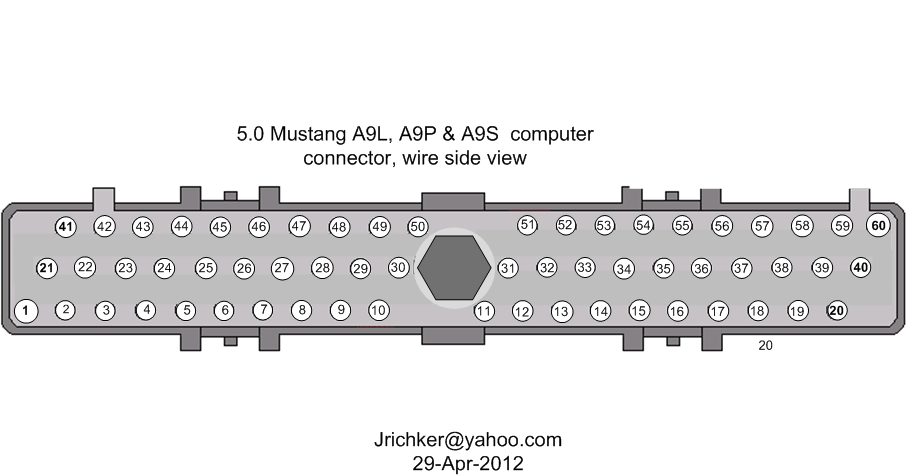
Diagram courtesy of Tmoss & Stang&2birds
Check out the diagram and notice all the places the black/white wire goes. Almost every sensor on the engine except the MAF is connected to it.
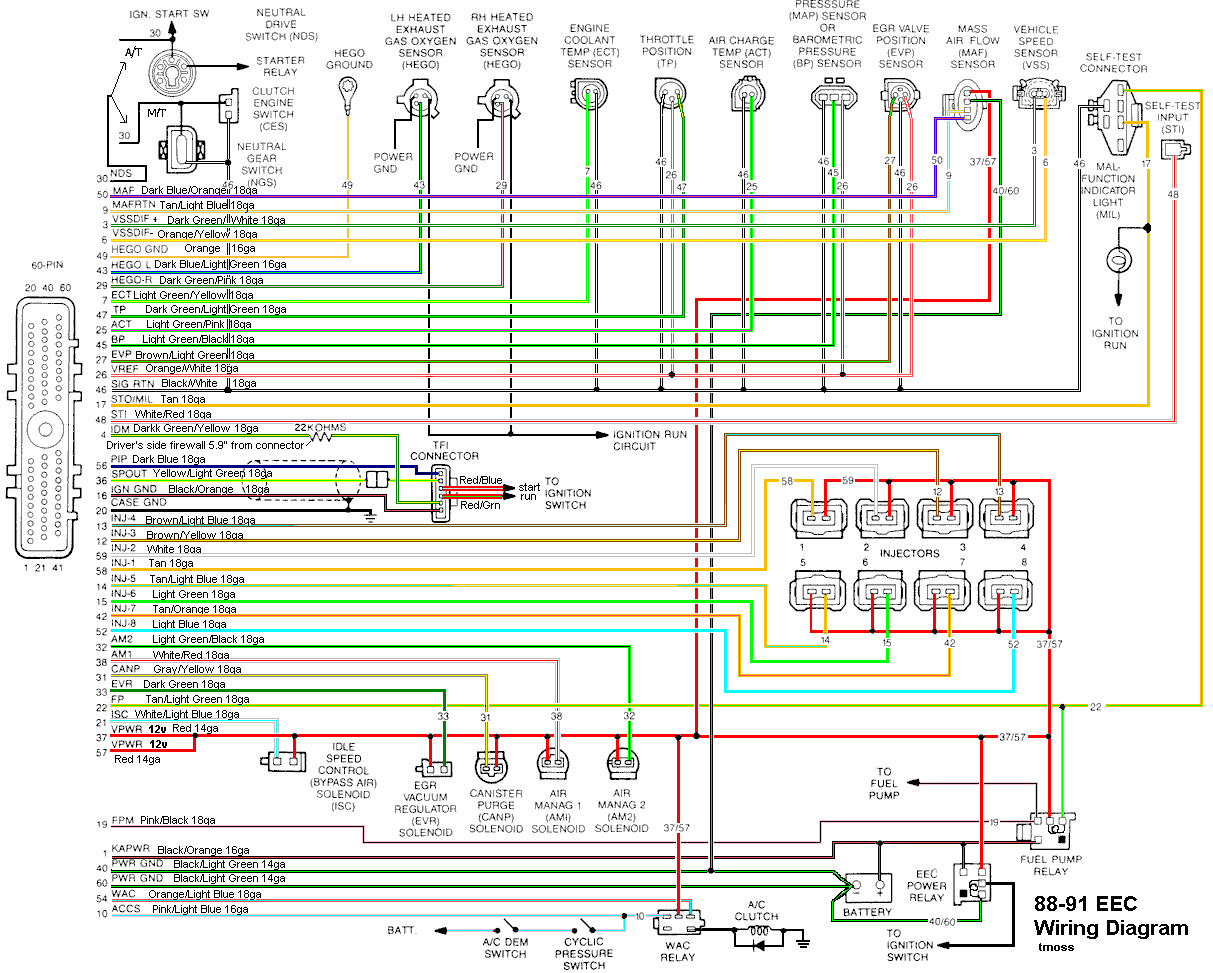
See the following website for some help from Tmoss (diagram designer) & Stang&2Birds
(website host) for help on 88-95 wiring http://www.veryuseful.com/mustang/tech/engine
See the graphic for the 10 pin connector circuit layout.
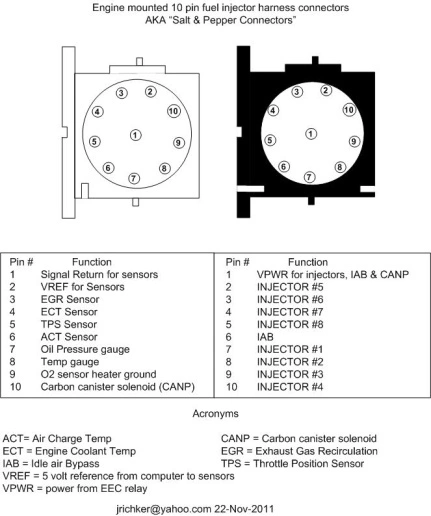
The first step is to get the computer to dump the codes. Without the diagnostic information that is stored in the computer, you are just shooting in the dark trying to hit a moving target.
If you are positive that you have the test light or Eqqus scanner connected up properly and you get no codes, the next step is to check the computer & wiring.
Computer will not go into diagnostic mode on 86-90 models 5.0 Mustangs .
Revised Dec 23 2107
1.) To clarify signal ground connections on the engine mounted fuel injector wiring harness and add diagram for the engine mounted fuel injector wiring harness
2.) To add warning about using an automatic transmission O2 sensor wiring harness with a A9L manual shift transmission computer.
]b]Disconnect the battery positive terminal before making any resistance checks.
The voltage drop in the ground cable will cause incorrect resistance readings.[/b]
How it is supposed to work:
The black/white wire (pin 46) is signal ground for the computer. It provides a dedicated ground for the EGR, Baro, ACT, ECT, & TPS sensors as well as the ground to put the computer into self test mode. If this ground is bad, none of the sensors mentioned will work properly. That will severely affect the car's performance. You will have hard starting, low power and drivability problems. Since it is a dedicated ground, it passes through the computer on its way to the computer main power ground that terminates at the battery pigtail ground. It should read less than 1.5 ohms when measured from any signal ground on the engine mounted fuel injector harness with the battery pigtail ground as the other reference point for the ohmmeter probe.
Engine mounted fuel injector wiring harness sensors for a 5.0 mustang
What sometimes happens is that the test connector black/white wire gets jumpered to power which either burns up the wiring or burns the trace off the pc board inside the computer. That trace connects pins 46 to pins 40 & 60.
OR
If an O2 sensor harness from an automatic transmission Mustang is used with an A9L manual shift transmission computer. The 12 volts from the automatic transmission starter circuit will damage the A9L computer.
The STI (Self Test Input) is jumpered to ground to put the computer into test mode. Jumpering it to power can produce unknown results, including damage to the computer. The ohm test simply verifies that there are no breaks in the wiring between the test connector and the computer input.
How to test the wiring:
With the power off, measure the resistance between the computer test ground (black/white wire) on the self test connector and battery ground. You should see less than 1.5 ohms.
If that check fails, remove the passenger side kick panel and disconnect the computer connector. There is a 10 MM bolt that holds it in place. Measure the resistance between the black/white wire and pin 46 on the computer wiring connector: it should be less than 1.5 ohms. More than 1.5 ohms is a wiring problem. If it reads 1.5 ohms or less, then the computer is suspect. On the computer, measure the resistance between pin 46 and pins 40 & 60: it should be less than 1.5 ohms. More than that and the computer’s internal ground has failed, and the computer needs to be repaired or replaced.
While you have the computer connector disconnected from the computer, turn the ignition switch to the Start position and look for 12 volts on pin 46 of the computer wiring harness. If you see 12 volts then you have an automatic transmission O2 sensor harness. That will damage the A9L manual shift transmission computer.
See http://www.stangnet.com/mustang-forums/749974-computer-issue.html#post7490537 for Joel5.0’s fix for the computer internal signal ground.
If the first ground check was good, there are other wires to check. Measure the resistance between the STI computer self test connector (red/white wire) and pin 48 on the computer main connector: it should be less than 1.5 ohms. More than 1.5 ohms is a wiring problem
The following is a view from the computer side of the computer wiring connector: it is for an A9L, A9P computer.
Diagram courtesy of Tmoss & Stang&2birds
Check out the diagram and notice all the places the black/white wire goes. Almost every sensor on the engine except the MAF is connected to it.
See the following website for some help from Tmoss (diagram designer) & Stang&2Birds
(website host) for help on 88-95 wiring http://www.veryuseful.com/mustang/tech/engine
See the graphic for the 10 pin connector circuit layout.
Boostedpimp
20+ Year Stangneter
@Crexun
Save yourself the money of throwing parts at this car without knowing what the problems are. You need to skip the ignition parts and focus on getting the codes for a starting point. You will need to use a test light or scanner like mentioned below.
It could be as simple as a bad map sensor or a serious vacuum leak but you won't know unless you start dumping those codes.
Save yourself the money of throwing parts at this car without knowing what the problems are. You need to skip the ignition parts and focus on getting the codes for a starting point. You will need to use a test light or scanner like mentioned below.
It could be as simple as a bad map sensor or a serious vacuum leak but you won't know unless you start dumping those codes.
@Crexun
The first step is to get the computer to dump the codes. Without the diagnostic information that is stored in the computer, you are just shooting in the dark trying to hit a moving target.
If you are positive that you have the test light or Eqqus scanner connected up properly and you get no codes, the next step is to check the computer & wiring
Yeah I'm gonna keep trying to pull codes but I already have a new cap and rotor so may as well put em in. I'm hoping that it was sudden mechanical failure like everything else has been so far is all but I doubt I'm that lucky. Is 1500 a normal idle for an aftermarket can or is that also something I should worry about?
You do that and we will revoke your membership!
Unless of course it's just used for winter time beer runs.
Unless of course it's just used for winter time beer runs.
Similar threads
- Replies
- 10
- Views
- 351


- Replies
- 6
- Views
- 250
- Replies
- 12
- Views
- 283

- Replies
- 16
- Views
- 772
