1994 GT 5.0L crank no start

Hoping the forum gods can help me out here, I've exhausted the internet searching for hints and been through jrichker's crank-no-start troubleshooting guide (revision 26-Jul-2017) a dozen times and still coming up with nothing. Any further insights or hints as to what I might have missed would be greatly appreciated. Detailed testing results included below.

I bought this car not running, and have no idea what the back story is. New parts first, I've replaced the fuel filter, starter, battery, and fuel pressure regulator. The car came with a spare ignition coil, distributor, computer, and TFI module (all tried, no change). Somebody has spent time troubleshooting this before me but to what end I don't know. Everything under the hood appears to be stock, confirmed factory heads and camshaft, engine block date code indicates 1994-95. Somebody did delete the salt and pepper shakers but the wiring is extremely neat and appears well done, but I have not unwound the loom to check it myself.

I have spark, as confirmed by an inline spark tester and by holding a loose plug near the block, nice fat spark. I have approximately 90psi of fuel pressure when the fuel pump primes and it levels off around 40psi after sitting for a few minutes as measured by a fuel pressure gauge. I have pulse to the fuel injectors as confirmed by my fuel injector tester. I have confirmed the camshaft, timing gears, timing chain are all in correct alignment as per countless posts and YouTube videos. I found top dead center watching the valves, top of compression stroke, all timing dots in alignment, dizzy pointing at the distributor cap #1 terminal. Plug wires are in 1-3-7-2-6-5-4-8 order, plugs 1-4 are front to back on the passenger side and 5-8 on the driver side. Cranking RPMs are 225 as measured by an optical tach on the crankshaft. I have checked engine grounds are all in place, added a few more for good measure, ground tested good at ECU pins 40 and 60. TPS voltage 0.99v. Only code offered by the computer is 1-1-1 systems pass.

Engine cranks fine, sounds good, but zero life. It isn't even trying to catch, even with irresponsible amounts of ether applied and the throttle open.

Anyone have additional thoughts? What have I missed? What should I test again? Thanks!
 
ECU could be the culprit. Hard to believe you are not getting a ECT code with the motor not being up to operating temp.

Also, 0.99v at the TPS is a myth. Do a search here and we have brought this up multiple times. 0.99 is fine so don’t feel like you need to reset it just more of an FYI.
 
Thank you much for the reply! So in what way can the ECU be involved if it is delivering pulse to the injectors? It would seem that I have all the magic ingredients for combustion. The ECU is capable of displaying other codes, I get 3-2-7 for instance if I intentionally disconnect the EGR widget, but with everything connected it is just 1-1-1

Just in case it might be helpful to anyone, here are two quick videos. The first is the ECU flashing out 1-1-1, just in case I am reading it wrong, and the second is the engine attempting to crank, spark tester, fuel injector testor, and fuel pressure gauge all connected.

ECU 1-1-1

Engine Cranking

Thanks!
 
What ECC is installed in the car?

Are there any, "chips" sticking out of the back?

What do you have base timing set to?


Of course the "Salt and Pepper Shaker" thing is suspect but it should be easy enough for you to test through those connections without tearing all apart. I would look into this first. Checkout www.veryuseful.com/mustang for diagrams.


Like AeroCoupe, I also suspect the EEC and the only way to rule it out is to send it in. Fortunately, you have two so: https://www.theecuexchange.com/product/ford-mustang-5-0-a9l-a9p-c3w-a3m-x3z-ecu-repair-service/50

Over the last year, I've lost count of how many of these have turned out needing [something]. This appears to be about how long they last.
 
No chips sticking out the back of either ECC, both are T4M0's. One has a date code of late '93 which I assume is factory to the car and the other has a '95 date code. Base timing is set at zero degrees right now, which I know is not optimal, but I think it should be able to crank at zero degrees, right? Thanks for the link to diagrams, I've been using those along the way and haven't found anything in particular amiss but I've only checked 4 or 5 specific connectors thus far.

Looking at the video I posted, it is hard to see the spark tester but it flashes once per revolution (duh), the fuel injector tester is indicating the injectors are pulsing MUCH faster than once per rev, is that normal? Anything else I can test ECU wise before sending it off? I do appreciate the link to a reputable shop for service.

So I did do a compression test using a "free" rental tool from AutoZone and it came up at 60psi.... dead... on every cylinder. I tested as described in the service manual with all spark plugs removed and verified a minimum of 180 RPM for the test... I just don't buy it. If compression is low I'd expect variance from cylinder to cylinder or left to right side of the engine. I tested a second time with the rockers removed, so all valves closed, same readings. I question if the tool is bad so I'm going to return that and go find a second for comparison. Visually the heads appear to be in great shape, springs all look fine, none of the pistons have gaping holes in them, head gaskets are new, bolts torqued to manual spec with a known good torque wrench.

Thanks all for the input!
 
Were the plugs wet?
Crank for 15 seconds throttle closed, check a couple plugs, note condition.
Crank for 15 seconds with throttle wide open, pull plug note condition.
Report back.
I agree with abovementioned timing advance method, try that too.
 
I only had a few minutes but with someone else cranking I loosened the retaining bolt and rotated the distributor cap clockwise, slowly, listening for any change in cranking... eh, not much, and certainly no sign of catching. Tried with ether and without, no difference. Spark tester indicating I had spark and fuel pressure was solid.

After this cranking I pulled a few plugs. Plug 6 in particular was definitely wet, plugs 2 and 3 appeared dry. Using the injection tester I was able to hear and feel injector 2 pulse when operating it manually, I should probably check the remaining plugs individually.

Was a bit rushed tonight, will do more thorough testing tomorrow. New compression gauge is on the way, should be here Friday.

Thank you all.
 
What ECC is installed in the car?

Are there any, "chips" sticking out of the back?

What do you have base timing set to?


Of course the "Salt and Pepper Shaker" thing is suspect but it should be easy enough for you to test through those connections without tearing all apart. I would look into this first. Checkout www.veryuseful.com/mustang for diagrams.


Like AeroCoupe, I also suspect the EEC and the only way to rule it out is to send it in. Fortunately, you have two so: https://www.theecuexchange.com/product/ford-mustang-5-0-a9l-a9p-c3w-a3m-x3z-ecu-repair-service/50

Over the last year, I've lost count of how many of these have turned out needing [something]. This appears to be about how long they last.
It'd the ecu I bet..I have bought 3 of them now my car won't start again again first time it was the pip now I have a short some place I can't find it I stuck
 
Great questions, keep'em coming.

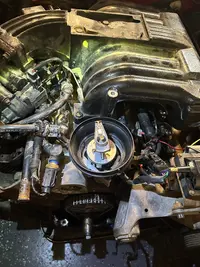
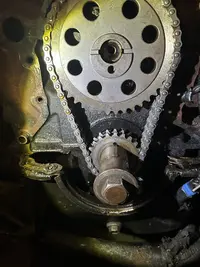
Here are pictures I just took of the cap, rotor, and timing chain. Valve cover is off so TDC was located by watching exhaust valve close, intake open, intake close, and then bringing the piston up to top, verified by an endoscope, and the timing chain dots all line up. I have the dizzy centered on the #1 terminal. Forum posts elsewhere conflicted as to if it should be centered or the center of terminal should be in line with left edge of rotor, I've tried both.

No idea how many miles are on these injectors. The ODO on the dash shows 686 miles.... which makes zero sense, I assume the cluster has been replaced at some point. I have not cleaned or flow tested the injectors. What I did do was confirm they are pulsing by unbolting the lower intake and separated it from the block by about two inches, it was a bit wonky but was able to leave the fuel lines connected and reinstall the distributor. With the coil disconnected from the distributor I we cranked the engine and the injectors were clearly spraying fuel (all over the place).

I haven't smelled gas in the garage, at least not very strong. The car is back down on the ground, next time I pick it up I'll do a quick sniff test on the exhaust, which is currently nothing more than long tube headers.

New compression gauge should be delivered tomorrow. Once it is here I'll get new compression readings and report back.
 

Attachments

  • cap.webp
    cap.webp
    628.2 KB · Views: 70
  • dizzy.webp
    dizzy.webp
    679.3 KB · Views: 68
  • timing chain.webp
    timing chain.webp
    467.3 KB · Views: 63
  • Like
Reactions: Mcmahst
Had some time over the weekend and a new compression tester. Tested 4 of 8 cylinders, two on either side, and I'm getting 50-55 PSI across the board. Having no idea what the back story is on this engine, or any clue as to how many miles are on it, I'm not sure what to make of this. The head gaskets are new and head bolts torqued to spec. I took the exhaust rockers off two cylinders just to test and that made no difference.

This was a dry test on a cold engine, both of which can lower the numbers, but not that low, right? Is there any other common factor that could be the source of multiple cylinders with low compression or is my testing somehow invalidated?
 
You can get a leak down tester from most parts stores as a rental tool. As mentioned YouTube is your friend. If you have low compression numbers then you always follow up with a leak down to help diagnose the problem.

Typically a compression test is done with the engine at operating temperature. A hot test will provide that actual compression of the cylinder as things have heated up and expanded. A cold engine test will exaggerate issues like bad rings.

Good thread on it here:

 
I bought a leak down test tool. Cold engine, dry or wet with WD40, each cylinder being tested at TDC, tried with and without pushrods installed, didn't matter, really rapid leak down into the crankcase. Its so bad that at this point I wonder if there are piston rings at all. I've got the top end of the motor off, the front accessories off, I'm going to go ahead and just yank the block out and start pulling pistons. Looking at the cylinder walls with the heads off I don't see any scoring or signs of damage, the motor looks good from what I can see.

Thanks all, I'll report back with what I find.
 
When you pull the heads of there is a lip on the cylinder at the top then I would say just worn out. Bonus then it’s a rebuild and something may have kept the rings from seating. If that’s the case then hone it and throw a set of rings in it and see what happens.
 
Finally back to turning wrenches on this project. Pulled the motor, fully disassembled now. The piston rings are hopelessly seized on every single piston. The pistons were not seized in the cylinders, cylinders look great, but the two compression rings on every piston are absolutely bound like hell in place. I only tried one oil ring, I had to destroy it to get it off but it came off. The only ring I've managed to remove came off in 2 inch pieces with about an inch still bound in the slot and that was using a flathead screwdriver and entirely too much anger with a hammer.

I've tried soaking for days in a 50/50 ATF/Acetone mix. I've heated it with a MAPP torch. One is soaking in Sea Foam now. I feel like the rings are almost pressed into place, not corroded. Wrong rings installed? I have a brand new set of rings ready to install but I gotta get these old ones out first. I have a metal lathe but not a parting tool that slender and doubt it wouldn't shatter if I did.

Any other ideas how to free these piston rings?

Thanks!