

You are using an out of date browser. It may not display this or other websites correctly.
You should upgrade or use an alternative browser.
You should upgrade or use an alternative browser.
Fox Xtremely high fuel consumption
- Thread starter PonyGTrider
- Start date

gkomo
now i can hopefully expect to receive the shaft
Well your new plugs definitely don't look like they showing a rich condition. Wonder if you should do a full tank with these plugs then report back mileage. 8 miles may not be enough to get a good idea of mileage.

86HO5.0
Active Member

If you are not running a tune the ECU is expecting 39 psig with the vacuum disconnected off the regulator and the line plugged. Once you have set it to that then unplug the line and reconnect. It should drop a little bit with the vacuum line connected and then rise as rpm’s go up but not go past the set point of the regulator.
All the 84 octane rating is going to do is lower the threshold for detonation. Has very little to do with fuel mileage.
All the 84 octane rating is going to do is lower the threshold for detonation. Has very little to do with fuel mileage.

Generally speaking, it should be set to 39psi with the vacuum line removed. Raising it is an old trick that eventually the computer learns and just reduces pulse width to compensate.That would be with a stock engine and stock cam wouldn’t it?
Fuel pressure in my engine runs at 40+ with vacuum off and with my stage 1 cam only drops to ~39 with vacuum line connected.
Am I doing this thing wrong???? What do I supposed to have my pressure set with my set up???? All my specs are in my signature or profile
There are a few things that stick out to me here.
-You said it's a stock regulator which aren't adjustable. If you FP is high there is a reason. You'll need to troubleshoot that.
-No change w/ vacuum on or off. Fuel pressure should drop approximately 1/2 of your engine vacuum when the line is attached. You want to measure actual engine vacuum with a hand held vac pump / guage and take a reading. You should be around 14" vacuum with that cam. Maybe a little less. If your base FP is 39, your FP should drop by 7 psi when the vac line is connected. So you should be seeing about 32 psi at idle.
I'm not saying this is your be all end all. But it is an issue that needs to he addressed. Then move on to the next thing you find.
Take the line off your regulator and smell it. They often leak fuel into the vac line when the diaphragm goes bad.

All the 84 octane rating is going to do is lower the threshold for detonation. Has very little to do with fuel mileage.
Wut He Sed
Yes I agree and that’s what I’m intending to do. I removed them just to see any rich/lean condition at WOT but I’ll install them back in the cylinders they came out and leave them there for a full fuel tank and see what they tell us.Well your new plugs definitely don't look like they showing a rich condition. Wonder if you should do a full tank with these plugs then report back mileage. 8 miles may not be enough to get a good idea of mileage.
Ok so to start I have never seen 14 inches of vacuum out of this cam. At idle I measure 10.5 - 11 inches at the most all the time, unless I have a massive vacuum leak and believe me I have never found one.Generally speaking, it should be set to 39psi with the vacuum line removed. Raising it is an old trick that eventually the computer learns and just reduces pulse width to compensate.
There are a few things that stick out to me here.
-You said it's a stock regulator which aren't adjustable. If you FP is high there is a reason. You'll need to troubleshoot that.
-No change w/ vacuum on or off. Fuel pressure should drop approximately 1/2 of your engine vacuum when the line is attached. You want to measure actual engine vacuum with a hand held vac pump / guage and take a reading. You should be around 14" vacuum with that cam. Maybe a little less. If your base FP is 39, your FP should drop by 7 psi when the vac line is connected. So you should be seeing about 32 psi at idle.
I'm not saying this is your be all end all. But it is an issue that needs to he addressed. Then move on to the next thing you find.
Take the line off your regulator and smell it. They often leak fuel into the vac line when the diaphragm goes bad.
As to why I have that much fuel pressure I just can’t tell you other than because of those low vacuum number, the fuel return line is free with no blockage and as far as fuel pressure regulator diaphragm is intact. In fact I have two good regulators and either one I use there is no fuel smell coming out of the vacuum port.

How the he'll is he runs by 84 octane and 16 degrees of timing? And he said no knocking??????
I'm gonna call something smells fishy hear.
I'm gonna call something smells fishy hear.
86HO5.0
Active Member
Well I guess we should ask where in Mexico he lives( average elevation is 3,900 ft.) Some places could be 10,00 ft.
And higher elevation does kill fuel milage......
And higher elevation does kill fuel milage......
yeah that’s a big factor, I’m at 5,200 ft….Well I guess we should ask where in Mexico he lives( average elevation is 3,900 ft.) Some places could be 10,00 ft.
And higher elevation does kill fuel milage......
86HO5.0
Active Member
That explains the octane/lack of pinging. It also explains a portion of the poor MPG, but not all of it IMO.
Let me explain what I'm seeing and maybe others will see it too:
This is an image from another thread on this forum. In this case, the member was getting oil in the intake. I'm not certain what he was trying to discover by putting a single platinum plug in the engine but... It helps to illustrate a point:
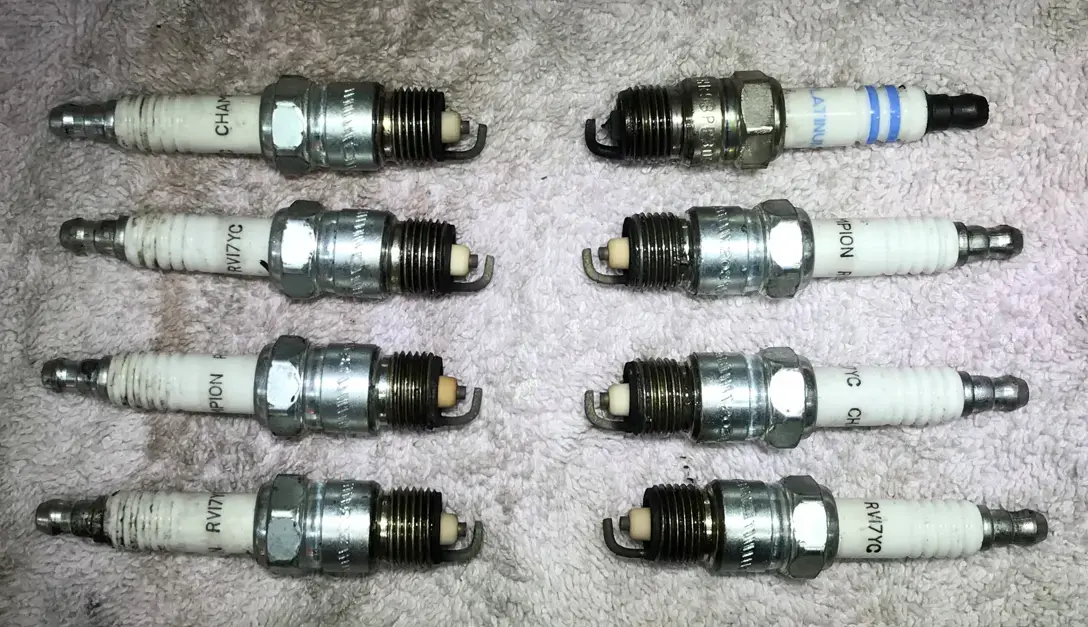
You can see the soot from the oil the ring and threads on all the plugs but only the platinum plug failed. It just wasn't getting the combustion mixture ignited like the copper plugs were with their big ole' fat electrodes and already [hot] OEM ignition coil. That small, condensed spark just wasn't getting it done.
The modification to these plugs attempts to accomplish a similar thing:
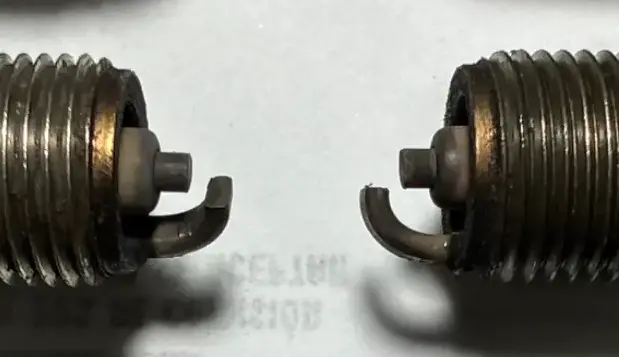
It condenses the spark to smaller surface area to increase the intensity of the spark. You can even see the aprk is concentrating on these electrodes.
Windsor engines to not respond well to this. You can do a search of the Fox section or Google or Youtube about how Platinum, Iridium, etc... spark plugs act in our engines.
So, let's assume for a moment that combustion is not being fully ignited or is starting so small that the exhaust valve is opening before combustion is complete. 16 degrees of initial timing supports this idea too. This is the head-start these plugs need to be fat enough to run well.
Then there is the enrichment issue:
An engine is an air-pump. It is a car guy cliché.
O2 sensors do not read raw fuel. They do not sense combustion fumes or fuel density. They detect free oxygen. So, the EEC sees all of this free oxygen in this unburned exhaust gas and does what? Enrichens to fuel to compensate for all of the free air it's finding. And narrowband sensors? It is [low] [off] [high]. It is essentially just a switch.
This is why I keep beating the podium on these plugs. You need to give it all a chance to have a reaction.
Let them new plugs chew for a bit. Give the EEC time figure out the new surroundings. The O2 sensors may have taken a beating sitting in that exhaust for a while but let's see what they say.
"She only needs what she needs, fellers." ~Derick Biere (I dunno how to spell it. The Vice Grip Garage guy)
This is an image from another thread on this forum. In this case, the member was getting oil in the intake. I'm not certain what he was trying to discover by putting a single platinum plug in the engine but... It helps to illustrate a point:
You can see the soot from the oil the ring and threads on all the plugs but only the platinum plug failed. It just wasn't getting the combustion mixture ignited like the copper plugs were with their big ole' fat electrodes and already [hot] OEM ignition coil. That small, condensed spark just wasn't getting it done.
The modification to these plugs attempts to accomplish a similar thing:
It condenses the spark to smaller surface area to increase the intensity of the spark. You can even see the aprk is concentrating on these electrodes.
Windsor engines to not respond well to this. You can do a search of the Fox section or Google or Youtube about how Platinum, Iridium, etc... spark plugs act in our engines.
So, let's assume for a moment that combustion is not being fully ignited or is starting so small that the exhaust valve is opening before combustion is complete. 16 degrees of initial timing supports this idea too. This is the head-start these plugs need to be fat enough to run well.
Then there is the enrichment issue:
An engine is an air-pump. It is a car guy cliché.
O2 sensors do not read raw fuel. They do not sense combustion fumes or fuel density. They detect free oxygen. So, the EEC sees all of this free oxygen in this unburned exhaust gas and does what? Enrichens to fuel to compensate for all of the free air it's finding. And narrowband sensors? It is [low] [off] [high]. It is essentially just a switch.
This is why I keep beating the podium on these plugs. You need to give it all a chance to have a reaction.
Let them new plugs chew for a bit. Give the EEC time figure out the new surroundings. The O2 sensors may have taken a beating sitting in that exhaust for a while but let's see what they say.
"She only needs what she needs, fellers." ~Derick Biere (I dunno how to spell it. The Vice Grip Garage guy)

Thank you for this whole explanation. I modified those spark plugs like three weeks ago following a claim that you have better combustion with side gap plugs, and I did this as another way trying to better my pathetic fuel economy but it didn’t help a bit.Let me explain what I'm seeing and maybe others will see it too:
This is an image from another thread on this forum. In this case, the member was getting oil in the intake. I'm not certain what he was trying to discover by putting a single platinum plug in the engine but... It helps to illustrate a point:
You can see the soot from the oil the ring and threads on all the plugs but only the platinum plug failed. It just wasn't getting the combustion mixture ignited like the copper plugs were with their big ole' fat electrodes and already [hot] OEM ignition coil. That small, condensed spark just wasn't getting it done.
The modification to these plugs attempts to accomplish a similar thing:
It condenses the spark to smaller surface area to increase the intensity of the spark. You can even see the aprk is concentrating on these electrodes.
Windsor engines to not respond well to this. You can do a search of the Fox section or Google or Youtube about how Platinum, Iridium, etc... spark plugs act in our engines.
So, let's assume for a moment that combustion is not being fully ignited or is starting so small that the exhaust valve is opening before combustion is complete. 16 degrees of initial timing supports this idea too. This is the head-start these plugs need to be fat enough to run well.
Then there is the enrichment issue:
An engine is an air-pump. It is a car guy cliché.
O2 sensors do not read raw fuel. They do not sense combustion fumes or fuel density. They detect free oxygen. So, the EEC sees all of this free oxygen in this unburned exhaust gas and does what? Enrichens to fuel to compensate for all of the free air it's finding. And narrowband sensors? It is [low] [off] [high]. It is essentially just a switch.
This is why I keep beating the podium on these plugs. You need to give it all a chance to have a reaction.
Let them new plugs chew for a bit. Give the EEC time figure out the new surroundings. The O2 sensors may have taken a beating sitting in that exhaust for a while but let's see what they say.
"She only needs what she needs, fellers." ~Derick Biere (I dunno how to spell it. The Vice Grip Garage guy)
I’ll keep your comment as it has good valuable information
I agree, I think is more to it and need to find more answers.That explains the octane/lack of pinging. It also explains a portion of the poor MPG, but not all of it IMO.
Well don’t know what to tell youHow the he'll is he runs by 84 octane and 16 degrees of timing? And he said no knocking??????
I'm gonna call something smells fishy hear.
But yes I was running 16 degrees BTDC without pinging. Now I’m at 14 and yesterday I did a few WOT sprints and zero pinging. Tomorrow I will back down two more degrees and will see how it responds. But nothing fishy at all 5,200ft of altitude.
Thank you for this whole explanation. I modified those spark plugs like three weeks ago following a claim that you have better combustion with side gap plugs, and I did this as another way trying to better my pathetic fuel economy but it didn’t help a bit.
I’ll keep your comment as it has good valuable information
I would hazard to guess you looked at the other ignition component in those same travels?
I guess I overlooked that oneI would hazard to guess you looked at the other ignition component in those same travels?

I'm sorry I missed that and glad others saw it. A lot is still not adding up, but yes, something is wrong if you're at 39 psi plugged in. This is likely already over fueling by ~10%. The computer should be able to trim that much back out, but with everything else going on, there's n9 telling WITHOUT A QUARTERHORSE or another way to tap into the EEC.
Also, what your plugs are doing at WOT is of very little concern. The EEC's fueling strategy uses a different table at WOT than at part throttle & cruise. Your vacuum should be reducing fuel pressure at cruise. Your computer also uses the elevation maps for fuel calculations. Again, we could see this in a datalog.
Stop screwing around with plug modifications. .045-.055" gap, and unless we've got others using those plugs without issue, but cheap copper autolite 3924s cannot be wrong with a TFS Twisted Wedge.
Back the timing down. They run damn near 40* at part throttle. You might be right to up with aluminum heads, but you might be wrong if the balancer has slipped. What we need to do is establish everything from the factory baseline.
Measure manifold vacuum. If you're losing it... there's a big sign things are wrong and you have a big leak. What RPM are you idling? That's a clue if you're having trouble keeping RPM down.
Did you say no codes, no stumbles, no misfires? I'd be tempted to do a complete tune up, anyways... plugs, wires, fuel filter, air filter, O2 sensors, MAF cleaning, dizzy cap & rotor, coil, check TPS voltage at idle and its range, clearly replace the fuel pressure regulator. Stock is fine. Noobz is right that if you're having ignition problems, and the O2s are seeing too much O2, then it doesn't know why, and will simply add more fuel... up to about 12%, when in reality the fuel is already right there, uncombusted, with it. But, it's an O2 sensor, not a fuel-in-exhaust sensor. Should be kicking a code there, though for your O2s being out of range.
Don't get tricky with fuel pressures, either. Yes, I've done it plenty, no it isn't good. Your computer knows some very specific things about those injectors, and if you change it by adding pressure, it throws everything off.
Take a picture of the MAF, and injectors please. Wanna see 'em with our own eyes.
Also, what your plugs are doing at WOT is of very little concern. The EEC's fueling strategy uses a different table at WOT than at part throttle & cruise. Your vacuum should be reducing fuel pressure at cruise. Your computer also uses the elevation maps for fuel calculations. Again, we could see this in a datalog.
Stop screwing around with plug modifications. .045-.055" gap, and unless we've got others using those plugs without issue, but cheap copper autolite 3924s cannot be wrong with a TFS Twisted Wedge.
Back the timing down. They run damn near 40* at part throttle. You might be right to up with aluminum heads, but you might be wrong if the balancer has slipped. What we need to do is establish everything from the factory baseline.
Measure manifold vacuum. If you're losing it... there's a big sign things are wrong and you have a big leak. What RPM are you idling? That's a clue if you're having trouble keeping RPM down.
Did you say no codes, no stumbles, no misfires? I'd be tempted to do a complete tune up, anyways... plugs, wires, fuel filter, air filter, O2 sensors, MAF cleaning, dizzy cap & rotor, coil, check TPS voltage at idle and its range, clearly replace the fuel pressure regulator. Stock is fine. Noobz is right that if you're having ignition problems, and the O2s are seeing too much O2, then it doesn't know why, and will simply add more fuel... up to about 12%, when in reality the fuel is already right there, uncombusted, with it. But, it's an O2 sensor, not a fuel-in-exhaust sensor. Should be kicking a code there, though for your O2s being out of range.
Don't get tricky with fuel pressures, either. Yes, I've done it plenty, no it isn't good. Your computer knows some very specific things about those injectors, and if you change it by adding pressure, it throws everything off.
Take a picture of the MAF, and injectors please. Wanna see 'em with our own eyes.
Similar threads

- Replies
- 24
- Views
- 928
- Replies
- 2
- Views
- 176

- Replies
- 10
- Views
- 323


- Replies
- 11
- Views
- 462

- Replies
- 53
- Views
- 2K