

Meh,....In the end, having a like/message count that matches is comparable to having your car in a magazine..
Been there,....done that,....now what?...
Been there,....done that,....now what?...

Ok Mike, you've taken the joy from me......100 consecutive likes border a little on the "You like me too much" side, don't you think Dave?
 .
.
Ok Mike, you've taken the joy from me......
Do you perhaps notice the timing of all of those likes with the previous comments on your thread?
I still do like you Mike, but, yes, that would have been obsessive to the point of being a cereal killer


 Jeti mind trick? Probably not, doubtful,
I swear JR, what kind of Star Wars junky are you? It's jeDi, not jeTi.Steve and I were talking about that option for you this afternoon.
sounds cool though.

Well,..... If something don't work right...throw money at it.
I called Aeromotive again,,and talked to the tech guy for about 30 minutes in my quest to try and figure out what the hell is going on...
Does my problem stem from defective product? or Is it something that is a byproduct of my fuel system design, or maybe both?
Dude tells me that he hears about this all the time. The external pump, sucking fuel through a "straw" pressurizing that fuel and pumping it forward, pushing it through turns and bends that get hotter as it moves into the engine compartment. Once in the Engine compartment where ambient air temps typically are around 200 degrees, then making its way back through another series of bends and turns before it get's dumped on top of the rest of the fuel in the tank in a much more aerated state, getting hotter, and hotter until at around 130 degrees fuel temps starts to turn to vapor. The pump gets angry and commensurately louder because it's sucking vapor instead of liquid until eventually you get the condition known as vapor lock.
And junk stops running.
Says that I don't have to buy his stuff, All I gotta do is figure out a way to control the heat, and minimize the cavitation.
Perfect. That's all I gotta do.....
Or.....Dude says,...I could try one of their Stealth systems that submerge the pump, surround the pick up w/ a foam baffle, and eliminate the return cavitation through a special return tube that submerges the returning fuel much like how putting a garden hose in a bucket of soapy water ( no suds if the hose is under the water)
He also decides that I should limit the size of the pump so that it more closely matches my HP level so that excess Sounds plausible to me.
fuel will not be forced to bypass the system so forcefully,...minimizing cavitation.
So I buy it.
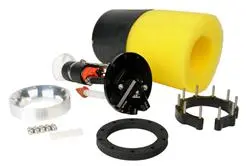
This is only a 200LPH system. But according to the dude and the printed stats is capable of supplying 450 HP forced induction...I'll have to drill a big assed hole in the top of the tank,..and re-route some lines, but other than that,....maybe I'll be done with pump issues.
What do you add to the dry ice to make the fog? I forget, then you can use the fog to make your get-a-way.Seems like you could've made an ice box for you return line.....a box...dry ice...some coiled tubing...it'll drop those fuel temps for sure.
So then,.....This was your longer worded version of saying..I told you so?You just got told what I have been saying for a long time now....
Excerpt from my tech note "Fuel pump sizing from the FORD RACING PERFORMANCE PARTS catalog"
My Comments:
A lot of people oversize the fuel pump by buying a 255LPH pump thinking that the fuel pump regulator will just pass the excess gas back to the tank. It does, but… Did you ever consider that circulating the fuel around as a 255 LPH pump does will cause the gas to pickup engine heat? What happens to hot gasoline? It boils off or pressurizes the fuel tank! With most of the 5.0 Mustangs having the carbon canister removed or disabled, the car stinks like gas, and the gas mileage drops since the hot fuel evaporates away into the air.
Accord to Microsoft Word's tracking feature, the date on those comments is May 15, 2013...
My comments are based in part on the 12 years that I spent fixing piston engine aircraft, mostly large, but some smaller ones as well. All of the aircraft engines that utilized a pressure carburetor or fuel injection had an immersed in tank fuel pump. This prevented vapor lock in the fuel supply line to the engine and the fuel served to cool the pump as well. Think back to Army Flight School and you'll recall that temperature decreases approximately 3° F for every 1000 feet of attitude. That temperature drop keeps the wing tanks cold and prevents the fuel temp from rising significantly from the heat generated by the fuel pump.


Maybe if it was a drag car.... The pump doesn't start to pss and moan until after it has sat in traffic at 212* engine temps for about ten minutes...Dry ice would've become fog by that time.Seems like you could've made an ice box for you return line.....a box...dry ice...some coiled tubing...it'll drop those fuel temps for sure.
Maybe if it was a drag car.... The pump doesn't start to pss and moan until after it has sat in traffic at 212* engine temps for about ten minutes...Dry ice would've become fog by that time.
I do not disagree with you, was just a thoughtToo many benefits to the in tank pump, no cavitation, less to no airiation, cooler pump temperature, less noise. Besides having to plumb the dude someplace for airflow or a fan to cool it.
Thats just my opinion, not based on any personal experience or knowledge, thats why noobz gave me an idiot light.
You got nothing from me....Trust me on this...,the silent treatment is the better of the two possible replies sometimes.Joe gets 'humble' mike
I get 'shutup stupid'
Life is not fair

unless you just prefer having bite marks on your ass


You got nothing from me....Trust me on this...,the silent treatment is the better of the two possible replies sometimes.


 actually he the same on the phone too.....

