alternator questions

z9_87

New Member
Apr 16, 2004
332
0
0
Urbana, IL
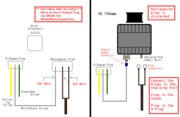
Currently I'm running the stock 86 alt on my motor. I have an electric fan and it charges okay at a stop with the fan on but not great. There's about a 1V drop when I turn it on. I also have a leftover alt from my 92 tbird. I was going to install it and see if it made more power but the connections on the back of the 2 are very different.
So, first does anyone know if the tbird alt is higher then my 75amp one and second is there an easy way to convert the connectors or any place I could pick up the connectors, cut and solder?
 
Not 100% on this but I believe that pre-87 Ford alternators were externally regulated and that 87+ are internally regulated. I would assume that if you got rid of the external regulator it might work but Im sure there would be some wiring issues. I think in the end, you may be better off buying an aftermarket hi amp alt for you car. Hopefully someone more versed in this will chime in. Good luck.
 
I believe that the 87-90 models were also different from the 91 and newer alternators. I upgraded to a 3g alternator for my 5.0 when I opted for the electric cooling fan. My unit is a autozone special p.o.s. but it seems to get the job done for now. If I were gonna do it again I would have upgraded to a PA performance 200 Amp unit just to be on the safe side.
 
Electric fan = 3G alternator if you want long life & reliability from your car.
The electric fan saves some HP. The stock fan's parasitic drag runs from 7-12 HP depending on who you talk to. The electric fan uses about 1/2 HP of power from the electrical system.

Figure this:
Ignition system & computer = 12 amps
Fuel pump = 12 amps
Exterior lights = 15 amps
Fan (heater or A/C) = 15 amps (can run between 5-25 amps depending on setting)
Radio & instruments = 10 amps
Wipers = 10 amps

That's grand total of 74 amps from a 65 amp alternator. Talk about overdrawn at the bank!

Here's websites with pictures of the 3G installation...

See http://www.geocities.com/smithmonte/Auto/3G_130A_Alternator_Upgrade.htm - all the tech data you could ever want to know
OR
http://www.mustangcentral.net/tech/alternator.html - excellent pictures of installation

Use these sites for information on the right way to do the wiring. Some people will tell you that you can skip the wiring upgrade, but it will catch up with you sooner or later. A fire in the wiring harness is ugly and expensive.

Under no circumstances connect the two 10 gauge black/white wires to the 3G alternator. If the fuse blows in the 4 gauge wire, the two 10 gauge wires will be overloaded to the point of catching fire and burning up the wiring harness.

See WWW.partsexpress.com for the fuse & fuse holder.
Fuse @ $3.90 each (need one) http://www.partsexpress.com/pe/showdetl.cfm?&DID=7&Partnumber=071-952

Fuseholder @ $5.80 each (need one) http://www.partsexpress.com/pe/showdetl.cfm?&DID=7&Partnumber=263-630

4 gauge black wire @ $1.25 a foot (use string to lay out routing & determine length) http://www.partsexpress.com/pe/showdetl.cfm?&DID=7&Partnumber=100-196

4 gauge red wire @ $1.25 a foot (use string to lay out routing & determine length) http://www.partsexpress.com/pe/showdetl.cfm?&DID=7&Partnumber=100-194

4 gauge ring crimp terminals (package of 5) $3.25. http://www.partsexpress.com/pe/showdetl.cfm?&DID=7&Partnumber=095-584

Don’t forget the alternator power ground!!!
The secondary power ground is between the back of the intake manifold and the driver's side firewall. It is often missing or loose. It supplies ground for the alternator, A/C compressor clutch and other electrical accessories such as the gauges. Any car that has a 3G alternator needs a 4 gauge ground wire running from the block to the chassis ground where the battery pigtail ground connects.
 
bullitstang1313 said:
I believe that the 87-90 models were also different from the 91 and newer alternators. I upgraded to a 3g alternator for my 5.0 when I opted for the electric cooling fan. My unit is a autozone special p.o.s. but it seems to get the job done for now. If I were gonna do it again I would have upgraded to a PA performance 200 Amp unit just to be on the safe side.
Some questions on the 200 amp. First, isn't it possible to overcharge a battery? If So, would a 200 amp alternator be too much for the battery to handle? Third, doesn't a bigger alternator mean more HP leeching?

I want to go to a 130 amp alternator because the stock alternator sux when I have my sound system booming with my windshield wipers and fans all turned on high, but I don't want to go too high either :rolleyes:
 
bluray said:
Some questions on the 200 amp. First, isn't it possible to overcharge a battery? If So, would a 200 amp alternator be too much for the battery to handle? Third, doesn't a bigger alternator mean more HP leeching?

I want to go to a 130 amp alternator because the stock alternator sux when I have my sound system booming with my windshield wipers and fans all turned on high, but I don't want to go too high either :rolleyes:
I cant speak for JR (his little toe is smarter than I), but I will take a shot at some of this.

I think you forgot about the alternator having a voltage regulator. In the same way that a 255 LPH fuel pump works for a stock motor, a 200 Amp alternator works even if little juice is needed (it uses what it needs and no more).
 
z9_87 said:
Thanks for the info jrichker, if they would go to a higher voltage system then these high amp problems melting wires really wouldnt be a problem.
The wiring (in my kindergarden understanding) is just barely adequate for the stock 65/75 amp alternator. Are you talking about going to a 42 volt system? There are a lot of issues with that (most being that morons will be shocked pretty good). People melt the stock wiring when upgrading the alternator w/o upgrading the stock 10 gauge wiring.

As an aside, Joe, thanks for the nice write up. I used your links above to pick up parts for the 160 amp unit going into the 88 GT vert. :nice: It saved me time searching for the right parts at the best price.

JRichker, a quick question if I may: I had wanted a wafer fuse rated for the weakest link (the 4 gauge cable; Alt is a 160 amp unit). But I had to get a 150 amp wafer fuse (I wanted a 125 amp fuse). Do you anticipate any issues in the event of a meltdown (like the cable catching fire before the fuse blows? I believe those fuses are slowburners). I will pick up a 125 amp fuse if I come across one while placing another order elsewhere (But I will do this ASAP if you see an problem). Thoughts? :)
 
HISSIN50 said:
The wiring (in my kindergarden understanding) is just barely adequate for the stock 65/75 amp alternator. Are you talking about going to a 42 volt system? There are a lot of issues with that (most being that morons will be shocked pretty good). People melt the stock wiring when upgrading the alternator w/o upgrading the stock 10 gauge wiring.

As an aside, Joe, thanks for the nice write up. I used your links above to pick up parts for the 160 amp unit going into the 88 GT vert. :nice: It saved me time searching for the right parts at the best price.

JRichker, a quick question if I may: I had wanted a wafer fuse rated for the weakest link (the 4 gauge cable; Alt is a 160 amp unit). But I had to get a 150 amp wafer fuse (I wanted a 125 amp fuse). Do you anticipate any issues in the event of a meltdown (like the cable catching fire before the fuse blows? I believe those fuses are slowburners). I will pick up a 125 amp fuse if I come across one while placing another order elsewhere (But I will do this ASAP if you see an problem). Thoughts? :)
The 150 amp fuse is OK. If it develops a dead short to ground, the 25 amp difference between the 2 fuses isn't going to make much difference. They will both blow in short order and prevent a fire.
 
HISSIN50 said:
I cant speak for JR (his little toe is smarter than I), but I will take a shot at some of this.

I think you forgot about the alternator having a voltage regulator. In the same way that a 255 LPH fuel pump works for a stock motor, a 200 Amp alternator works even if little juice is needed (it uses what it needs and no more).
So if thats tru, than regardless of alternator size (in amperage) the more juice drawn by your system, the harder it becomes to turn the alternator? So if I only draw 100 amps from a 200 amp alternator it will turn more freely and leech less HP than if I am drawing 150 from the same unit?
 
bluray said:
So if thats tru, than regardless of alternator size (in amperage) the more juice drawn by your system, the harder it becomes to turn the alternator? So if I only draw 100 amps from a 200 amp alternator it will turn more freely and leech less HP than if I am drawing 150 from the same unit?
That I could not tell you because I could care less. AFAIK, There is an increase in parasitic drag form the alternator for increased amperage output, but it is so small (we are talking a like 1-2 maybe) that I dont even consider it.

JR - Thank you very much for the info. :nice:
 
z9_87 said:
Well if we went to a higher voltage system then you're amperage can go down and power stays the same. A*V=W with the amps lowered you wont have the heat on the wire.

This is 100% correct. A 15 amp 12v circuit would consume just 4.3 amps at 42 volts. This would reduce the need, weight and cost for heavy wire.

Ohms law in its most basic is
P=I*E and E=I*R where P=power (watts or volt-amps), I=amperes, e=electromotive force (volts) and r= resistance

15amps*12v=180w I*42v=180w when we solve for I we get 4.2857 amps.

Problems with higher voltage = more battery weight and voltage in the 40 something range tends to bridge skin and could kill doing so.

Just increasing from 12 to 14volts reduces the current by 2.2 amps on a 15 amp load.
 
this might also help. just don't forget to add the 4awg wire.

99a89284.gif
 

Attachments

  • 99a89284.gif
    99a89284.gif
    77 KB · Views: 175
JerryD, Thank you!

hlln4wls, thats what I was getting at... if the voltage were raised and it doesnt have to be much at all, the amps will go down. Like say a 24V circut, will cut the amps in half and still be relativly low voltage.
 
z9_87 said:
JerryD, Thank you!

hlln4wls, thats what I was getting at... if the voltage were raised and it doesnt have to be much at all, the amps will go down. Like say a 24V circut, will cut the amps in half and still be relativly low voltage.
Yeah, I thought you were getting at that too (I hinted at it in my first post). It seems automakers (who were once hot on the idea) have backed down for the time being. I think it is a cool idea though, if people are careful about the juice. :)
 
There are some problems with your electrical theory, unless I have misread your posts. If you keep the R (ohms) constant and raise the voltage, the current will increase.

Example:
Volts (E) = 12 volts DC
Resistance (R) = 1 ohm.
I (amps) =E/R
I= 12/1
I = 12 amps

Volts (E) = 24
Resistance = 1 ohm
I (amps) = E/R
I= 24/1
I = 24 amps

Increasing the voltage in an automotive system with a fixed resistance causes current to increase

Using or example from above, if you increase from 12 volts to 14 volts with the same 1 ohm load, the current increases from 12 amps to 14 amps.

Volts x Currents =watts (Power)
In this case, the same amount of power (watts) can be achieved by doubling the voltage and dividing the current by 2. Again, as the voltage goes up, the resistance must decrease to keep the Power (Watts) at the same point.

Volts = 12 volts
Resistance = 1 ohm
Current (I) = E/R
12 volts/1 ohm = 12 amps
12 volts x 12 amps = 144 watts

Volts = 24 volts
Resistance = 2 ohm
Current (I) = E/R
24 volts/2 ohm = 6 amps
24 volts x 6 amps = 144 watts.

Higher voltages coupled with increased resistance for the working load reduce the current. This has a number of benefical effects such as reducing volage drop within a circuit, enabling the use of smaller wire sizes and smaller switches, motors and connectors.