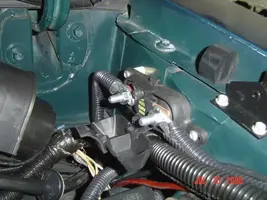
Best Fuse for 3G

The 130 would be ideal. but it would be tought to find. A 125 is the next best thing. Fuses are rated to carry 125% of their rated capacity for extended times before the blow.
 
I have a suggestion...why not do what Ford has done for years? Ford used two pieces of 12GA fusible link wire, ran parallel to each other (ll), in the wire that goes from the alt to the starter solenoid or battery junction box.

Check it out, it may be easier than finding Mega fuses amd the holder. Nobody had the Mega fuses and holder when I did my 3G swap, somebody recommended the fusible link wire, and sure enough, almost all Ford vehicles with a 3G has the two pieces of fusible link wire.

Just a thought, and the Fusible Link wire is only ~$5 for a roll at NAPA.
 
It depends on your wire size, not alt output. The alt is not gong to put out 130A continuously. It only puts out what is needed, most often around 50-90A.


With that said, what size wire are you running? Fusible links would be a great idea for protection.
 
Fuse holder from Napa

http://www.napaonline.com/MasterPag...BK&PartNumber=7821143&Description=Fuse+Holder

125 amp Fuse from Napa

http://www.napaonline.com/MasterPag...tNumber=7821137&Description=Fuse+-+Automotive


3g005.webp
 

Attachments

  • 3g005.webp
    3g005.webp
    34.4 KB · Views: 131
Swapping a fuse on the side of the road is easier than a pair of fusible links.

At some point I'll be going to a resettable circuit breaker.
 
Swapping a fuse on the side of the road is easier than a pair of fusible links.

At some point I'll be going to a resettable circuit breaker.


Best point made in this whole thread....it's all about maintenance. Who wants to rewire the whole setup when all you have to do is swap a fuze? Also something about the links makes me think FIRE when they go out and that's enough to scare me away even if it's highly unlikely.
 
It depends on your wire size, not alt output. The alt is not gong to put out 130A continuously. It only puts out what is needed, most often around 50-90A.
+1

Your alternator's rating is only an expression of how much continuous current it is capable of putting out. Typical automotive alternators are capable of putting out their rated amps at around 8000 - 9000 rpm. What engine speed this corresponds to depends on the size ratio of the crank pulley to the alternator pulley (I think it's usually between 3:1 and 4:1).

Your alternator will only put out the current that is demanded by the electrical system, up to what it is able to put out at the RPM it's turning. If you demand more than the alternator can put out at that speed, the electrical system pulls the additional current from the battery. At idle, your alternator is turning about 2000 rpm, and can only handle about 40 to 45% of it's rated output.

The fuse or circuit breaker is to protect the wiring from carrying more current than it is capable of. 4 gauge wire is generally able to carry a maximum of135 amps continuous load (more or less, depending on the length of the wire). A 2 ga. wire can withstand about 180 amps.

Pick an alternator that can handle your lights, HVAC fan, stereo, etc. while at idle. Choose your power wire based on how much maximum current you expect your electrical system to draw from the alternator (plus another 25 to 50% safety margin). Then choose the fuse based on what the wire can carry.

With a 4 ga. wire, you probably want to go with a maximum 130 amp fuse., even if you have an alternator that's rated for more than that. I have a 125 amp fuse, even though I have a 150 amp alternator.
 
I'm running the exact same thing... it's pretty ideal, I like how the fuse actually bolts down, and it was only about $15 all together. Best of all I know where to find a replacement fuse if I ever need one.


I could be wrong but i think most every fuze of this magnitude is going to bolt down....my 130 that i got from the car audio store did as well.


I paid a bit more for my setup....i think the fuze was like $30 and the holder was about $20, but the holder is a water tight box that seals the fuze inside...so that was added protection IMO. No corroded connectors...etc.