

You are using an out of date browser. It may not display this or other websites correctly.
You should upgrade or use an alternative browser.
You should upgrade or use an alternative browser.
Black Jack: Working up to slicks
- Thread starter FastDriver
- Start date

Sounds strong to me!
I think you will get lucky with it just the gauge.
Sending positive thoughts your way!
I think you will get lucky with it just the gauge.
Sending positive thoughts your way!


89ripper
Founding Member
Same thing as what happened in your video happened to me
Gave me quite the scare, ended up being sending unit but at the time replaced oil pump and some other things just cant remember as it was years ago. Good luck to you!
Gave me quite the scare, ended up being sending unit but at the time replaced oil pump and some other things just cant remember as it was years ago. Good luck to you!

85GTStangGuy
5 Year Member
So, since I'm back in grad school *sigh*... I've handed over some duties I'd prefer to do on my own. The steering rack started leaking so bad I was putting the drain pan under the car in the garage each night and refilling each morning. So, I got the closest mechanic to take some things off of my plate. It was good to get a 2nd set of eyes on the car. He replaced the rack, swapped the oil pressure sender with the early style that actually has a potentiometer (pressure is above halfway on the gauge now, yay!)
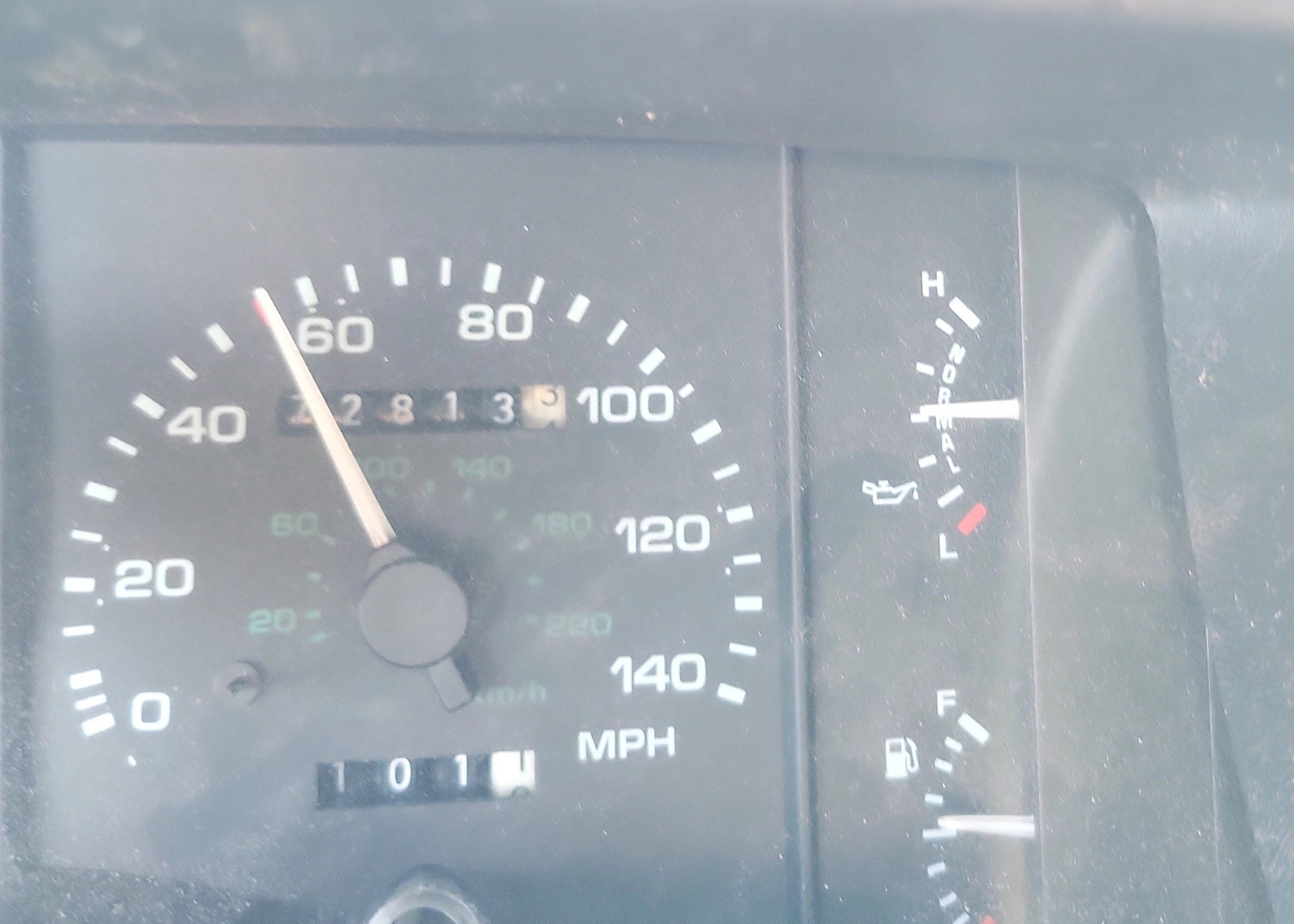
, adjusted the hood, which wasn't closing right, and I guess tugged on the e-brake cable a bit and got the driver's rear caliper to stop dragging how it was. Hopefully, that's permanent.
Ironically, I actually prefer the worn out rack's steering, lol. It seems like there was more feedback, before. I can't believe how little resistance there is to turning the wheel, now. But, it does it without noise, and without leaking, now.
I'm on at 1pm tomorrow with Firestone for an alignment, tomorrow. Will do the lifetime deal. I've gotten every bit of my money out of those deals with my truck and with the old Saturn.
, adjusted the hood, which wasn't closing right, and I guess tugged on the e-brake cable a bit and got the driver's rear caliper to stop dragging how it was. Hopefully, that's permanent.
Ironically, I actually prefer the worn out rack's steering, lol. It seems like there was more feedback, before. I can't believe how little resistance there is to turning the wheel, now. But, it does it without noise, and without leaking, now.
I'm on at 1pm tomorrow with Firestone for an alignment, tomorrow. Will do the lifetime deal. I've gotten every bit of my money out of those deals with my truck and with the old Saturn.
Last edited:

Any of the SN95 racks are an improvement over the Fox rack. Get the Maximum Motorsports hybrid steering shaft and you are in business. You will need to swap the inner tie rods from the Fox rack to the SN95 so you have SAE threads for your outer tie rods. Both of my Foxes have this done and its night an day difference. You can under drive the power steering pump with a larger pulley which will slow the pump down and reduce the boost.
I want to say 94/95 V6 Mustang and 3.8 Thunderbirds & Cougars had them. Part number I have for the factory pulley is E2SZ-3A733-A. Did a quick Google search and cam up with these threads:
Good info in both.
I want to say 94/95 V6 Mustang and 3.8 Thunderbirds & Cougars had them. Part number I have for the factory pulley is E2SZ-3A733-A. Did a quick Google search and cam up with these threads:

My power steering pump is going out. It whines when I'm idling, and it REALLY whines when I hit the throttle.
Bottomline, the thing's going to be replaced next weekend.
But I was just wondering, has anybody replaced their stock p/s pulley with a lightweight or underdrive pulley?
My stang already has a Ford Racing underdrive pulley on crank, so can I still get away with underdriving the p/s pump and the alternator without messing anything up?
Bottomline, the thing's going to be replaced next weekend.
But I was just wondering, has anybody replaced their stock p/s pulley with a lightweight or underdrive pulley?
My stang already has a Ford Racing underdrive pulley on crank, so can I still get away with underdriving the p/s pump and the alternator without messing anything up?
- Ike83
- Replies: 11
- Forum: Fox 5.0 Mustang Tech
Good info in both.

Thanks for the suggestions, guys. Lotsa other stuff on my plate, but when I come back to it, I'll try to improve the steering feel.
Last edited:
Minor Update:
Completed wiring the fog light switch to arm the nitrous system.
- Wired the two-step into the Hurst shifter button, along with the reverse lockout and line lock that were already connected there. To avoid being on the spark limiter while spraying, I added a 5-pin relay that’s normally closed for the nitrous circuit but switches to the two-step when the Hurst button is pressed. This ensures both can’t activate simultaneously. The downside is that the nitrous needs to be armed to use the two-step. To address this, I plan to wire in a secondary circuit using a normally closed (NC) relay to power the two-step when the nitrous system is inactive.
- Reinstalled the head unit and shifter trim.
- Installed Fiddle Fart Fab door pins. Ran into Thom Hill at Foxtoberfest and reminded him of our past interaction when I had purchased and returned three sets of door strikers for being too large. He gave me a set to test, and so far, they seem to be working correctly. If everything holds up after a couple of weeks of driving—no rattles or other issues—I plan to order a few more sets for the other cars. These pins eliminate the need for the plastic bushings that always break and fail, which is a nice upgrade.
- I don’t recall if I ever mentioned this, but I also pulled out the hatch striker. Despite not returning the original set after our first interaction, I bought his new hatch striker to try. It’s quite small, so I’m skeptical, but I haven’t tested it yet to confirm its effectiveness.
Completed wiring the fog light switch to arm the nitrous system.
- Wired the two-step into the Hurst shifter button, along with the reverse lockout and line lock that were already connected there. To avoid being on the spark limiter while spraying, I added a 5-pin relay that’s normally closed for the nitrous circuit but switches to the two-step when the Hurst button is pressed. This ensures both can’t activate simultaneously. The downside is that the nitrous needs to be armed to use the two-step. To address this, I plan to wire in a secondary circuit using a normally closed (NC) relay to power the two-step when the nitrous system is inactive.
- Reinstalled the head unit and shifter trim.
- Installed Fiddle Fart Fab door pins. Ran into Thom Hill at Foxtoberfest and reminded him of our past interaction when I had purchased and returned three sets of door strikers for being too large. He gave me a set to test, and so far, they seem to be working correctly. If everything holds up after a couple of weeks of driving—no rattles or other issues—I plan to order a few more sets for the other cars. These pins eliminate the need for the plastic bushings that always break and fail, which is a nice upgrade.
- I don’t recall if I ever mentioned this, but I also pulled out the hatch striker. Despite not returning the original set after our first interaction, I bought his new hatch striker to try. It’s quite small, so I’m skeptical, but I haven’t tested it yet to confirm its effectiveness.
Tuning, finally!!!
Months ago, I installed the Quarterhorse into an A9L computer I purchased from another SN member. I have been excited to start tuning on it since then, but grad school has been getting in the way. Meanwhile, as the season changed from summer to winter, the car was having more troubles idling and I was stalling it backing out of parking spaces or just turning on the A/C. As a bandaid, I spun the throttle set screw a bit, and pushed idle up to around 1100 RPM. I was already very close to 1V on the TPS, and turning the throttle body definitely pushed it over the threshold, which the computer uses to ID when you are not at idle. It cured my stalling issues, but it caused a CEL & I noticed it was running even more rich-smelling than usual.
I should be doing a mid-term today, but I just really wanted to address this issue. So, I finally cracked into the quarterhorse, set the relevant tables to set idle at 850, turned the set screw back down, and set the TPS.
This has seemingly cured my surging and stalling. The computer was using air and timing to TRY to bring idle back down to the stock 672 setting in the computer. So, it would keep pulling air and timing, and eventually it would almost stall the car, and then flip to trying to save it. Now, with the settings adjusted for 850 RPM, & the window widened before the computer kicks in to try to control the RPM, it just got done running for about 20 minutes in my driveway without any surging. I might play with this later, if I can idle it down another 100 RPM or so with the E-cam, but 850 seems like a nice place to start.
Other Adjustments: I *should* get some added utility from the QuarterHorse...
- Opening up the fuel limiter: My dyno curves suggest a ~6.2-6.3k optimal shift point, but I can't do that on nitrous, because you never want to run up against the fuel limiter. Now, I'll be able to set the nitrous cutoff there, the spark limiter to 6.5k at the fuel limiter above that (effectively turned off)
- 'Calibrated MAFs' have worked just fine for me, and I wouldn't hesitate to use them again, but they are also still just a band-aid. You know, there's all kinds of little settings that don't care about what your MAF is reporting. Injector pulsewidth while cranking, actually setting injector-specific data like voltage offset, breakpoint, & injector high & low slopes should improve driveability all around
- Eventually, I'll turn the dizzy back down to the stock 10* and then adjust the timing from the tables. Until then, I won't mess with the spark tables.
Anyways, it's nice to finally start tweaking the car.
Months ago, I installed the Quarterhorse into an A9L computer I purchased from another SN member. I have been excited to start tuning on it since then, but grad school has been getting in the way. Meanwhile, as the season changed from summer to winter, the car was having more troubles idling and I was stalling it backing out of parking spaces or just turning on the A/C. As a bandaid, I spun the throttle set screw a bit, and pushed idle up to around 1100 RPM. I was already very close to 1V on the TPS, and turning the throttle body definitely pushed it over the threshold, which the computer uses to ID when you are not at idle. It cured my stalling issues, but it caused a CEL & I noticed it was running even more rich-smelling than usual.
I should be doing a mid-term today, but I just really wanted to address this issue. So, I finally cracked into the quarterhorse, set the relevant tables to set idle at 850, turned the set screw back down, and set the TPS.
This has seemingly cured my surging and stalling. The computer was using air and timing to TRY to bring idle back down to the stock 672 setting in the computer. So, it would keep pulling air and timing, and eventually it would almost stall the car, and then flip to trying to save it. Now, with the settings adjusted for 850 RPM, & the window widened before the computer kicks in to try to control the RPM, it just got done running for about 20 minutes in my driveway without any surging. I might play with this later, if I can idle it down another 100 RPM or so with the E-cam, but 850 seems like a nice place to start.
Other Adjustments: I *should* get some added utility from the QuarterHorse...
- Opening up the fuel limiter: My dyno curves suggest a ~6.2-6.3k optimal shift point, but I can't do that on nitrous, because you never want to run up against the fuel limiter. Now, I'll be able to set the nitrous cutoff there, the spark limiter to 6.5k at the fuel limiter above that (effectively turned off)
- 'Calibrated MAFs' have worked just fine for me, and I wouldn't hesitate to use them again, but they are also still just a band-aid. You know, there's all kinds of little settings that don't care about what your MAF is reporting. Injector pulsewidth while cranking, actually setting injector-specific data like voltage offset, breakpoint, & injector high & low slopes should improve driveability all around
- Eventually, I'll turn the dizzy back down to the stock 10* and then adjust the timing from the tables. Until then, I won't mess with the spark tables.
Anyways, it's nice to finally start tweaking the car.
Last edited:
Well, I'll be damned... I've been saying that the factory limiter is at 6,250 for probably 20 years. Turns out, it's apparently different depending on the exact EEC. In the '93 Cobras, Cougar 5.0 says it actually is 6,250. In the A9L, I found the RPM limiter tables, but they didn't add up to any personal experience:

That looks like 7k (assuming it's used despite the fact that the notes tables in binary editor suggests otherwise). But, Cougar5.0 posts suggested that the MNPIP8 scalar actually is the A9L's effective limiter:

So, if I understand correctly, 6,504 is the actual rev limiter with an A9L. I just set this to 6.8k, my MSD to 6.5k, and my nitrous cutoff to 6.2k.
These files could be adjusted and saved, and therefore may not be Ford's original tune, but this is the "A9L.BIN", and it's supposed to be the stock values from Ford. Well, digging a little deeper, I found that the A9P (from a Leech motorsports video comparison) has a limiter at no higher than 6.2k:
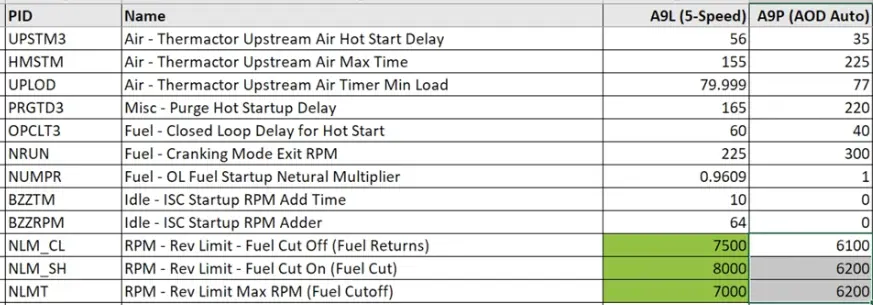
Anyways, until you get your hands dirty, I guess you never really know anything for sure.
Edit after test drive:
On a test drive, I can at least confirm that I was able to hold a sustained 6,400 RPM after my adjustments, according to both the MSD signal & the EEC's RPM signal in Binary Editor's live dashboard. Therefore, I can't confirm with absolute certainty that changing the MNPIP8 changed anything, but I can confirm that with it at 6.8k, the MSD Digital 6+ at 6.5k, I can read at least 6.4k.
I went WOT and heard no detonation or anything concerning. After confirming with 1 or 2 brief test runs, I let 'er rip to the limiter and though I could feel torque falling off, my calcs still say it'll be more optimal to shift at 6.5k NA. With the juice set to cut off at 6.2K, I'm going to put a shift light in at 6k, now. I don't know how that will compare to the 5.6k pill I used to have in the light, but I'll report back after the next track outing.
I installed the WB 02 sensor and was seeing WOT AFRs in tge mid-low 12s, a bit too rich, but nothing to worry about.
That looks like 7k (assuming it's used despite the fact that the notes tables in binary editor suggests otherwise). But, Cougar5.0 posts suggested that the MNPIP8 scalar actually is the A9L's effective limiter:
So, if I understand correctly, 6,504 is the actual rev limiter with an A9L. I just set this to 6.8k, my MSD to 6.5k, and my nitrous cutoff to 6.2k.
These files could be adjusted and saved, and therefore may not be Ford's original tune, but this is the "A9L.BIN", and it's supposed to be the stock values from Ford. Well, digging a little deeper, I found that the A9P (from a Leech motorsports video comparison) has a limiter at no higher than 6.2k:
Anyways, until you get your hands dirty, I guess you never really know anything for sure.
Edit after test drive:
On a test drive, I can at least confirm that I was able to hold a sustained 6,400 RPM after my adjustments, according to both the MSD signal & the EEC's RPM signal in Binary Editor's live dashboard. Therefore, I can't confirm with absolute certainty that changing the MNPIP8 changed anything, but I can confirm that with it at 6.8k, the MSD Digital 6+ at 6.5k, I can read at least 6.4k.
I went WOT and heard no detonation or anything concerning. After confirming with 1 or 2 brief test runs, I let 'er rip to the limiter and though I could feel torque falling off, my calcs still say it'll be more optimal to shift at 6.5k NA. With the juice set to cut off at 6.2K, I'm going to put a shift light in at 6k, now. I don't know how that will compare to the 5.6k pill I used to have in the light, but I'll report back after the next track outing.
I installed the WB 02 sensor and was seeing WOT AFRs in tge mid-low 12s, a bit too rich, but nothing to worry about.
Last edited:

More tuning updates:
- Shut off the EGR so it's not trying to control anything, and should prevent any codes.
- Reset base timing to 10* (from 14) & bumped WOT spark only by 4* across the board
- Was able to find the "EVP" which is the EGR Voltage. I connected it to my wideband analog output from the Innovate MTX-L. So, now I can see & datalog my AFR within Binary Editor, which is going to be awesome for tuning
- In the Fuel tables, there's a WOT multiplier that the stock A9L uses to add something like 3-9% fuel. I removed that multiplier (set all = to 1), but I also messed with the tables. Here's what the stock Open Loop target AFR table looks like:
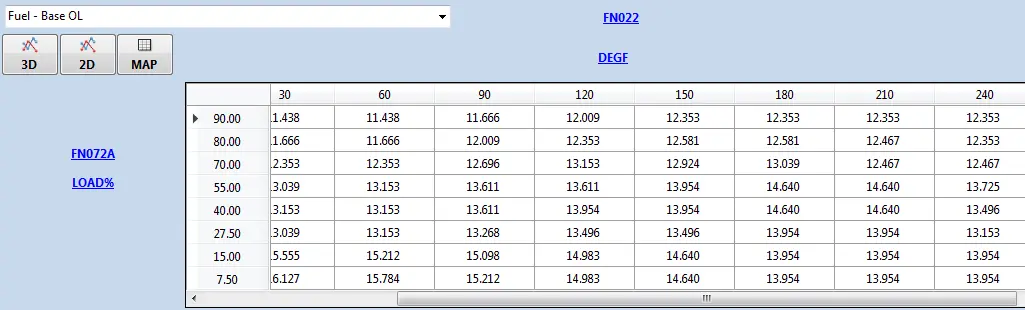
So, it looks like it's commanding 12.353:1 AFR from 150* on up. And... that's about what I saw from my WB O2 guage at WOT. I adjusted these targets to the following by multiplying the table values all at once:
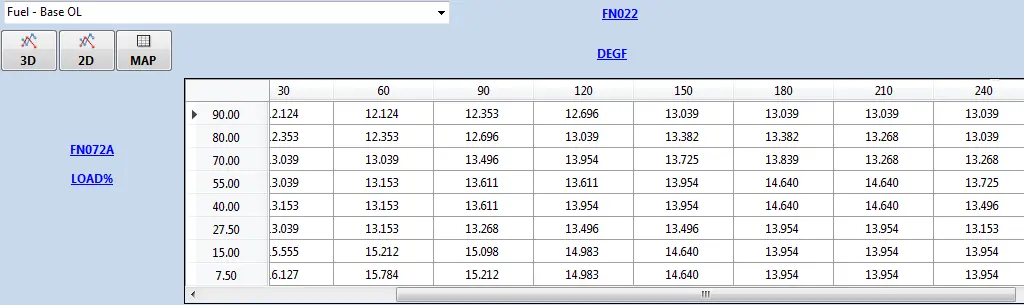
So, these AFRs are ballpark where I'd like to see them. I went for a drive and ran it out a couple times. On the first pull, I was seeing 13.3 to 13.5, and on the 2nd pull, I saw as high as 13.7. That's definitely leaner than I'd like it to be. So, I went back and restored the WOT Fuel Multiplier table, for now. It's not my preferred solution, but it should get me by until I can get back to tuning again.
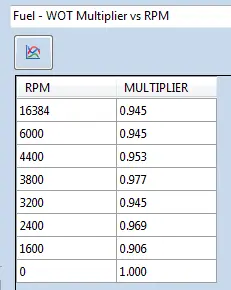
That supposedly multiplies the target AFR in the first tables by the multiplier, effectively enrichening the AFR by RPM.
When I datalog, I should get information that tells me if I need to make global changes (injector slopes), or local changes (MAF xfer function). I may also learn about more tables or settings that might be relevant. I'm basing setting that table to 1 because the Leech Motorsports guy was saying there are more elegant ways of handling Fuel Adjustments. Honestly though, as I review this again, I'm surprised I'm not seeing a Load (x-axis) vs. RPM (y-axis) kind of fuel table. So, this actually is still the way that makes the most sense to me. But, I'm open-minded to his techniques. Just need to learn more.
- Shut off the EGR so it's not trying to control anything, and should prevent any codes.
- Reset base timing to 10* (from 14) & bumped WOT spark only by 4* across the board
- Was able to find the "EVP" which is the EGR Voltage. I connected it to my wideband analog output from the Innovate MTX-L. So, now I can see & datalog my AFR within Binary Editor, which is going to be awesome for tuning
- In the Fuel tables, there's a WOT multiplier that the stock A9L uses to add something like 3-9% fuel. I removed that multiplier (set all = to 1), but I also messed with the tables. Here's what the stock Open Loop target AFR table looks like:
So, it looks like it's commanding 12.353:1 AFR from 150* on up. And... that's about what I saw from my WB O2 guage at WOT. I adjusted these targets to the following by multiplying the table values all at once:
So, these AFRs are ballpark where I'd like to see them. I went for a drive and ran it out a couple times. On the first pull, I was seeing 13.3 to 13.5, and on the 2nd pull, I saw as high as 13.7. That's definitely leaner than I'd like it to be. So, I went back and restored the WOT Fuel Multiplier table, for now. It's not my preferred solution, but it should get me by until I can get back to tuning again.
That supposedly multiplies the target AFR in the first tables by the multiplier, effectively enrichening the AFR by RPM.
When I datalog, I should get information that tells me if I need to make global changes (injector slopes), or local changes (MAF xfer function). I may also learn about more tables or settings that might be relevant. I'm basing setting that table to 1 because the Leech Motorsports guy was saying there are more elegant ways of handling Fuel Adjustments. Honestly though, as I review this again, I'm surprised I'm not seeing a Load (x-axis) vs. RPM (y-axis) kind of fuel table. So, this actually is still the way that makes the most sense to me. But, I'm open-minded to his techniques. Just need to learn more.


Quarter Horse looks like the way to go if your wiring and computer is good, and you are more tech savvy than I am. 

Nowadays people are quick to recommend Holley or megasquirt. The quarterhorse really is quite powerful. There are still people out there doing remote tunes if you don’t want to learn to tune. Ofcourse you’d need to find a quarterhorse too, which can be difficult.
Last I checked, about 6 months ago, Decipha was still selling them as new for a couple hundred each. I picked up a spare and a couple of the 1-tune chips. I'd like to have a few ready to go so I can keep doing this for a long time.Nowadays people are quick to recommend Holley or megasquirt. The quarterhorse really is quite powerful. There are still people out there doing remote tunes if you don’t want to learn to tune. Ofcourse you’d need to find a quarterhorse too, which can be difficult.
I read these threads where guys have a garbage tuner fail at their job, and then rip out their EEC just to fix a stumble at a certain RPM. That's a shame, because this thing is extremely capable. For my NA combo, I would so far NOT prefer my multi-thousand dollar BS3.
Yup exactly. Someone like Decipha can probably tune an a9l (and any other ecu supported) just as good as someone with a standalone ecu. His a9l2 cal is very broken out.
I had a reputable tuner dyno tune my car. It seems to run pretty good, to me. Decipha took one look at it and said “Yea, that’s not really a good tune, best to start over. I can make one 100x better guaranteed.” Working on that now.
I’ve learned a lot from his write ups and watching him remote tune my truck.
I had a reputable tuner dyno tune my car. It seems to run pretty good, to me. Decipha took one look at it and said “Yea, that’s not really a good tune, best to start over. I can make one 100x better guaranteed.” Working on that now.
I’ve learned a lot from his write ups and watching him remote tune my truck.
That's what I mean. When I look at a tune and the displacement is wrong, the inj data is wrong, the desired idle RPM doesn't match what the car is doing, and the MAF xfer is all they did, that tuner screwed you. I didn't know enough before to call BS. Of course, Decipha would probably tell me that mine is a hack job, but at least I have unlimited time to work on it for free.
85GTStangGuy
5 Year Member
.... and I was stalling it backing out of parking spaces ....
No worries.... I've heard that can happen.




Similar threads
What's it Worth?
1997 Cobra, a ton of mods and restoration
- Replies
- 2
- Views
- 122

- Replies
- 21
- Views
- 1K
- Replies
- 0
- Views
- 374

- Replies
- 0
- Views
- 1K
