
Reed
New Member
Strype said:We have a saying in Alabama...
"The cooler the air- the hotter the fire"
"Fire" is pronounced "Far"
That, is awesome.
Strype said:We have a saying in Alabama...
"The cooler the air- the hotter the fire"
"Fire" is pronounced "Far"

Strype said:Thanks for the replies guys
We have a saying in Alabama...
"The cooler the air- the hotter the fire"
"Fire" is pronounced "Far"
That is HOT HOT HOT air being sucked right into your throttle body my friend
 Does it have to do with the air/fuel ratio temp wise?? I cant see it making that much of a difference
RUNINAGT said:What is a good reason for the coolant line anyway. There must of been some reason for Ford putting it on there????

Strype said:The coolant line is there to keep the throttle body from freezing up in cold conditions... at least that's what I read years ago-
I deleted that too
we'll find the answer to this sooner or later Strype
Boss 351 said:What about those thermal-lick-it I mean phonelic (sp?) spacers they sell? Everytime I think about buying one, I do a search on here and 99% of the time - all I see is that the spacer does nothing as far as performance goes but will help if you need tall valve covers...
mob said:Dont remove the line from the t/b to the valve cover, it has to be there for a reason and the gains your going to get? what gains..
RUNINAGT said:Haven't heard that one before. Why wouldn't they use that system now? Iv'e heard that it has something to do with the air coming in, that it heats the air on purpose. I think we need to post in the tech forum, maybe someone can clarify this up for us. Im going to the back of the shop now to ask some of our techs, asked 2 of them and they gave an answer similar to mine but were not 100% clear on it. Got 3or 4 more to ask. On a mission

Strype said:Nope- no reason on earth you would ever want to warm the air... it's just some bullspit safety crap Ford put on there
Why would you use nitrous to freeze air if warm was better?
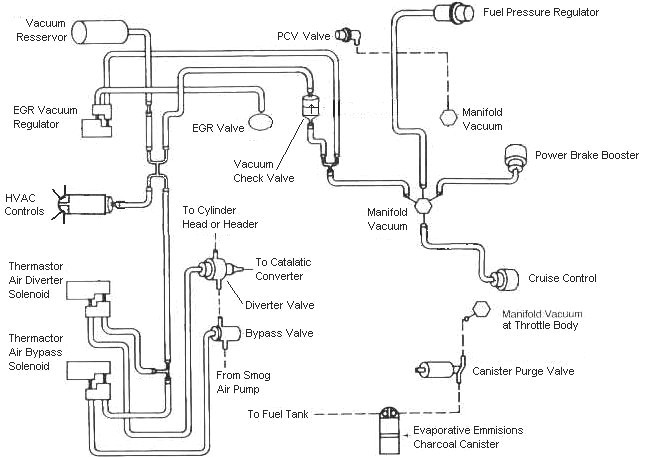
jrichker said:In some places it does get really cold - maybe not in Al-bam-her. The cold air combined with moisture and pressure drop accross the throttle butterfly can produce ice. The ice causes stalling, poor idle & low speed performance. That on top of the fact that the 195* water is cooler than the exhaust gases piped to the EGR is the reason for the water piping to the EGR.
Some basic theory to clarify how things work is in order…
The EGR shuts off at Wide Open Throttle (WOT), so it has minimal effect on performance. The addition of exhaust gas drops combustion temperature, increases gas mileage and reduces the tendency of the engine to ping. It can also reduce HC emissions by reducing fuel consumption.
The EGR system has a vacuum source (line from the intake manifold) that goes to the EVR, computer operated electronic vacuum regulator. The EVR is located on the back of the passenger side shock strut tower. The computer uses RPM, Load. and some other factors to tell the EVR to pass vacuum to open the EGR valve. The EGR valve and the passages in the heads and intake manifold route exhaust gas to the EGR spacer (throttle body spacer). The EGR sensor tells the computer how far the EGR valve is open. Then computer adjusts the signal sent to the EVR to hold, increase or decrease the vacuum. The computer adds spark advance to compensate for the recirculated gases and the slower rate they burn at.
Diagram courtesy of Tmoss & Stang&2birds.
The EGR sensor is basically a variable resistor, like the volume control on a radio. One end is 5 volt VREF power from the computer (red/orange wire). One end is computer signal ground (black/white), and the middle wire (brown/lt green) is the signal output from the EGR sensor. It is designed to always have some small voltage output from it anytime the ignition switch is the Run position. That way the computer knows the sensor & the wiring is OK. No voltage on computer pin 27 (brown/lt green wire) and the computer thinks the sensor is bad or the wire is broken and sets code 31. The voltage output can range from approximately .6-.85 volt.
)



jrichker said:n a budget? do the junkyard upgrade...
Gears - 87-88 T-Bird Turbo Coupe rear axle - disc brakes and 3.55 or 3.73 gears in one package for $125-$300. Add another $100-$200 or so to complete the brake upgrade.
94-95 Mustang GT MAF - $40-$100. It is 70 MM instead of the stock 55 MM on regular stangs built prior to 94. It uses a slip on duct on the side that goes to the throttle body and a 4 bolt flange on the other. You need a $25-$35 flange adapter from Pro-M to fit the stock slip on air ducting that goes to the air box. Wiring plugs right in with no changes. *1
95-97 Ford Explorer intake manifold & throttle body $150-$300. The intake manifold flows 220 CFM +, much better than stock. Throttle body is 65 MM, bigger than the 60 MM on stock stangs. I got a 96 with EGR passages that match the stock setup, so my smog gear works just like factory. You’ll need a 65 MM EGR spacer & new gaskets for $65-$90 so you have a place to mount the EGR & throttle linkage.
3G alternator from 94-95 Mustangs or other Ford. $20-$120. A must have to make the electrical system work like it should. You’ll need a 4 gauge power wire and a 125-135 amp fuse to go with it about $15- $30.
Lincoln MK VIII electric fan -$40-$160. Free up some HP by not having to drive the stock fan. The 3G alternator upgrade is a must have prerequisite before you do the MK VIII fan. You won’t have enough electrical power if you don’t do the 3G upgrade.
Aluminum driveshaft: (courtesy of shawn13) It needs to be from a 92-93-94 Aerostar AWD and you will need the u-joint, part #353 from NAPA. It should bolt right up after the u-joint swap.
*1.) I got a metal flange adapter from Powered by Ford for $35 and tax. That was over a year ago. Summit Racing may also have one too.
Powered By Ford
1516 South Division Avenue
Orlando, FL 32805
Hours 0800-1800
Phone 407-843-3673
http://www.poweredbyford.com/
Strype said:Cool info (no punn intended
Yea I thought I was right about the ice- I've been reading 5.0 mags for about 10 years, so sometimes I'll remember something and I don't have back up
:
good call Strype.
Hey where did u get that plug in for the computer? and do you thnk they have one for a 2001 Eclipse GS? My buddy's eclipse has been giving him nothing but hell, the comp says its EGR and so did his mech. but we have replaced almost evrything, that would be a big help, thanks.Strype said:Cool info (no punn intended
Yea I thought I was right about the ice- I've been reading 5.0 mags for about 10 years, so sometimes I'll remember something and I don't have back up
Also, I have a $30 plug in that tells the computer the egr is working properly
Thanks jrichker
 I didn't look for other cars though lol
grey5.0beast said:Hey where did u get that plug in for the computer? and do you thnk they have one for a 2001 Eclipse GS? My buddy's eclipse has been giving him nothing but hell, the comp says its EGR and so did his mech. but we have replaced almost evrything, that would be a big help, thanks.
jrichker said:Some basic theory to clarify how things work is in order…
The EGR shuts off at Wide Open Throttle (WOT), so it has minimal effect on performance. The addition of exhaust gas drops combustion temperature, increases gas mileage and reduces the tendency of the engine to ping. It can also reduce HC emissions by reducing fuel consumption.


