Do i need larger injectors?? (speed density)

SSheila1988

New Member
Jan 1, 2011
3
0
2
I have an 88 speed density mustang with the following mods… Cobra upper/lower intake, 70 mm TB, BBK cold air intake, AFR 165cc heads, 1.7 rr, stock cam, Adj fuel pressure regulator (currently at 42psi, guage on fuel rail), 190 lph fuel pump, Accel 19lb injectors, shorty headers, full custom exhaust with high flow cats, MSD blaster tfi coil, msd dizzy, UD pulleys, elect fan…

The question is am I to the point where I need larger injectors or just keep running it the way I am?

Any thoughts would be greatly appreciated :)
 
I have an 88 speed density mustang with the following mods… Cobra upper/lower intake, 70 mm TB, BBK cold air intake, AFR 165cc heads, 1.7 rr, stock cam, Adj fuel pressure regulator (currently at 42psi, guage on fuel rail), 190 lph fuel pump, Accel 19lb injectors, shorty headers, full custom exhaust with high flow cats, MSD blaster tfi coil, msd dizzy, UD pulleys, elect fan…

The question is am I to the point where I need larger injectors or just keep running it the way I am?

Any thoughts would be greatly appreciated :)

You do not need larger injectors. If you get to the point where the EEC starts throwing HEGO codes then it might be time to adjust your fuel pressure a bit to compensate. Installing 24 lb injectors with an OEM SD EEC often requires some messaging to get it to work correctly. This is something you cannot do without a wideband 02 meter at least temp installed in order get a reference.
 
Cool! Thanks for the quick reply :) I wasn't sure if i was pushing the stocks ones to far.

PS any idea how the horsepower I have? Haven't had the time or money to put her on a dyno :( just curious
 
The price can be a little discouraging, but a wideband O2 gauge/sensor is a great tuning tool and IMO will be one of the better purchases you'll make for your car. It is truly the best way to know if your car is getting enough fuel.
 
The price can be a little discouraging, but a wideband O2 gauge/sensor is a great tuning tool and IMO will be one of the better purchases you'll make for your car. It is truly the best way to know if your car is getting enough fuel.
Yes it is a great tool. It makes it easier to tune also. Just don't buy one with the light show gauge. Make sure it gives you an actual readout of afr or lambda. I recommend the innovate lc-1 for about 200 bucks on eBay.
 
You will find that while the engine may run OK with all the mods you currently have, that further modification results in idle/driveablity problems. At that time you will need to convert to a Mass Air Computer and a MAF designed to match your injectors or custom dyno tune chip.

Speed Density uses Manifold vacuum (MAP), Throttle position (TPS) and RPM, Air Temperature (ACT) & Engine Coolant (ECT) to guess how much air the engine is pulling in. Then it uses all of them to calculate the air/fuel mixture. It is dependent on steady manifold vacuum and minimal changes in airflow from the stock engine configuration to maintain the proper air/fuel ratio. Change the airflow or vacuum too much and the computer can't compensate for the changes, and does not run well. Forget about putting a supercharger, turbocharger or monster stroker crank in a Speed Density engine, because the stock computer tune won’t handle it. Every time you seriously change the airflow through the engine, you need a new custom burned chip to make the engine run at peak performance.

Mass Air uses a Mass Air Flow meter (MAF) to actually measure how much air is being pulled in and uses the inputs from the TPS, ACT, ECT, RPM and Barometric Pressure sensor (Baro) to calculate the proper air/fuel ratio. It is very tolerant of changes in airflow, and vacuum and tolerates wild cams, high flowing heads, and changes in displacement with minimal difficulties. Larger injectors can be used with an aftermarket calibrated MAF or a custom dyno tune. This makes it possible to use the stock computer with engine displacements from 302-408 cu in, and make many modifications without a custom dyno tune chip. Put a new intake manifold on your 331 stroker and the computer figures out how much more fuel to deliver without having to have a new chip burned to accommodate the extra airflow.

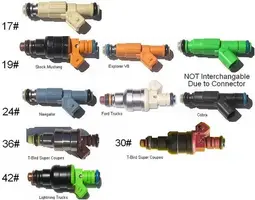
Fuel injector sizing & injector photos

Revised 11-Dec-2011 to add larger injector sizes to injector table

Injector HP ratings: divide flow rating by.5 and multiply the result by the number of injectors. This uses a 100% duty cycle. These ratings are for naturally aspirated engines at the flywheel.

Example:
19/.5 = 38, 38 x 8 = 304 HP
24/.5 = 48, 48 x 8 = 384 HP
30/.5 = 60, 60 x 8 = 480 HP
36/.5 = 72, 72 x 8 = 576 HP
42/.5 = 84, 84 x 8 = 672 HP

The preferred duty cycle is about 85% maximum, so for a safety factor multiply the final figure times .85.

19/.5 = 38, 38 x 8 = 304 HP x .85 = 258 HP
24/.5 = 48, 48 x 8 = 384 HP x .85 = 326 HP
30/.5 = 60, 60 x 8 = 480 HP x .85 = 408 HP
36/.5 = 72, 72 x 8 = 576 HP x .85 = 490 HP
42/.5 = 84, 84 x 8 = 672 HP x .85 = 571 HP

Remember that the above ratings are at 39 PSI. Increasing the pressure will effectively increase the flow rating. Example: a 19 lb injector will flow 24 lbs at 63 PSI, and a 24 lb injector will flow 30 lbs at 63 PSI.

See http://users.erols.com/srweiss/ to get the calculators used in these examples.

Here's the duty cycle explanation. Duty cycle is how much of the time the intake is open the injectors are turned on. The 85% figure means that for 85% of the time the intake valve is open, the injectors are spraying. The idea is that you want some percentage of the duty cycle left over so that you have some room to grow the process.

If you are at 100% and you need more fuel, all you can do is turn up the fuel pressure. That means the whole fuel curve from idle to WOT is affected. Maybe you are already too rich at idle, and turning up the fuel pressure makes it worse. If you had some injector duty cycle left to play with, a custom tune could use that where it is needed. That would not over richen the whole range from idle to WOT.

If you did turn up the fuel pressure, you might be able to change the injector duty cycle to get the air/fuel mixture ratio you want since the injectors will have extra fuel delivery capability.

With larger than stock injectors or higher that stock fuel pressure, you will need an aftermarket MAF that matches the injector size. The MAF “lies” to the computer to get a fuel delivery schedule that meets the engine’s needs and isn’t too rich or too lean. The best strategy is an aftermarket MAF and a custom tune to insure the best air/fuel ratio over all the RPM range.

Don't forget to increase the fuel pump size when you increase injector size or significantly increase the fuel pressure


Diagram courtesy of Tmoss & Stang&2birds
Ford_Injector_Guide.webp


See the following website for some help from Tmoss (diagram designer) & Stang&2Birds (website host) for help on 88-95 wiring http://www.veryuseful.com/mustang/tech/engine/ Everyone should bookmark this site.

Ignition switch wiring
http://www.veryuseful.com/mustang/tech/engine/images/IgnitionSwitchWiring.gif

Fuel, alternator, A/C and ignition wiring
http://www.veryuseful.com/mustang/tech/engine/images/fuel-alt-links-ign-ac.gif

Complete computer, actuator & sensor wiring diagram for 88-91 Mass Air Mustangs
http://www.veryuseful.com/mustang/tech/engine/images/88-91_5.0_EEC_Wiring_Diagram.gif

Vacuum diagram 89-93 Mustangs
http://www.veryuseful.com/mustang/tech/engine/images/mustangFoxFordVacuumDiagram.jpg

HVAC vacuum diagram
http://www.veryuseful.com/mustang/tech/engine/images/Mustang_AC_heat_vacuum_controls.gif

TFI module differences & pinout
http://www.veryuseful.com/mustang/tech/engine/images/TFI_5.0_comparison.gif

Fuse box layout
http://www.veryuseful.com/mustang/tech/engine/images/MustangFuseBox.gif
 

Attachments

  • Ford_Injector_Guide.webp
    Ford_Injector_Guide.webp
    28.1 KB · Views: 402
You will find that while the engine may run OK with all the mods you currently have, that further modification results in idle/driveablity problems. At that time you will need to convert to a Mass Air Computer and a MAF designed to match your injectors or custom dyno tune chip.

Speed Density uses Manifold vacuum (MAP), Throttle position (TPS) and RPM, Air Temperature (ACT) & Engine Coolant (ECT) to guess how much air the engine is pulling in. Then it uses all of them to calculate the air/fuel mixture. It is dependent on steady manifold vacuum and minimal changes in airflow from the stock engine configuration to maintain the proper air/fuel ratio. Change the airflow or vacuum too much and the computer can't compensate for the changes, and does not run well. Forget about putting a supercharger, turbocharger or monster stroker crank in a Speed Density engine, because the stock computer tune won’t handle it. Every time you seriously change the airflow through the engine, you need a new custom burned chip to make the engine run at peak performance.

Mass Air uses a Mass Air Flow meter (MAF) to actually measure how much air is being pulled in and uses the inputs from the TPS, ACT, ECT, RPM and Barometric Pressure sensor (Baro) to calculate the proper air/fuel ratio. It is very tolerant of changes in airflow, and vacuum and tolerates wild cams, high flowing heads, and changes in displacement with minimal difficulties. Larger injectors can be used with an aftermarket calibrated MAF or a custom dyno tune. This makes it possible to use the stock computer with engine displacements from 302-408 cu in, and make many modifications without a custom dyno tune chip. Put a new intake manifold on your 331 stroker and the computer figures out how much more fuel to deliver without having to have a new chip burned to accommodate the extra airflow.

Fuel injector sizing & injector photos

Revised 11-Dec-2011 to add larger injector sizes to injector table

Injector HP ratings: divide flow rating by.5 and multiply the result by the number of injectors. This uses a 100% duty cycle. These ratings are for naturally aspirated engines at the flywheel.

Example:
19/.5 = 38, 38 x 8 = 304 HP
24/.5 = 48, 48 x 8 = 384 HP
30/.5 = 60, 60 x 8 = 480 HP
36/.5 = 72, 72 x 8 = 576 HP
42/.5 = 84, 84 x 8 = 672 HP

The preferred duty cycle is about 85% maximum, so for a safety factor multiply the final figure times .85.

19/.5 = 38, 38 x 8 = 304 HP x .85 = 258 HP
24/.5 = 48, 48 x 8 = 384 HP x .85 = 326 HP
30/.5 = 60, 60 x 8 = 480 HP x .85 = 408 HP
36/.5 = 72, 72 x 8 = 576 HP x .85 = 490 HP
42/.5 = 84, 84 x 8 = 672 HP x .85 = 571 HP

Remember that the above ratings are at 39 PSI. Increasing the pressure will effectively increase the flow rating. Example: a 19 lb injector will flow 24 lbs at 63 PSI, and a 24 lb injector will flow 30 lbs at 63 PSI.

See http://users.erols.com/srweiss/ to get the calculators used in these examples.

Here's the duty cycle explanation. Duty cycle is how much of the time the intake is open the injectors are turned on. The 85% figure means that for 85% of the time the intake valve is open, the injectors are spraying. The idea is that you want some percentage of the duty cycle left over so that you have some room to grow the process.

If you are at 100% and you need more fuel, all you can do is turn up the fuel pressure. That means the whole fuel curve from idle to WOT is affected. Maybe you are already too rich at idle, and turning up the fuel pressure makes it worse. If you had some injector duty cycle left to play with, a custom tune could use that where it is needed. That would not over richen the whole range from idle to WOT.

If you did turn up the fuel pressure, you might be able to change the injector duty cycle to get the air/fuel mixture ratio you want since the injectors will have extra fuel delivery capability.

With larger than stock injectors or higher that stock fuel pressure, you will need an aftermarket MAF that matches the injector size. The MAF “lies” to the computer to get a fuel delivery schedule that meets the engine’s needs and isn’t too rich or too lean. The best strategy is an aftermarket MAF and a custom tune to insure the best air/fuel ratio over all the RPM range.

Don't forget to increase the fuel pump size when you increase injector size or significantly increase the fuel pressure


Diagram courtesy of Tmoss & Stang&2birds

Ford_Injector_Guide.jpg


See the following website for some help from Tmoss (diagram designer) & Stang&2Birds (website host) for help on 88-95 wiring http://www.veryuseful.com/mustang/tech/engine/ Everyone should bookmark this site.

Ignition switch wiring
http://www.veryuseful.com/mustang/tech/engine/images/IgnitionSwitchWiring.gif

Fuel, alternator, A/C and ignition wiring
http://www.veryuseful.com/mustang/tech/engine/images/fuel-alt-links-ign-ac.gif

Complete computer, actuator & sensor wiring diagram for 88-91 Mass Air Mustangs
http://www.veryuseful.com/mustang/tech/engine/images/88-91_5.0_EEC_Wiring_Diagram.gif

Vacuum diagram 89-93 Mustangs
http://www.veryuseful.com/mustang/tech/engine/images/mustangFoxFordVacuumDiagram.jpg

HVAC vacuum diagram
http://www.veryuseful.com/mustang/tech/engine/images/Mustang_AC_heat_vacuum_controls.gif

TFI module differences & pinout
http://www.veryuseful.com/mustang/tech/engine/images/TFI_5.0_comparison.gif

Fuse box layout
http://www.veryuseful.com/mustang/tech/engine/images/MustangFuseBox.gif
Question. so if I have Speed Density setup, you’re saying I can’t run a supercharger without a tuner?