
You are using an out of date browser. It may not display this or other websites correctly.
You should upgrade or use an alternative browser.
You should upgrade or use an alternative browser.
Eibach Pro kit vs. Steeda Lowering Springs
- Thread starter Guamie
- Start date
Sean`03///Zed4
New Member
- Jan 29, 2004
- 39
- 0
- 0
Guys I noticed the front suspension setup for the 05 Mustang is ditto to the BMW 3-series (E46), except for the strut attachment to the spindle is by two bolts while the E46 is drop in. But this design matches that of the E36.
So having established this and I have changed the springs on the struts on my ex-E46; it's pretty straight forward really. The easiest way to is to loosen the upper strut nut while the car is sitting . Jack up both the front wheels off the ground. Since the sway bar is linked to the strut housing you have to relieve pressure by jacking both wheels off the ground. Rest the chassis on jack stands. After loosening the sway bar links remove the two lower strut nuts attaching the strut to the spindle. Don't remove the bolts yet.
Place a jack under the l-arm or the point where the spindle meets the arm ( a scissor jack is best) & slowly compress or raise the l-arm to relieve presure on the loose strut nut. Go back to the engine bay and remove it completely. The advantage of this process is you are using the weight of the car to compress the spring, relieve pressure on the strut nut. Slowly lower the scissor jack and lo the strut will come off (with the hat still attached to the strut tower; alternatively you can also remove the strut tower nuts holding the upper hat).
After the strut is free off the spring, remove or slide out the two lower bolts. Remove the strut hat which should be attached to the tower. To install the new springs you may need a spring compressor. In my case I was using coilovers and i really needed the hat. If the new springs are shorter you may be able to get away by compressing the springs very little or pushing on it (I did by pushing on it on the coilovers) and turning the upper nut a few turns. you can reverse the procedure to recompress the strut (scissor jack method and after re attaching the lower strut bolts and sway bar links, reattaching strut hat to engine bay, taking car off jacks, retighten the strut nut from the engine bay. This is it. If you are good at suspension work it should take about 1 1/2 hour per side.
For the money you have to pay someone to get it installed you might as well get a coilover kit.
Lowering the rears is a piece of cake. You will have to remove the shocks (at chassi or axle) and/or sway bar links and let the axle drop (taking care to remove the rear parking cable link to the chassis). slide old spring out slide new spring in (accounting for the fact that perches stay the way they are.) JAck up axle and reattach the shocks/sway bar links.
However lowering the car does alter the suspension geometry. Up front because of the l-arm McPherson setup only the camber should decrease. Since the hat's attachment points on the strut tower is fixed or does not adjust, the only correction option is the use of camber plates. The caster is fixed and cannot be altered unless the strut hat points are modified to move fore-aft.
The rear is more complicated. At stock height the lower trailng arms will point slightly upward (when looking towards the front of the car). The arms should not point downwards as it will cause wheel hop (axle hop). After lowering and should the LCA's point downwards (when looking towards the front of the car), the forward force of the axle will also result in a upward motion of the axle (the lca mount point on the axle is now above the point on the chassis, hence the axle will tend to move upwards or away from the road)while the weight of the car will try to bring it down (wheel /axle hop). So this will have to be corrected (LCA relocation brackets maybe).
Next the panhard bar or the track bar prevents the side movment of the axle . At stock height the length of the panhard bar is s.t it centrally locates the axle. When the rear is lowered (axle moves up) the panhard rod will move up in an arc thereby pushing the axle to the left (when facing the front & assuming the panhard bar connects to the axle on LHS). Hence an adjustible Panhard bar is the best way to relocate the axle back to the centre.
The third link or the single upper control arm has the same effect as the LCA's. In stock height it's designed to control axle twist and also plant the axle. After lowering the angle of thrust might change as well.
I have learnt that recorrecting the rear suspension gemetry to near stock specs. after lowering by the use of relocation brackets, adjustible Panhard and adjustible LCA's (if reqd) is the major budget hogger).
EDIT: I just recalled that the third link or the little upper control arm controls torque twist for the axle( prevents the axle to twist up and also controls pinion angle). Ideally one would want 0 degress of pinion or -1 perhaps but when you lower the rear the pinion angle changes so one might have to get an adjutible UCA to reset the pinion angle.
So having established this and I have changed the springs on the struts on my ex-E46; it's pretty straight forward really. The easiest way to is to loosen the upper strut nut while the car is sitting . Jack up both the front wheels off the ground. Since the sway bar is linked to the strut housing you have to relieve pressure by jacking both wheels off the ground. Rest the chassis on jack stands. After loosening the sway bar links remove the two lower strut nuts attaching the strut to the spindle. Don't remove the bolts yet.
Place a jack under the l-arm or the point where the spindle meets the arm ( a scissor jack is best) & slowly compress or raise the l-arm to relieve presure on the loose strut nut. Go back to the engine bay and remove it completely. The advantage of this process is you are using the weight of the car to compress the spring, relieve pressure on the strut nut. Slowly lower the scissor jack and lo the strut will come off (with the hat still attached to the strut tower; alternatively you can also remove the strut tower nuts holding the upper hat).
After the strut is free off the spring, remove or slide out the two lower bolts. Remove the strut hat which should be attached to the tower. To install the new springs you may need a spring compressor. In my case I was using coilovers and i really needed the hat. If the new springs are shorter you may be able to get away by compressing the springs very little or pushing on it (I did by pushing on it on the coilovers) and turning the upper nut a few turns. you can reverse the procedure to recompress the strut (scissor jack method and after re attaching the lower strut bolts and sway bar links, reattaching strut hat to engine bay, taking car off jacks, retighten the strut nut from the engine bay. This is it. If you are good at suspension work it should take about 1 1/2 hour per side.
For the money you have to pay someone to get it installed you might as well get a coilover kit.
Lowering the rears is a piece of cake. You will have to remove the shocks (at chassi or axle) and/or sway bar links and let the axle drop (taking care to remove the rear parking cable link to the chassis). slide old spring out slide new spring in (accounting for the fact that perches stay the way they are.) JAck up axle and reattach the shocks/sway bar links.
However lowering the car does alter the suspension geometry. Up front because of the l-arm McPherson setup only the camber should decrease. Since the hat's attachment points on the strut tower is fixed or does not adjust, the only correction option is the use of camber plates. The caster is fixed and cannot be altered unless the strut hat points are modified to move fore-aft.
The rear is more complicated. At stock height the lower trailng arms will point slightly upward (when looking towards the front of the car). The arms should not point downwards as it will cause wheel hop (axle hop). After lowering and should the LCA's point downwards (when looking towards the front of the car), the forward force of the axle will also result in a upward motion of the axle (the lca mount point on the axle is now above the point on the chassis, hence the axle will tend to move upwards or away from the road)while the weight of the car will try to bring it down (wheel /axle hop). So this will have to be corrected (LCA relocation brackets maybe).
Next the panhard bar or the track bar prevents the side movment of the axle . At stock height the length of the panhard bar is s.t it centrally locates the axle. When the rear is lowered (axle moves up) the panhard rod will move up in an arc thereby pushing the axle to the left (when facing the front & assuming the panhard bar connects to the axle on LHS). Hence an adjustible Panhard bar is the best way to relocate the axle back to the centre.
The third link or the single upper control arm has the same effect as the LCA's. In stock height it's designed to control axle twist and also plant the axle. After lowering the angle of thrust might change as well.
I have learnt that recorrecting the rear suspension gemetry to near stock specs. after lowering by the use of relocation brackets, adjustible Panhard and adjustible LCA's (if reqd) is the major budget hogger).
EDIT: I just recalled that the third link or the little upper control arm controls torque twist for the axle( prevents the axle to twist up and also controls pinion angle). Ideally one would want 0 degress of pinion or -1 perhaps but when you lower the rear the pinion angle changes so one might have to get an adjutible UCA to reset the pinion angle.
brownbrosperf == I got the Eibach sports kit. I didnt want to put too much to lower the car. Do you know any webtsites to get a cheap adj panhard bar and lca relocation kits? I need to order them asap since the springs will come in tomorrow.. sheeet ... hahaha.. thansk for the info
brownbrosperf
New Member
I get alot of my parts from www.rtmmotorsports.com They ship everywhere.lostsoul said:brownbrosperf == I got the Eibach sports kit. I didnt want to put too much to lower the car. Do you know any webtsites to get a cheap adj panhard bar and lca relocation kits? I need to order them asap since the springs will come in tomorrow.. sheeet ... hahaha.. thansk for the info
I wonder how far off the geometry will be after droping the car only 1.3" - I am going with the Saleen kit (springs & shocks in the rear, springs/struts & sway bar in front). I've got an adjustable panhard bar on order, but I wonder if I'll need to do camber plates in front and lca and/or uca relocation in the rear as well.
If I'm going to need the extras to get everything set up right, I wonder why Saleen doesn't include them and I also wonder if all three Saleen models (well, the S and SC that are out) are running around with f'd suspension geometry. I wish I could find a good rear shot just to eyeball how straight the rear axle is.
If I'm going to need the extras to get everything set up right, I wonder why Saleen doesn't include them and I also wonder if all three Saleen models (well, the S and SC that are out) are running around with f'd suspension geometry. I wish I could find a good rear shot just to eyeball how straight the rear axle is.
Sean`03///Zed4
New Member
- Jan 29, 2004
- 39
- 0
- 0
The suspension in the 05 Mustang is a combination of the E46 BMW front (L-arm and sway bar linked to a true McPherson strut housing) and the Camaro 3 link rear (with the exception of the use UCA instead of a torque arm) but 3-links nevertheless.
Both are great for handling & roadholding. In reality for the V8 Mustang with a 55-45 wt. distribution one does not need to lower except to get rid of the wheel gap. The stock roadholding index @.89 g's is in super car territory. I think it still exceeds a base E46, MB's, or Maserati.
Can't say about handling though as I haven't come across any slalom speed test-figures. But lowering should make the car handle better. If the rear geometry is not corrrected than the car will handles worse than at stock form.
I have both cars and neither vendor will push for buying suspension geometry correction. Well the bimmer does not really need anything except camber correction plates upfront since the camber of the IRS is correctable to a certain degree.
The Camaro vendors do advice rear correction kits but items such as relocation brackets (which is best if welded to the axle could run as high as $250+). An adjustable panhard also differs in price by vendors. But they do not force these upon the buyers. Perhaps it's a marketing gimme as the total price for lowering a car becomes high. (Check out Jegs they have good prices)
If the car is driven without correcting the rear geometry it will increase tyre wear up front (wrong rear thrust angle will take out toe) and wheel hop during cornering will be noticeable at high/freeway speeds.
The rear could need correction by the use of a adjustible panhard bar only, if after lowering, the LCA's still point upward. This depends upon the inital angle at stock height and how much one has lowered. If the arms are || to the ground at stock height and one is to lower the car by 2-3"es then one would require reloc brackets. If the arms are || after lowering then you could get away without using LCA reloc brackets but remember just like the panhard the LCA's move in an arc. Upon lowering the LCA's will push the axle back (increase the wheelbase).This not only alters the pinion angle but also the point of contact twixt pinion & ring gear. Hence the items usually recommended to correct suspension geomtery for lowering a 3-link rear are:
1.) Adjustible Panhard (recentering the axle)
2.) Adjustible LCA's (to bring axle forward, back to stock location and also mantain 0 toe for both wheels)
3.) Reloc Brackets if LCA's point downwards (prevent axle hop, bring down roll centre)
4.) Adjustible UCA to correct pinion angle.
Both are great for handling & roadholding. In reality for the V8 Mustang with a 55-45 wt. distribution one does not need to lower except to get rid of the wheel gap. The stock roadholding index @.89 g's is in super car territory. I think it still exceeds a base E46, MB's, or Maserati.
Can't say about handling though as I haven't come across any slalom speed test-figures. But lowering should make the car handle better. If the rear geometry is not corrrected than the car will handles worse than at stock form.
I have both cars and neither vendor will push for buying suspension geometry correction. Well the bimmer does not really need anything except camber correction plates upfront since the camber of the IRS is correctable to a certain degree.
The Camaro vendors do advice rear correction kits but items such as relocation brackets (which is best if welded to the axle could run as high as $250+). An adjustable panhard also differs in price by vendors. But they do not force these upon the buyers. Perhaps it's a marketing gimme as the total price for lowering a car becomes high. (Check out Jegs they have good prices)
If the car is driven without correcting the rear geometry it will increase tyre wear up front (wrong rear thrust angle will take out toe) and wheel hop during cornering will be noticeable at high/freeway speeds.
The rear could need correction by the use of a adjustible panhard bar only, if after lowering, the LCA's still point upward. This depends upon the inital angle at stock height and how much one has lowered. If the arms are || to the ground at stock height and one is to lower the car by 2-3"es then one would require reloc brackets. If the arms are || after lowering then you could get away without using LCA reloc brackets but remember just like the panhard the LCA's move in an arc. Upon lowering the LCA's will push the axle back (increase the wheelbase).This not only alters the pinion angle but also the point of contact twixt pinion & ring gear. Hence the items usually recommended to correct suspension geomtery for lowering a 3-link rear are:
1.) Adjustible Panhard (recentering the axle)
2.) Adjustible LCA's (to bring axle forward, back to stock location and also mantain 0 toe for both wheels)
3.) Reloc Brackets if LCA's point downwards (prevent axle hop, bring down roll centre)
4.) Adjustible UCA to correct pinion angle.
Does purchase, installation and warranty on the Eibach pro kit at about $1200 really sound realistic??? That's what I was quoted from the tire shop who lowers 05 mustangs for Palm Springs Ford.
WOW! what a bunch of Thieves!!! Installing the springs should be about $400 plus parts $260 thats $660 and thats too much To Hell with that tire store go find a shop that lowers those Asian racers. they can do it and wont rip you off.
WOW! what a bunch of Thieves!!! Installing the springs should be about $400 plus parts $260 thats $660 and thats too much To Hell with that tire store go find a shop that lowers those Asian racers. they can do it and wont rip you off.
Thanks for the very informative replies, Sean - they definitely make it easier to understand the forces at work here.
I took a quick look under the rear this morning, and from eyeballing it, the lca looks almost level stock, so I would think an lca relocation would be in order after lowering. I still wonder how much of a difference a one-inch drop will make, though, as my goal is simply to reduce the fender gap and stiffen up the suspension for a bit less body roll - and the larger front sway bar should reduce the tendency to understeer. Prying loose a few hundred bucks to get the suspension geometry corrected is not a huge deal (part of the price of admission) - I'm just a little reluctant to have someone weld on my rear axle if it turns out to not be necessary.
I'm going to measure the height of the front and rear of the lca before & after I install the new springs & shocks. Based on what I find (and how the handling changes), I'll decide whether to go with lca relocation and adjustable uca. I'm also going to wait until I install before deciding whether to go with camber adjustment plates in the front, no use buying them if dropping 1.1" - 1.3" doesn't take them significantly out. Might actually help by putting a little more of the outboard front tire in contact with the road on hard turns. Tire wear isn't that big an issue for me yet, just an excuse to go to wider tires sooner. I'm running 255/45/18's now, but wish I'd gone with 275's or even 285's on my 18x9 rims.
I took a quick look under the rear this morning, and from eyeballing it, the lca looks almost level stock, so I would think an lca relocation would be in order after lowering. I still wonder how much of a difference a one-inch drop will make, though, as my goal is simply to reduce the fender gap and stiffen up the suspension for a bit less body roll - and the larger front sway bar should reduce the tendency to understeer. Prying loose a few hundred bucks to get the suspension geometry corrected is not a huge deal (part of the price of admission) - I'm just a little reluctant to have someone weld on my rear axle if it turns out to not be necessary.
I'm going to measure the height of the front and rear of the lca before & after I install the new springs & shocks. Based on what I find (and how the handling changes), I'll decide whether to go with lca relocation and adjustable uca. I'm also going to wait until I install before deciding whether to go with camber adjustment plates in the front, no use buying them if dropping 1.1" - 1.3" doesn't take them significantly out. Might actually help by putting a little more of the outboard front tire in contact with the road on hard turns. Tire wear isn't that big an issue for me yet, just an excuse to go to wider tires sooner. I'm running 255/45/18's now, but wish I'd gone with 275's or even 285's on my 18x9 rims.
Sean`03///Zed4
New Member
- Jan 29, 2004
- 39
- 0
- 0
For the Camaro I went by feel. I got an adjustible Panhard first and then reloc brackets. I think I need adjustible LCA's as the toe of the left wheel is different form the right (rear). The onyl thing is I have to work on the rear multiple times but then it's fun though.
The last on the list is an adjustible torque arm (to correct the pinion angle)
The last on the list is an adjustible torque arm (to correct the pinion angle)

BigWorm2005GT said:I asked the same question at Les Schwab and was quoted an out the door price of just over $500. Look elsewhere, they're trying to rip you off.
I had this done on 2 cars before at a local mineke muffler shop...
Like $200 something dollars both times... Sometimes I think
those shops do it for cheaper because they are not set up to
do a price hike for performance cars... they just look at a price
list and a few hours later my car is done.
I plan on dropping my 05 mustang soon...

Guamie said:Does purchase, installation and warranty on the Eibach pro kit at about $1200 really sound realistic??? That's what I was quoted from the tire shop who lowers 05 mustangs for Palm Springs Ford. I've seen the kit sell for about $256. How can install cost me a grand? They don't even put new camber adjusters or anything, just the kit. PLEASE Help! Thanks!
I would suggest the Steeda. The Pro kit has a tendency to sag quicker then a lot of other springs. We installed a set of H&Rs on a buddies 40th Stang GT and it was a snap. I think the quote you got is way to high!
Get a good alignment after the install and then you will see if you have to get a camber/castor kit.
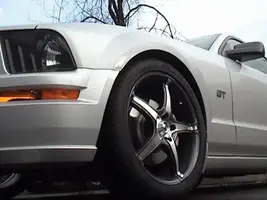
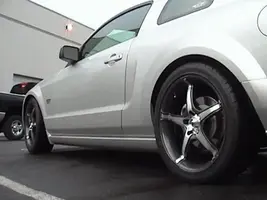
SteedaGus said:The Eibach springs will be around 1.5 inches. Ours will be closer to 1 inch. Either one will work but our springs will have more clearance for your 20 inch wheels than the Eibachs. If you want it as low as possible, I would take measurements and see how much clearance you have and make your decision from there.
i have the pro kit Eibach springs.i have 20 inch wheels. and the gap is perfect. i love the stance.
Similar threads

- Replies
- 24
- Views
- 780


- Replies
- 0
- Views
- 115
- Replies
- 3
- Views
- 216


- Replies
- 5
- Views
- 193
