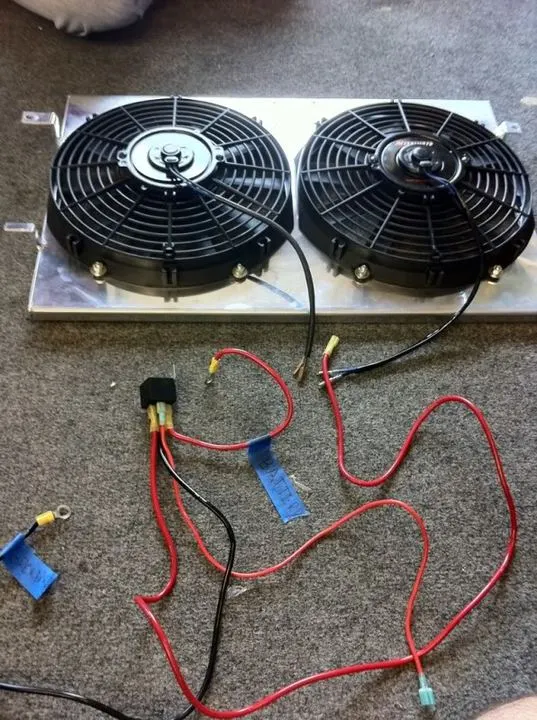
Electric Fan Install Help

VibrantRedGT

"STANGNET'S PENGUIN SMACKER"
15 Year Member
Nov 29, 1999
14,679
424
154
Boca Raton, Florida
Yes, I did the search and read some great stuff. Have an idea on how.

The dilema is the double electric fan set up came from a 94-95 so it will not be a direct bolt on. Knew that going in. Barted left over Steeda suspension parts for an even trade.

When I had my 94 a buddy of mine installed a switch so I could manually turn on / off the fan. Worked very well, especially at the track for cool downs. When I sold the 94 (still regret that), I removed all the wiring.

Please take a look at this picture and let me know if my current set up will work in a FOX. I'm no electrical guru so any help that will save me from a fire would be greatly appreciated.

Should I put a fuse on it? The relay in the picture is a 40a / 5 prong. Can I link both fans together or run seprate (one for low / one for high)? I'd rather just "High" when the key is on. Let me know where everything goes.

JR, Stangs&2Birds our there?

7c0c9716.webp
 
Hi.

Thankfully, This looks simple to figure out. :)
First, yes, always use a fuse. Put it as close to the power source as possible. Fans do short out, and so do wires.

Also, for the sn95s, they used a separate electronics box (?CCRM?) and the EEC to control fan speed via PWM ("pulses the voltage on/off" the correct way to control DC motor speed).


So, the sn95 fans are a single speed fan. The variable speed is done by electronics (the correct way to do cooling).
The black wire is ground, the blue wire is power.


A dual fan sn95 setup should be pretty good. Now, we get into the desired use for your car.

For a street car, I'd suggest a DCC controller to get better gas mileage and better life from the alternator and battery.


For a track car, you have a few options.
*I* would suggest that you always run at least one fan. Putting both fans on a switch means a few grand in melted engine parts sometime in the future. Sorry, we all make mistakes. It's too easy to turn both fans off and end up with melted metal.

So, you could use a relay setup that turns both fans on. Or, in this case, the second fan.


Disclosure: I haven't emailed Brian in 5+ years, or even chatted on the forums. A long time ago, we did have a few correspondences - via the forums. I have zero financial interest and gain in the DCC. But, I like Brian, the design, and I personally have a DCC controller (the WP85) that I bought through his website a few years , I never told him about it. I was just one of the regular customers. And, yes, it did take more than a month to get the unit. No such thing as email updates, etc. Kinda like ordering in a black hole. IMHO, BFD! :) I knew that was the case, and for my money, I greatly prefer the DCC units to anything else out there.

With the above said, I suggest using the:
WP85 $174.95
Fan Control

Yea, it is an overkill for the fans. But, the hotter the electronics run, the faster/greater the failure rate. So, I want my fan controller to be taking it easy, not being hot, and saying "That's a load - ha, ha, ha". :)

Ever have an electric fan or controller go on you? I HAVE! IMHO, for the cost of my engine, and security of mind, I want the best cooling I can (within reason of course). So, I also like dual fan setups and using real FORD fan motors.

For cool-down, just wire up a simple switch to the AC input on the DCC controller to run the fans at full-speed.

And, yes, the DCC web-pages and links and instruction leave a lot to be desired in terms of being up to date.


From:
WP60 Install
AC input
If the vehicle has air conditioning and a factory installed electric fan, connect the blue AC input wire of the harness to the unit and to the positive terminal of the OEM fan wiring harness. If the vehicle has air conditioning and originally came with a mechanical fan, connect the blue AC input wire of the harness to the air conditioning compressor input.

Testing the unit
Start the car. If equipped with air conditioning, turn on the AC, the fan should run at 100%.


Or, as I mentioned before,
1) Run the first fan always - through a separate relay that gets activated when the car turns on.
and
2) Run the second fan though a driver-controlled switched relay.

My concern with that type of setup is that there is still a chance of making a human mistake (like we all make), and not having the second fan running and the engine gets hot for some amount of time before the temperature gauge is checked and noticed. If the engine gets too hot, it'll cost more for a head gasket replacement (gaskets, anti-freeze, oil, etc) than for the DCC controller. Also, how much does it cost to do even just a few runs on one day?

I say first put the money where it makes the most sense and gains the most. :) My full-time gig my be with an FFRDC (part cost is often secondary when you're building only a few), but I still have my part-time, very cost sensitive & high volume, commercial product gig. I love telling people at my FFRDC how at my commercial gig, I had to spend 3-5 days to convince and prove to management to add a 25-cent FLASH chip to the design. :) So, figure that at my commercial gig, they spent about $2K in engineering time (they pay me per hour) to decide if we should ad a 25-cent chip. With the yearly volumes for that product, that made sense (and cents). But, if we where building only a few, then spending over $2K discussing the sense of adding a 25-cent chip would be foolish.

So, as I said, *I* consider where it makes the most sense to put the money to get the most back.
And, in my view, for a Fox or sn95 5.0, they need as much help in the cooling department as possible. The 5.0 throws off a ton of heat (it's very inefficient). And, the engine bay is tight with poor air flow.


Good Luck!
 
The 94-95 V8 cars have two-speed fans and they are not PWM.

If not going with a Delta unit, I'd use a 75 amp relay to control both of those.

I might be a little concerned about the shroud on that thing in the Fl heat. There's not a whole lot of area for air to move through when at speed...............
 
what kind of fuse should i use on the power wire for my electric fan and where should i hook the power input to? thanks.
What kind of fan and what size of wire is being used? Both are factors in choosing circuit protection.

You'll likely want to source power from the battery or starter solenoid.
 
If you don't have a high current alternator, you can forget about using the fan. The stock 65 amp alternator on 86-93 Mustangs isn't big enough to run the fan and the rest of the car. If you have a 94 or later Mustang, the stock 3g alternator should be fine if it is working correctly.

Switching a fan on and off manually is a bad idea. Too many guys have been distracted (hot girl kissing on their neck, too much to drink, dog tired and not thinking clearly) and cooked things because they forgot to flip the switch. An equal number have forgotten to turn the switch off for the same reasons and run down their battery.

The best fan controller available today is a DC Control unit. www.dccontrol.com. Cost is about $???. Be prepared to wait 4 weeks or more to receive your controller once you have sent in your payment. The controllers are custom made in small lots and lead times can stretch out.

Next best is a SPAL controller - $70-$90 See http://www.spalusa.com/fans/automated/accessories/fanpwm.html. eBay will have the controllers for the $70: do a Google search and see what you find.

At the bottom are the Hayden or Imperial controllers available through Advance Discount Auto Parts and AutoZone. The non adjustable one is about $30 ( Hayden 226206) and the adjustable one is about $60 (Hayden 226204). I recommend you do a Google search on Hayden and the part number for more info.

Do not use a simple on/off switch without using a relay. The current load can burn up the typical cheap automotive switch very quickly. The fan draws 30+amps and you need to use #10 wire on the fan power and ground wiring.

If you are good with electrical stuff (90% of the people here aren't), build your own controller. The numbers on the diagram (#86, #87, etc) refer to the numbers on the bottom of a typical automotive relay.

attachment.php


Note that the temp sensor in the diagram needs to match the thermostat in your engine. The preferred arrangement is to have it open about 5 degrees above the thermostat.

To allow the ignition switch to control the fan so that it does not run when the ignition is off, connect the relay contact #86 to the red/green wire on the ignition coil or to the red/yellow wire on the coolant level sensor.

If you are an experienced electronics tech or electrical engineer, email me and I will send you the prototype drawings of a fan controller that is similar in function to the DC Control unit. It is a build it, troubleshoot it yourself item. I will not build or troubleshoot units, so it is not suitable for anyone who isn't really good with electronics.

Alternate placement for a temp gauge sender or temp switch/temp sensor for an electric fan. Use the heater feed that comes off the intake manifold. Cut the rubber hose that connects the manifold water feed to the heater and splice in a tee adapter for the temp gauge sender. Be sure to use the same water feed line as the ECT sensor. That way you will get the most accurate temp readings.

Tee adapter info:
Make a pilgrimage to your local hardware or home supply center and get some copper pipe and a tee that fits the temp gauge sender. Solder two pieces of copper pipe onto a copper pipe tee with threads in the tee part. Find the correct brass fitting to match the temp sender threads to the tee fitting.

attachment.php


Fuse links come with a current rating just like fuses. A clue as to what current they are designed for is to look at the size wire they protect.

Choose the fuse according to the wire size.


Wire size current table:
http://www.stangnet.com/mustang-for...-wire-gauge-current-capacity-lenght-chart.gif


18 gauge wire = 5-8 amps
16 gauge wire = 10-12 amps
14 gauge wire = 15-17 amps
12 gauge wire = 20-25 amps
10 gauge wire = 30-40 amps
8 gauge wire = 50-60 amps.

Keep in mind that the wire size in the chart is for the circuit itself, not the size of the fuse link. The packages of fuse link repair material you can get at the auto parts stores also will have a current rating on them.

See http://fordfuelinjection.com/?p=7 for some excellent tips of soldering wires for best electrical performance.

Aircraft type circuit breakers are designed for low voltage DC applications and would be an excellent choice to replace fuse links. They come as a push/pull to reset button, and range from 1.5 amps to 60 amps and higher.

See http://www.aircraftspruce.com/index.php or http://www.wicksaircraft.com/catalogDetails.php or http://www.sacskyranch.com/ for circuit breakers and other items.

There is a store local to Orlando that does electronic surplus and has all kinds of circuit breakers. See www.skycraftparts.com That's where I get most of my wiring supplies. There may be a similar type store in your area
 
Hissan, I dont believe those are actually the 94-95 fans but the set-up was used in a SN car ;) otherwise your dead right.

Ive actually had decent succes with the Derale fan controllers over the years, I really like the DCC but I believe they are OOB?
 
Rick, we've got a couple of different guys posting so maybe that's the source of confusion. Those are definitely not OEM fans in Joe's/Vibe's post (it looks like the dual Mishimoto kit to me).

I don't think we know what kind of fan OonDeanisS wants to run.

Some of the info in my first post was not directed at Vibe, but was in response to someone else's post (I try to be be subtle and respectful, part of which is to not necessarily quote something which I feel might be slightly incorrect). :)