Engine Tech: How to improve efficiency?

I killed a turbo'd RX 8...they're slow as hell, handle really good though. But Yount's right, for a 1.3 thats pretty damn good. But the downside is you have to rev to like 6,500 to get it, rev's for power on the street is no bargain.
 
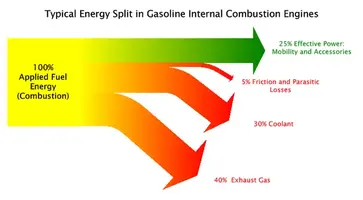
Here is an interesting tid-bit of info.
energy_path_gasoline_ice.webp
 

Attachments

  • energy_path_gasoline_ice.webp
    energy_path_gasoline_ice.webp
    12.9 KB · Views: 131
Michael Yount said:
Both the V6 AND THE V8 SHO's were engineered and built by Yamaha -- but Ford paid LOTS of money to put their name on it --- so it's a Ford. The Chrysler Crossfire has a Mercedes engine and tranny in it. Some of Saturn's vans have Honda engines. Ford's new hi/po Focus line in Europe will be powered by Volvo-derived engines; Lincoln LS V8 shares architecture with Jaguar/Aston Martin V8's (both owned by Ford); the new Toyota Nascar trucks and (soon) Camry's run pushrod V8's developed by Toyota Racing Development (TRD) -- Toyota doesn't have a pushrod V8 of their own; Bugatti's new Veyron has (basically) a VW motor in it; the Corvette 4-valve ZL-1 from years back had it's engine design/developed by Mercury of boat fame --- the list could go one forever. The manufacturers do what they have to do to put out product they think they can sell at a price that keeps them profitable.

If you really want to get convoluted -- take a look at Volvo's new 4.4L 60 DEGREE V8 - sound familiar? The folks at Yamaha were involved in that one too via Ford's ownership of Volvo...it's a bigger/bolder SHO III.
Agree'd:nice: I put Crane 1.7 RR's on my LX,the same one's used on the Cobra's,Ford has their name stamped on them even though Crane makes them!!
 
The turbo recaptures a relatively small percentage of the energy that's wasted as heat out the exhaust.

Hydrogen is a marvelous fuel - but for the fact it's extremely unstable (way more dangerous than gasoline) and that it doesn't occur on it's own anywhere because of that instability. So -- you have to extract it from other sources -- usually methane (CH4) or water (H2O). Therein lies the problem -- the energy it takes to liberate the hydrogen from the stuff it's attached to MORE than overcomes the benefits of using it as a fuel. And -- in order to liberate it -- most of our currently economic technology for creating hydrogen (electrolysis or biomass gasifiers or processing from methane) -- use, you guessed it -- hydrocarbon fuel. So either way --- we're still using hydrocarbons -- just in a different location. Hydrogen as a fuel the way we use gasoline as a fuel just doesn't make any sense because of that fact -- it costs more to create the hydrogen than it saves to use it, and for the most part it simply transfers the emissions issues to the processing plant rather than the car. So you see - while the hydrogen itself is a clean fuel, getting to it turns out to be just as dirty, and less efficient (when you include processing to make the hydrogen) as using the gasoline in the car.

The hydrogen lobby has marketers that are just as good as the guys that market big brakes.... :)
 
Another problem with Hydrogen is infrastructure.

Who makes it? You have to build plants to make it
Who stores it? You have to build tanks to store it
Who ships it? You want to be next to a semi with a hyrdogen bomb? - well not really
Who sells it? Where are all the hydrogen stations?

What do you do with current technology?
Who gets to pay for all of this capital expenditure?
Is this government funded and / or regulated?

Hydrogen represents a dream. That dream is about 0 emissions and really needs a good reality check.


*Note: California is making strides in establishing hydrogen stations / infrastructe but it is very localized.

Also, does anyone know if the engineers have figured out how to get the hydrogen motors started durring winter?
 
srothfuss said:
Another problem with Hydrogen is infrastructure.

Who makes it? You have to build plants to make it
Who stores it? You have to build tanks to store it
Who ships it? You want to be next to a semi with a hyrdogen bomb? - well not really
Who sells it? Where are all the hydrogen stations?

What do you do with current technology?
Who gets to pay for all of this capital expenditure?
Is this government funded and / or regulated?

Hydrogen represents a dream. That dream is about 0 emissions and really needs a good reality check.
I worked for united airlines in Denver (DIA) loading planes and we had to fuel our ground equipment.75% of the vehicles out there were Hydrogen..They worked fine,motors had plenty of power but you had to ride along side of a huge Hydrogen tank that took up the passenger seat! All the buses in Denver (mass transit) were hydro!

*Note: California is making strides in establishing hydrogen stations / infrastructe but it is very localized.

Also, does anyone know if the engineers have figured out how to get the hydrogen motors started durring winter?
I worked for united airlines in Denver (DIA) loading planes and we had to fuel our ground equipment.75% of the vehicles out there were Hydrogen..They worked fine,motors had plenty of power but you had to ride along side of a huge Hydrogen tank that took up the passenger seat! All the buses in Denver (mass transit) were hydro!
 
Hydrogen is a marvelous fuel - but for the fact it's extremely unstable (way more dangerous than gasoline) and that it doesn't occur on it's own anywhere because of that instability. So -- you have to extract it from other sources -- usually methane (CH4) or water (H2O). Therein lies the problem -- the energy it takes to liberate the hydrogen from the stuff it's attached to MORE than overcomes the benefits of using it as a fuel.

One of my current GEO classes is "Geological Perpective on Global Engery," so ill actually listen tomorrow for somethign good. It's in intro course, and im mostly upper level classes such as Mineral Structure and suck, so these filler classes get mighty boring.:rolleyes: Anyways Hydrogen is a real pain in the ass to get/use like Yount said. I still think the majority of transportation will NOT be relying on much gas 20 years from now.
 
90mustangGT said:
Diesel's do have TBs, or most of them do, don't they? Fuel/Air ratio is important on them as well. I don't see too many of them, so I can't be sure. next time a CTD, Powerstroke, or Duamax comes in I'll be sure too look. Diesels are great becasuse they use the heat of compression to fire, they use the fuel injectors to fire actually. It's called Direct Injection, something I don't understand why isn't done to a gas motor. Imagine, running 16:1 - 20:1 compression with a blower on pump gas.

There are engine's and motors, the difference is that while a motor just coverts energy, the engine actually has to make it. Our vehicles have engine's which have to convert a flamable liquid into rotational energy.

I agree with 88Stangboy. You need to minimize friction and try to get all the power to the wheels.

In a four-cycle motor, only one of those cycle's is creating power. After the combustion stoke, where the power is made, then the engine has to push the old gasses out, then pull the new gasses in, compress them for the next combusiton cycle. On top of this, you have to turn the weight of the rotation assembly, the camshaft, the oil pump, and other accesories that are running 100% of the time. A steam turbine is a very effeceint motor, that is what most powerplants such as nuclear and coal burning plants use. Of course they are in constant use, while in a car, with all the cold start ups and all, the efficency would be lost.
not all diesels are direct injection.....my 1992 f-250 banks turbo is An IDI motor
 
willys1 said:
I worked for united airlines in Denver (DIA) loading planes and we had to fuel our ground equipment.75% of the vehicles out there were Hydrogen..They worked fine,motors had plenty of power but you had to ride along side of a huge Hydrogen tank that took up the passenger seat! All the buses in Denver (mass transit) were hydro!


Also are all the forklifts and stuff like that in Lowes and stores like that....or maybe that was natural gas :shrug: we had a van in school that ran on gas and natural gas
 
I stand corrected. My friend's rx produces a peak of 250 ft lbs of torque but for a good chunk of the low to mid rpm range its painfully low. Anyways its beside the point. Wankel is not an efficient engine.
Kevin
 
I think that the engieering R&D centers are still searching for the perfect engine. Or at least a renewable fuel source that doesn't come from the middle east....

Ethonal mixed with regular gasoline is starting to become popular also. But that is just a crutch.
 
srothfuss said:
I think that the engieering R&D centers are still searching for the perfect engine. Or at least a renewable fuel source that doesn't come from the middle east....

Ethonal mixed with regular gasoline is starting to become popular also. But that is just a crutch.
the LS1 isnt the perfect engine? :shrug: :rlaugh: