First P-51 Intake Running in Alberta

MatthewP

Founding Member
Dec 7, 2001
355
0
0
Calgary, Alberta
I recently completed a significant upgrade on my 02 Mustang GT Convertible. The car is a daily, year round driver and while I wanted better performance, reliability and streetability were also of paramount importance. As many of you know, I have another Mustang that’s oriented more toward the drag strip, and I didn’t want to turn my driver into a loud unreliable unlivable kind of vehicle. Consequently, I decided to go with a reasonably mild N/A build up with a target of making the GT at least as fun as a 97 Cobra that I used to have. To that end, I chose the following parts:

- Comp XE262AH cams
- Comp beehive modular springs
- Bassani mid-length headers
- Bassani X-pipe
- Accufab 75mm Throttle body
- Steeda underdrive pullies
- Fox Lake P-51 intake manifold
- Heads – Ported PI, Ferrea valves, milled .020”
- 3.73 Ford Racing Gears

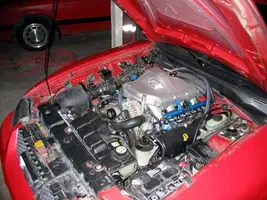
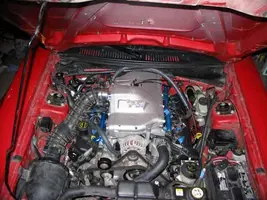
The project went well, though it took a little more time than I had originally anticipated. The headers are a tight fit, but the Bassani mid lengths are decidedly easier to install than long tubes on the 4.6. The X-pipe did not fit out of the box and required a little trimming on the passenger side with a hacksaw, but finally bolted up ok. The intake fits but it does have minor hood clearance problems and getting the EGR system hooked up to it was more difficult than I expected it to be.

I ported the heads myself, and would say that they are generally an easier job than typical 5.0 heads since the ports are straighter and the castings are actually pretty nice. You do have to worry more about cleanup after the port work because of the oil passages in the heads which provide lubrication to the cams. I also installed the slightly larger Ferrea valves, Comp’s beehive springs, and had the heads milled .020”, which was the maximum amount recommended by Ford’s tech line to avoid cam timing problems.

I chose the Comp XE262AH cams because of their good power in the 3000-6000 RPM range, and their clean reputation for clearing stock pistons. Although there are several competitive cams out there that are popular for the mod motors, if you look closely at the specs you will find that Comp’s basic PI mod motor cams (XE262AH) are about as aggressive as the competitions stage 2 or even stage 3 cams. I’ve had great luck with Comp cams over the years, and these are no exception.

Following the upgrades, the street manners are good – very close to stock. While the car sounds more aggressive than it did stock, it’s not harsh or unlivable and in my opinion is just perfect for a daily driven cruiser.

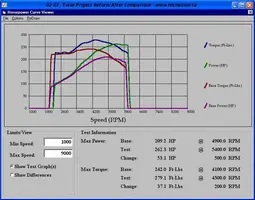
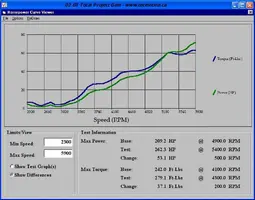
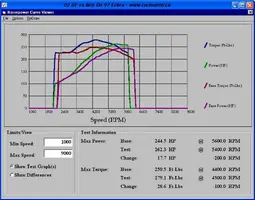
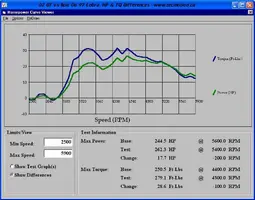
From a power standpoint, the modifications created a much fatter power and torque curve in the 3000-6000 RPM range, gaining as much as 70 RWHP on the Mustang MD-600 dynamometer at 5900 RPM. I did not lose power or torque at any point in the curve, though I had expected to be slightly worse than stock below 3000 RPM. From a comparative standpoint, the car is much better than an intake/exhaust/pulleys/chip 97 Cobra that I tested recently, with between 20 and 25 more RWHP between 3500 and 5400 RPM, and as much as 30 ft-lb’s more torque in the same range. I also compared the car to a bolt on 03 Mach I that I tested and the modified GT compared very well, besting the Mach between 4500 and 5800 RPM. Final numbers on the GT were 262.3 RWHP and 279.1 RWTQ, which I estimate to be about 350 HP and 372 ft-lbs SAE Net.

Putting the dyno tests aside, the car feels great on the street, and is definitely more car than my old 97 Cobra was. Although I didn’t build it for the track, I think it might make for a fun evening one night next summer.

-Matthew
 

Attachments

  • IMG_0703_small1.webp
    IMG_0703_small1.webp
    72.3 KB · Views: 233
  • IMG_0705_small1.webp
    IMG_0705_small1.webp
    75.5 KB · Views: 203
It seems a little low on power. The intake didn't seem to add anything. I make those numbers with stock intake, stock heads, stock plenum, and VT stage 2 cams. I may be way off base but I would have guessed a little higher. Congrats on getting it together!
 
TweekedGT said:
It seems a little low on power. The intake didn't seem to add anything. I make those numbers with stock intake, stock heads, stock plenum, and VT stage 2 cams. I may be way off base but I would have guessed a little higher. Congrats on getting it together!

You have a lot higher compression on a 96, and long tubes, and aftermarket mufflers, and if I'm not mistaken you also have a cold air setup right? All of those things make a difference. I compared the car to a reference car which was quite similar to yours - 98 GT, long tubes, PI head swap, pullies, Comp 262AH cams, and all the other usual bolt ons, and my car looks right on what that car did - just a few HP more.

I think that one of the key areas where the intake is helping is in the higher RPM ranges. You will notice that at 5900 RPM, my total project gain is 70 RWHP, which is pretty close to 95 HP at the flywheel. I do think that the intake has helped the average horsepower over the usable range significantly.

As to the intake being ugly, I like it better installed on the car than I did on the bench, but I actually think it's kind of cool looking. I am disappointed with the hood clearance issues, and when I called Fox Lake about it they just blamed Ford for not making the hood higher/engine installation lower. The port finish on the intake where it meets the heads is poor out of the box, so I cleaned it up with a die grinder. Regardless of these flaws, making an 02 run with a PI head swap 96-98 that has a few more tricks means that the intake IS helping. How much is a matter of debate, since I didn't have time to do the project with the stock intake, dyno it, then switch to the P-51 and dyno it again.

-Matthew
 
That is a pretty wild estimation on the HP and TQ at the flywheel. What transmission do you have? There is no way you are losing that much HP or TQ through your drivetrain. My 96 TBird with a 4R70W and IRS does not lose anywhere near that and a mustang is far more efficient at putting HP to the wheels over a TBird.

Realisticilly, you are at about 310HP and 325 TQ.
 
It's a Mustang MD-600 which reads quite a bit lower than the dynojets. On a dynojet, it would be about 298 HP / 317 ft-lbs, at the wheels. I run a dyno shop and I can assure you that this is a reasonable cross reference.

As another reference, a stock 05 GT makes about 240 HP at the wheels on my dyno. The same cars are making 270-275 HP at the wheels on a dynojet.

The Mustang dyno may not be the best for your ego, but I do like it better for tuning, and the numbers are repeatable and cross-referencable to other standards.

-Matthew
 
Your estimation is still way off! You haven't answered my question.

I am going to use your 05 GT example to attempt to show you your flaw. An 05 GT is rated at 300 HP at the flywheel, yet makes 240 HP at the wheels on your dyno. That is a 60HP difference. Now the 05's manual transmission drivetrain is not as efficient as an 04 GT's manual drivetrain. They have the same clutch, transmission and differential, the difference is that the 05 has a 2 piece driveshaft, compared to the 04's 1 piece. Not a lot of HP is lost by going to that, so an 04 GT is likely putting down around205 RWHP on your dyno in stock trim.

A thunderbird on a mustang dyno loses about 75 - 80 HP compared to it's flywheel rating. There is no way your car is less efficient than that. Depending on the transmission in your car you are losing between 60 - 75 HP, which puts you bang on to where I suggested.

I might be somewhat new to Stangnet, but I am not some Newbie that has no experience with dynos and such.
 
TGJ said:
Your estimation is still way off! You haven't answered my question.

Well, I don't know about you, but I've personally run thousands of dyno tests with the Mustang MD-600 and cross referenced them against dynojets in back to backs, drag strip results, and tests on the same or similar vehicles at other facilities, and I can tell you that my conversion to SAE Net is reasonably accurate. As with any conversion, there is room for a small error margin, but the stated results are approximately accurate.

As to these specific tests, let's take a closer look. The car started in totally stock form at 209.2 HP, and ended at 262.3, a gain of 25.4%. If you accepted that the factory rating of 260 SAE Net HP is accurate, you must attribute at least 326 SAE Net HP to the car now. It is my opinion following tests on hundreds of Mustangs that the cars built since the Cobra power fiasco in 1999 have been underrated. I would suggest to you that my car in stock trim actually produced about 278 SAE Net HP, and adding 25.4% to that, you get about 348, which is right where I suggested the power was.

Mustangs built before the 1999 Cobra fiasco generally produce power on the dyno which is consistent with their rated power levels, or even slightly lower. The 1997 Cobra in my example is a good case in point. That car has pullies, cat back, cold air, and a chip, and made 245 HP at the wheels. I estimate that to be about 326 SAE Net. The parts on the car are well known and account for an approximately 20 HP gain over stock, which puts the stocker at about 305, right on where it is rated.

As to the 05 GT's, my opinion is that they are actually producing about 318 SAE Net as shipped.

While I appreciate your comments regarding the conversion, and accept that at first blush it appears high, I stand by the calculation as accurate within reason.

-Matthew
 
well take your ending hp 262 and subtract it from your starting power 209 that = 53rwhp gain. now take the factory rating 260 and add the 52hp. that =312 hp at the engine.

that is also how i figure mine to be about 325 hp engine. this might be the wrong method, but seems more realistic then the % route you are using.
 
You can't add a RWHP gain to an SAE Net rating and get any meaningful number. It's like adding apples and oranges, or Canadian and US dollars without a currency conversion. If your 290 number is an SAE J1349 number from a dynojet, I would suggest that you are closer to 340 SAE Net.

-Matthew
 
MatthewP said:
You can't add a RWHP gain to an SAE Net rating and get any meaningful number. It's like adding apples and oranges, or Canadian and US dollars without a currency conversion.
-Matthew

I may have been low, but not by much. You did know that the factory rating is SAE. You are correct, you can not add the difference back, but you are VERY WRONG to use a percentage, which looks like you did. Your car lost 51HP in the drivetrain in stock trim, and according to you now you are losing 88 RWHP with the current setup. There is no way you are losing that. It is correct to think that a drivetrain will eat more HP as HP goes up, but it is not based off a percentage.
 
I'm saying that although the stock setup is rated 260 HP, the real output is closer to 280, as shipped. In that case, based on your method, the accessory and drivetrain loss is 71 HP. Because the power peak moved up over 10% from 4900 to 5400, accessory and drivetrain losses at the power peak have increased by at least 10%. In fact, since many of the losses are through systems with nonlinear power consumption such as the water pump, power steering pump, transmission and rear end, actual losses will be more than 10% higher, somewhere in the 80 HP range. Adding the additional losses of about 9 HP to the realized gain of 53 HP, and the original power level of about 280 HP gives you 342 HP, which is right in the ballpark compared to my other conversion method.

We could argue all day about exactly what the SAE net power level is, but what really matters is how it compares to other cars. As I've indicated, with the modification program it now compares favorably with mildly modded Mach I's, mildly modded 05 GT's, typical H/C/I 5.0's, and is much better than a typically modified 97 Cobra. Even better, it feels great on the street.

-Matthew
 
In 2001, the 4.6 2V mustang motor got a slight compression bump. 2001 is also the first year Ford adopted a new method of rating the HP of their motors, which is verified by an independant company which CAN alter the factory rating of a motor. I find it rather strange that this independent company never changed the output of the 2v 4.6 from 260 to 280. I mean they have changed some of GM's outputs from 175 to 177, 200 to 201 and 200 to 205 in some cases. If the 4.6 was making 280 as you suggest, why did they never change it, I am curious? Maybe just maybe, Ford was bang on with the 260 rating. The same thing with the 05, it has not changed.

I know for a fact that a Tremec 3650, stock 1 piece driveshaft, solid axle in a mustang will make 18 RWHP more with an identical engine setup in a 4R70W, stock 2 piece driveshaft and IRS Thunderbird. According to your calculations with your car( 71 HP ) to a Thunderbird( 75 - 80 ), that difference is 4 - 9 RWHP. What drivetrain mods have you done to your car that made it's output almost as bad as a TBird's again, I am curious?

I am not going to continue to argue with you. All you are doing is digging yourself a deeper hole!
 
Is Mat's car auto??? I don't think he's that out to lunch if you consider that the mustang dyno always reads quite a bit lower than the dynojet and calgary's ridiculous altitude. If you take the gains and add them to the stock ratings and add say 20 hp for drivetrain loss and maybe even 10 for altitude that puts you around 345 wouldnt it? Add another 5 for an experience bonus and that gets you your 350. Which is deffinetly not an unreasonable number for his combo and tuning experience.
 
TweekedGT said:
It seems a little low on power. The intake didn't seem to add anything. I make those numbers with stock intake, stock heads, stock plenum, and VT stage 2 cams. I may be way off base but I would have guessed a little higher. Congrats on getting it together!

the power does seem low for all those parts,I have that with factory heads/cams/headers, see my sig