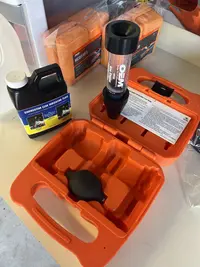
It’s one of the hand pump ones where you squeeze a tiny vacuum ball so maybe it’s just a crappy tester?Just tested it using a renter from the autostore. Fluid stayed blue and never changed color, so no head gasket leak?
It’s one of the hand pump ones where you squeeze a tiny vacuum ball so maybe it’s just a crappy tester?Just tested it using a renter from the autostore. Fluid stayed blue and never changed color, so no head gasket leak?

You're not talking about his thing, I hope:It’s one of the hand pump ones where you squeeze a tiny vacuum ball so maybe it’s just a crappy tester?
No haha. Mine has the same ball tho. I’ll snap a picYou're not talking about his thing, I hope:
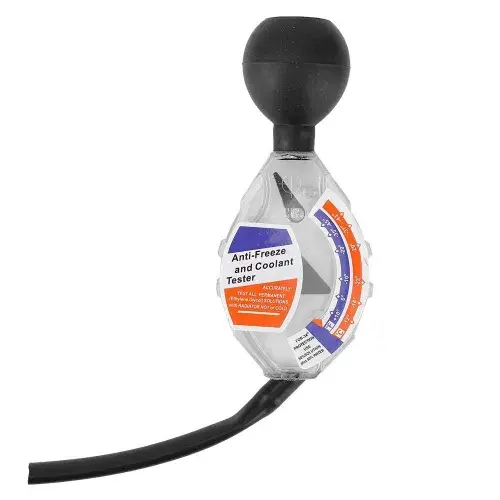
No haha. Mine has the same ball tho. I’ll snap a pic


 stangnet.com
I’ll do this while I’m doing the radiator!Tried and true way to get the air out is to drill a 1/8" hole in the thermostat body and install it at the 12:00. Requires going into the t-stat housing which sucks but once done its always there and get as much air out of the system as you can on a refill. See Post #52 here:
347 RUNNING HOT
I did this 2 days ago. I reinstalled a 185* T-stat after not running one. Temp gauge went from bottom to mid gauge. Probably right where it should be.

600k miles amazing how many miles between oil changes? Is the transmission original?Cause and effect...
Cause there is oil dripping on the starter......
It's not supposed to be oiled, only operates (hopefully) for a few seconds.
I won't bore you with 'my '97 Super Duty has 600k+ miles and only replaced starter once'. True story.
Effect...
Oil seepage disrupts the electrical current, dirt and crude gathers on the oily residue making matters worse. Inside and out.
To put it in perspective, take a scrap piece of metal, any metal, place a couple drops in the centre, stick it in a corner, on a shelf, under your car, someplace out of the sun and out of your way. You will be surprised how much it spreads in a week or so. Imagine months and miles, heat cycles, you get the picture.
Replace the starter pay'n attention to the condition of cables and connections, fix the oil leak, most times it's the valve cover gaskets.
Now go forth my friend and be powerful

Sounds like Air in the system..So, new radiator from LMR and new temp gauge sender.
Car still overheats at idle with the ac on and cools right back down when driving. Took some temps with the infrared today and it read 140° at the radiator and upper hose, 220° and rising with the thermostat housing, and 180° at the temperature gauge sensor (drivers side intake). Is this thing overheating or what? The gauge sits there and climbs at idle but the only thing that gets hotter is the thermostat housing. Should I test somewhere else to be more accurate?

I slept poorly for many nights after the Lorena Bobbit story broke......NOTE: don't let the chief cook know you used one the their pots, remember there are sharp knifes near by.
3 year old LMR fan and clutch. I’ll give the washout a try when I get back from the beach!What fan do you have? Also, with the condenser core (AC "radiator" in front of the engine radiator) in front of the radiator it get all the debris so typically when you replace the radiator a gentle high pressure washout of the condenser is a good thing. We did my buddy's a few years back and washed it from the engine side to the front of the car and holy crap there was a bunch of crap in it. Car ran way cooler and it was like it had a new AC system.
Noted lol! I’ve been planning on getting a new temp gauge, just haven’t bought it yet. I’ll check thermostat and all when I return from the beach aswell.#1 get a real temp gauge, I have mine at the bottom of the dash near the left corner, slight head move and I can see it.
#2 test the t-stat on the stove, I compared it with a meat thermometer, first 180* stat I tested didn't open till over 200*, second one opened at 185* , I can live with that.
NOTE: don't let the chief cook know you used one the their pots, remember there are sharp knifes near by.
The t-stat housing will most times test a little higher than the lower part of the radiator.