NOTE: Disconnect the battery negative terminal before making any resistance measurements.
The small voltage drop caused by the current draw of the computer and radio can upset the resistance measurements.
Reconnect the battery cable after you complete your resistance checks. Be aware that this will clear the
computer of codes, but it will not fix the root cause that made the computer set the codes.
Code 22 MAP (vacuum) or BARO signal out of range. The MAP or BARO sensor is pretty much the same
sensor for both Mass Air & Speed Density cars. The main difference is where it is connected. Mass Air cars
vent it to the atmosphere, while Speed Density cars connect it to the intake manifold vacuum.
It's purpose is to help set a baseline for the air/fuel mixture by sensing changes in barometric pressure.
The MAP or BAP sensor puts out a 5 volt square wave that changes frequency with variations in
atmospheric pressure. The base is 154 HZ at 29.92" of mercury - dry sunny day at sea level, about 68-72 degrees.
You need an oscilloscope or frequency meter to measure it. There is no way you can use a common cheap
voltmeter or DVM to accurately measure the output signal.
The MAP/BARO sensor is mounted on the firewall behind the upper manifold.
Baro or MAP test using frequency meter - run the test key on engine off. The noise from the ignition system
will likely upset the frequency meter. I used a 10 x oscilloscope probe connected from the frequency meter
to the MAP/BAP to reduce the jitter in the meter's readout.
If it is defective, your air/fuel ratio will be off and the car’s performance & emissions will suffer
Some basic checks you can make to be sure that the sensor is getting power & ground:
Note that all resistance tests must be done with power off. Measuring resistance with a circuit
powered on will give false readings and possibly damage the meter.
Check the resistance
between the black/white wire on the MAP/BARO sensor and then the black/white wire on the EGR and
the same wire on the TPS. It should be less than 1 ohm. Next check the resistance between
the black/white wire and the negative battery cable. It should be less than 1.5 ohm.
The following power on check requires you to turn the ignition switch to the Run position.
Use a DVM to check for 5 volts on the orange/white wire. If it is missing, look for +5 volts at the
orange/white wire on the TPS or EGR sensors. Use the black/white wire for the ground for the DVM.
Code 34 Or 334 - EGR voltage above closed limit - Failed sensor, carbon between EGR pintle valve
and seat holding the valve off its seat. Remove the EGR valve and clean it with carbon remover.
Prior to re-installing see if you can blow air through the flange side of the EGR by mouth. If it leaks, there
is carbon stuck on the pintle valve seat, replace the EGR valve ($85-$95).
If the blow by test passes, and you have replaced the sensor, then you have electrical ground problems.
Check the resistance between the black/white wire on the MAP/BARO sensor and then the black/white
wire on the EGR and the same wire on the TPS. It should be less than 1.5 ohm. Next check the
resistance between the black/white wire and the negative battery post. It should be less than 1.5 ohm.
Note that all resistance tests must be done with power off. Measuring resistance with a
circuit powered on will give false readings and possibly damage the meter.
Let’s put on our Inspector Gadget propeller head beanies and think about how this works:
The EGR sensor is a variable resistor with ground on one leg and Vref (5 volts) on the other. Its’ resistance
ranges from 4000 to 5500 Ohms measured between Vref & ground, depending on the sensor. The center
connection of the variable resistor is the slider that moves in response to the amount of vacuum applied.
The slider has some minimum value of resistance greater than 100 ohms so that the computer always
sees a voltage present at its’ input. If the value was 0 ohms, there would be no voltage output. Then the
computer would not be able to distinguish between a properly functioning sensor and one that had a
broken wire or bad connection. The EGR I have in hand reads 700 Ohms between the slider (EPV) and
ground (SIG RTN) at rest with no vacuum applied. The EGR valve or sensor may cause the voltage to
be above closed limits due to the manufacturing tolerances that cause the EGR sensor to rest at a
higher position than it should.
This will affect idle quality by diluting the intake air charge
Code 35 EVR - EVP sensor signal is/was high – Bad sensor, or possible missing ground for EVR circuit.
With the power off, measure the resistance between the black/white wire and battery ground.
You should see less than 1 ohm. Check the same black /white wire on the TPS and MAP sensor.
More than 1 ohm there and the wire is probably broken in the harness between the engine and the computer.
The 10 pin connectors pass the black/white wire back to the computer, and can cause problems.
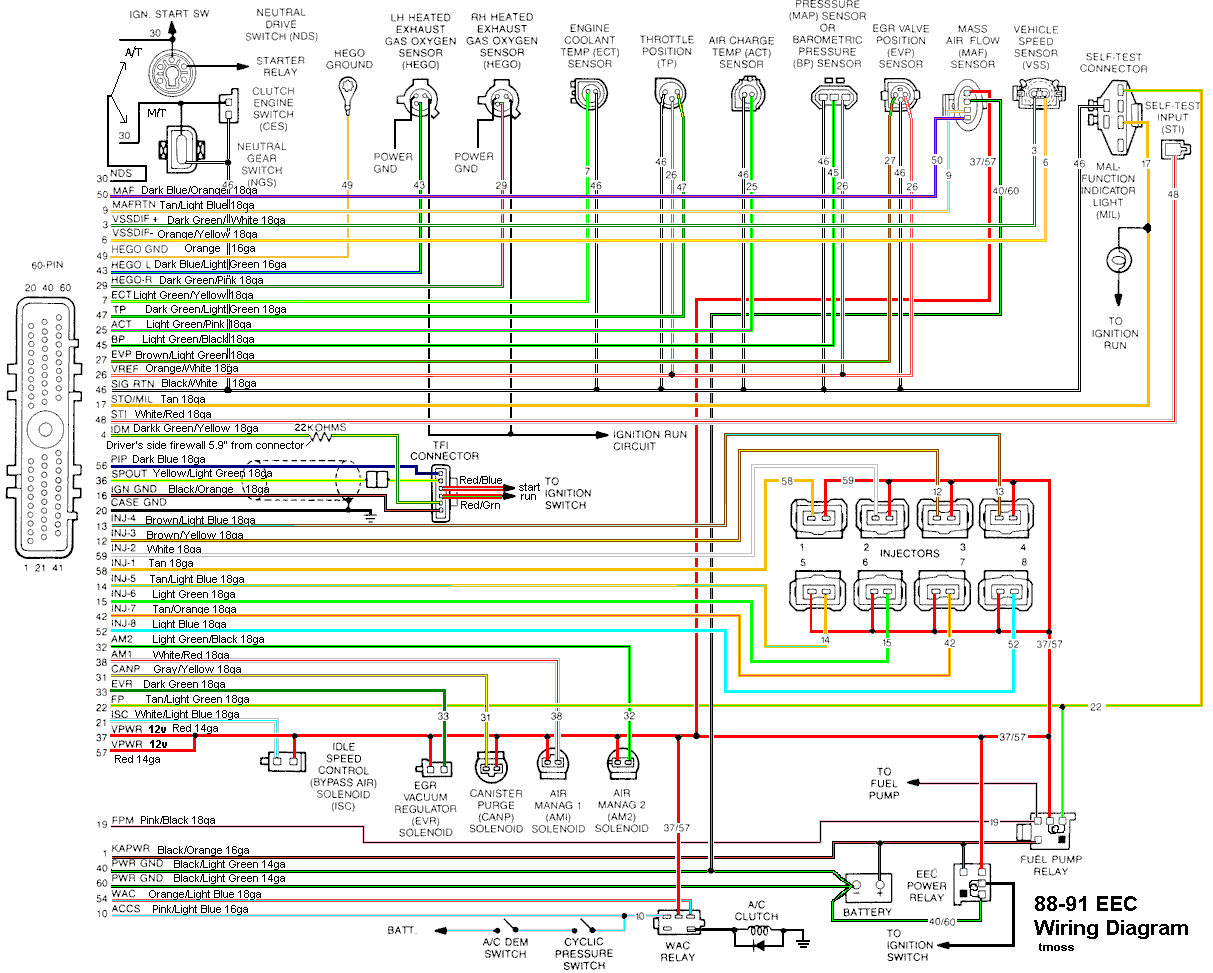
See the following website for some help from Tmoss (diagram designer) & Stang&2Birds (website host)
http://www.veryuseful.com/mustang/tech/engine/images/88-91eecPinout.gif
See
http://fordfuelinjection.com/index.php?p=6 for more wiring help & 10 pin connector diagrams
Code 51 Engine Coolant Temperature (ECT) sensor signal is/was too high -
Possible bad ECT sensor, or wiring.
Possible missing signal ground – black/wire wire broken or bad connection. With the power off, measure the
resistance between the black/white wire and battery ground. You should see less than 2 ohms.
Check the same black /white wire on the TPS and MAP sensor. More than 2 ohms there and the wire is
probably broken in the harness between the engine and the computer. The 10 pin connectors pass the
black/white wire back to the computer, and can cause problems.
Pin 7 on the computer - ECT signal in. at 176 degrees F it should be .80 volts
Voltages may be measured across the ECT by probing the connector from the rear.
Use care in doing it so that you don't damage the wiring or connector.
Here's the table :
68 degrees F = 3.02 v
86 degrees F = 2.62 v
104 degrees F = 2.16 v
122 degrees F = 1.72 v
140 degrees F = 1.35 v
158 degrees F = 1.04 v
176 degrees F = .80 v
194 degrees F = .61
Note that all resistance tests must be done with power off. Measuring resistance
with a circuit powered on will give false readings and possibly damage the meter.
Ohms measures at the computer with the computer disconnected, or at the sensor with
the sensor disconnected.
50 degrees F = 58.75 K ohms
68 degrees F = 37.30 K ohms
86 degrees F = 27.27 K ohms
104 degrees F = 16.15 K ohms
122 degrees F = 10.97 K ohms
140 degrees F = 7.60 K ohms
158 degrees F = 5.37 K ohms
176 degrees F = 3.84 K ohms
194 degrees F = 2.80 K ohms
Diagram courtesy of Tmoss & Stang&2birds
See the following website for some help from Tmoss (diagram designer) & Stang&2Birds (website host)
for help on 88-95 wiring
http://www.veryuseful.com/mustang/tech/engine/
http://www.veryuseful.com/mustang/tech/engine/images/IgnitionSwitchWiring.gif
http://www.veryuseful.com/mustang/tech/engine/images/fuel-alt-links-ign-ac.gif
http://www.veryuseful.com/mustang/tech/engine/images/88-91_5.0_EEC_Wiring_Diagram.gif
Code 53 - Throttle Position sensor too high – TPS – TPS out of adjustment, bad connections, missing signal ground, bad sensor.
Try this... Currently there is some dispute about setting it at .99 volts being worth the effort, but anything l
ess is probably OK. All you need is less than 1.0 volt at idle and more than 4.25 at Wide Open Throttle (WOT).
You'll need a Digital Voltmeter (DVM) to do the job.
Wire colors & functions:
Orange/white = 5 volt VREF from the computer
Dark Green/lt green = TPS output to computer
Black/white = Signal ground from computer
Always use the Dark Green/lt green & Black/white wires to set the TPS base voltage.
Do the test with the ignition switch in the Run position without the engine running.
Use the Orange/white & Black white wires to verify the TPS has the correct 5 volts source from the computer.
Here’s a TPS tip I got from NoGo50…
When you installed the sensor make sure you place it on the peg right and then tighten it down properly.
Loosen the back screw a tiny bit so the sensor can pivot and loosen the front screw enough so you
can move it just a little in very small increments. I wouldn’t try to adjust it using marks.
Set it at .97v-.99v, the closer to .99v the better. Just don’t go over .99, or you upset the fuel calibration and idle quality will suffer.
(copied from MustangMax, Glendale AZ)
1. Always adjust the TPS and Idle with the engine at operating temp. Dive it around for a bit if you can and get it nice and warm.
2. When you probe the leads of the TPS, do not use an engine ground, put the ground probe
into the lead of the TPS. You should be connecting both meter probes to the TPS and not one to the
TPS and the other to ground.
3. Always reset the computer whenever you adjust the TPS or clean/change any sensors. I just pull the battery lead for 10 minutes.
4. Check the procedure for your year, on my 90 I have to turn the idle screw until it just touches the tab,
then insert a .010 feeler gauge and give it about one more turn. Then you adjust the TPS voltage to .98v,
reset the computer. Start it up, if the idle is to low then turn the screw in until it is just right, then readjust
the TPS voltage to .98v and reset the computer and start it up. The key is to adjust the TPS voltage
and reset the computer whenever the idle screw is changed.
Adjusting the TPS fails to resolve the problem:
Check the black/white wire resistance. Connect one ohmmeter lead to the black/white wire on the
TPS and one lead to the negative post on the battery. You should see less than 1.5 ohm,
more than that indicates a problem.
Always take resistance measurements with the circuit powered off.
Clean the 10 pin salt & pepper shaker connectors.
.
See
http://fordfuelinjection.com/index.php?p=85 for more help
Code 54 – ACT sensor out of range. Broken or damaged wiring, bad ACT sensor. Note that that if the
outside air temp is below 50 degrees F that the test for the ACT can be in error.
Check the resistance of the black/white wire to battery ground. If it is less than 2 ohms, it is good.
If it is more than 2 ohms, the black/white wire has bad connections or a broken wire. Always take
resistance measurements with the circuit powered off.
Then check the resistance of the ACT sender located in the #5 intake runner on most 5.0 stangs.
ACT & ECT test data:
The ACT & ECT have the same thermistor, so the table values are the same
Pin 7 on the computer - ECT signal in. at 176 degrees F it should be .80 volts
Pin 25 on the computer - ACT signal in. at 50 degrees F it should be 3.5 volts. It is a good number i
f the ACT is mounted in the inlet airbox. If it is mounted in the lower intake manifold, the
voltage readings will be lower because of the heat transfer. Here's the table :
68 degrees F = 3.02 v
86 degrees F = 2.62 v
104 degrees F = 2.16 v
122 degrees F = 1.72 v
140 degrees F = 1.35 v
158 degrees F = 1.04 v
176 degrees F = .80 v
194 degrees F = .61
Ohms measures at the computer with the computer disconnected, or at the sensor with the sensor disconnected.
50 degrees F = 58.75 K ohms
68 degrees F = 37.30 K ohms
86 degrees F = 27.27 K ohms
104 degrees F = 16.15 K ohms
122 degrees F = 10.97 K ohms
140 degrees F = 7.60 K ohms
158 degrees F = 5.37 K ohms
176 degrees F = 3.84 K ohms
194 degrees F = 2.80 K ohms
All of the above codes have the black/white signal ground as their common connection point.
If this signal ground goes bad, all the sensors that use it will read high or inoperative.
Code 95 - the following test path is for 86-90 model Mustangs.
The 95 code is because at one time or another, the fuel pump relay hiccupped and didn't provide
power the pump when the computer told it to run. Sometimes this is a one time thing, other times
it is a no run or runs poorly condition.
To help troubleshoot the 95 code, follow this link for a wiring diagram
http://www.autozone.com/images/cds/gif/large/0900823d80167162.gif
Using the diagram, check the red/black wire from the fuel pump relay: you should see 12 volts or so.
If not, check the inertia switch: on a hatch it is on the driver’s side by the taillight. Look for a black
rubber plug that pops out: if you don't find it, then loosen up the plastic trim. Check for voltage
on both sides of the switch. If there is voltage on both sides, then check the Pink/black wire
on the fuel pump relay: it is the power feed to the fuel pump. No voltage there, check the Orange/Lt blue wire, i
t is the power feed to the fuel pump relay & has a fuse link in it. If there is good voltage there & at
the Pink/black wire, swap the relay.
Some Mass Air conversions neglect to run the extra fuel pump wire, and they always have a 95 code. See
http://www.stangnet.com/tech/maf/massairconversion.html for more information on the Mass Air wiring conversion.
Code 96 – KOEO- Fuel pump monitor circuit shows no power - Fuel pump relay or battery power
feed was open - Power / Fuel Pump Circuits. The fuel pump lost power at some time while the ignition
switch was in the run position.
Look for a failing fuel pump relay, bad connections or broken wiring. The fuel pump relay is located under
the Mass Air Meter on Fox bodied stangs built after 91. On earlier model cars is under the passenger
seat. On Mass Air Conversions, the signal lead that tells the computer that the fuel pump has power
may not have been wired correctly. See
http://www.stangnet.com/tech/maf/massairconversion.html
To help troubleshoot the 96 code , follow this link for a wiring diagram for 87-90 models
http://www.veryuseful.com/mustang/tech/engine/images/fuel-alt-links-ign-ac.gif
for 91-93 models see
http://www.autozone.com/images/cds/gif/large/0900823d80195960.gif
Look for power at the fuel pump - the fuel pump has a connector at the rear of the car with a
pink/black wire and a black wire that goes to the fuel pump. The pink/black wire should be hot
when the test connector is jumpered to the test position. . To trick the fuel pump into running,
find the ECC test connector and jump the connector in the lower RH corner to ground.
No voltage when jumpered, check the fuel pump relay and fuse links.
86-90 Models:
Using the diagram, check the red/black wire from the fuel pump relay: you should see 12 volts or so.
If not, check the inertia switch: on a hatch it is on the drivers side by the taillight. Look for a black
rubber plug that pops out: if you don't find it, then loosen up the plastic trim. Check for voltage on
both sides of the switch. If there is voltage on both sides, then check the Pink/black wire on the
fuel pump relay: it is the power feed to the fuel pump. Good voltage there, then the fuel pump is the
likely culprit since it is getting power. No voltage there, check the Orange/Lt blue wire, it is the power
feed to the fuel pump relay & has a fuse link in it. Good voltage there & at the Pink/black wire, swap the relay.
91-93 Models:
Using the diagram, check the dark green/yellow wire from the fuel pump relay: you should see 12 volts or so.
If not the relay has failed or is intermittent. Check the inertia switch: on a hatch it is on the drivers side by
the taillight. Look for a black rubber plug that pops out: if you don't find it, then loosen up the plastic trim.
Check for voltage on both sides of the switch. If there is voltage on both sides, then check the Pink/black
wire on the fuel pump relay: it is the power feed to the fuel pump. Good voltage there, then the fuel
pump is the likely culprit since it is getting power. No voltage there, check the Pink/black wire, it is
the power feed to the fuel pump relay & has a fuse link in it. Good voltage there & at the dark green/yellow wire, swap the relay.