Help!! My Car Just Died

They just put my old distributor in and still no difference.
Where is the fuel pump relay coil located?

I think I'm going to have to bring it to the garage that has all the computer software.

If the computer is shot, how much for a new one? And which kind should I get?
 
Lots of jumping to conclusions here.

First of all, if there is spark, why would someone swap dizzies?

The reference a coil is the fuel pump relay. The coil is what allows the the relay to open and close.

If you do not have injector pulsing but do have spark, I'd have checked for key-on 12 volts to the injectors. If that's missing, there's a fusible link or wiring issue.
 
I just brought my car to my other mechanic that has all the diagnostic tools and computer related equipment.
He can't get to it untill Monday or Tuesday.

I may try to check injector pulse this weekend, key on 12 volts to the injectors.

HISSIN, where do I put my postive and negative probes on my voltage meter to check this? And, do I check every injector?
Also I'm going to check the fusible link. There's one on the under dash fuse box.
Are there any other fusible links that I should be checking, and where are they if so.
Do you just pull the fusible link straight out just like any other fuse?

Sorry for all the question. But maybe I could solve this problem myself and save some money!
Thanks for all the input.
It's verymuch appreciated.
 
I just brought my car to my other mechanic that has all the diagnostic tools and computer related equipment.
He can't get to it untill Monday or Tuesday.

I may try to check injector pulse this weekend, key on 12 volts to the injectors.

HISSIN, where do I put my postive and negative probes on my voltage meter to check this? And, do I check every injector?
Also I'm going to check the fusible link. There's one on the under dash fuse box.
Are there any other fusible links that I should be checking, and where are they if so.
Do you just pull the fusible link straight out just like any other fuse?

Sorry for all the question. But maybe I could solve this problem myself and save some money!
Thanks for all the input.
It's verymuch appreciated.

On your meter, set it to 20 DC volts. Ground the black meter lead. Connect the positive lead to one of the injector 12 volt wires (it doesnt matter which injector you use). With the key turned on (the car does NOT need to be running), you should see the DMM read 12+ volts. I'd only check one injector.

Most all of the fusible links are located just off of the starter solenoid. They tend to get gooey when they burn.

One more thing to check: If you have spark but no injector pulsing, check your TPS signal-return wire. If it reads above ~3 volts with the throttle closed, you need to check it out (it should be ~0.8-1.2 volts). If at 3+ volts, the computer is probably thinking you are trying to clear a flood condition and shutting off the injectors. When the throttle is floored while cranking, the injectors shut off.
 
Thanks Hissin50

When I check my TPS. Check it like I normally do?
Key on, DMM red to TPS green wire, DMM black to TPS black wire?
Or should I be checking it differently.
It was at .98 last time I checked, about 2-weeks ago.

Starter selenoid is located next to the TFI Coil, correct?

Thanks again.
 
Thanks Hissin50

When I check my TPS. Check it like I normally do?
Key on, DMM red to TPS green wire, DMM black to TPS black wire?
Or should I be checking it differently.
It was at .98 last time I checked, about 2-weeks ago.

Starter selenoid is located next to the TFI Coil, correct?

Thanks again.

You got it. If your TPS setting went from 0.98 to magically being at 3+ volts, that'd be your problem. It doesn't sound like it will be the case but it's definitely worth checking.

You got it about the solenoid.

Good luck.
 
Well, my mechanic hooked the diagnostics up today to my car and couldn't get anything from the computer. He's 95 percent sure the computer is shot. We won't know for sure untill he takes it out and opens it up. But it looks like that's the problem.

If i have to get a new computer, should I buy new or used?
What brand?
Where?
I found a used one on here for 125.00 used
Late Model Resto has a new one for 249.00
Advanced Auto has rebuilt one for 96.00 plus 100.00 core charge.
Should I go to my Ford Dealer?
Thanks for the help
 
Well, my mechanic hooked the diagnostics up today to my car and couldn't get anything from the computer. He's 95 percent sure the computer is shot. We won't know for sure untill he takes it out and opens it up. But it looks like that's the problem.

If i have to get a new computer, should I buy new or used?
What brand?
Where?
I found a used one on here for 125.00 used
Late Model Resto has a new one for 249.00
Advanced Auto has rebuilt one for 96.00 plus 100.00 core charge.
Should I go to my Ford Dealer?
Thanks for the help

The puters tend to be pretty robust. If another puter is needed, I'd go for a used/take-off puter from a donor car. Or they go for around 100 bucks shipped on the Corral.
I would not want a reman'd puter, but that's just me.

BTW, here's some info about not being able to get the car to spit codes. If you have some sort of wiring issue, that can cause the car to not run and not spit codes.

Good luck.
 
What's involved in taking the old computer out and installing a new one.
Doesn't the heater box have to be removed to get it out? This car use to have AC also.
I have to try and do this myself and get it done.
My mechanic is so backed up with work.
He only gets to look at my car for a short time each day.

Thanks
 
Your mechanic will probably have no clue if he does manage to remove the computer and open it up.
I have been working with computers and electronics for 30 years and unless something smoked big time,
it is hard for me to find the failed component without some very complex and expensive test equipment.

Computer will not go into diagnostic mode on 91-93 model 5.0 Mustangs

How it is supposed to work:
The grey/red wire (pin 46) is signal ground for the computer. It provides a dedicated
ground for the EGR, Baro, ACT, ECT, & TPS sensors as well as the ground to put the
computer into self test mode. If this ground is bad, none of the sensors mentioned will work
properly. That will severely affect the car's performance. You will have hard starting, low power
and drivability problems.
Since it is a dedicated ground, it passes through the computer on its
way to the computer main power ground that terminates at the battery pigtail ground. It should
read less than 1.5 ohms when measured from anyplace on the engine harness with the battery
pigtail ground as the other reference point for the ohmmeter probe.

What sometimes happens is that the test connector grey/red wire gets jumpered to power
which either burns up the wiring or burns the trace off the pc board inside the computer.
That trace connects pins 46 to pins 40 & 60. Only an experienced electronics technician can open
the computer up & repair the trace if it burns up and creates an open circuit.

The STI (Self Test Input ) is jumpered to ground to put the computer into test mode. Jumpering
it to power can produce unknown results, including damage to the computer. The ohm test
simply verifies that there are no breaks in the wiring between the test connector and the computer input.

How to test the wiring :
With the power off, measure the resistance between the computer test ground
(grey/red wire) on the self test connector and battery ground. You should see less than
1.5 ohms.

attachment.php


If that check fails, remove the passenger side kick panel and disconnect the computer
connector. There is a 10 MM bolt that holds it in place. Measure the resistance between
the grey/red wire and pin 46 on the computer wiring connector : it should be less than
1.5 ohms. More that 1.5 ohms is a wiring problem. If it reads 1.5 ohms or less, then the
computer is suspect. On the computer, measure the resistance between pin 46 and pins
40 & 60: it should be less than 1.5 ohms. More that that and the computer’s internal
ground has failed, and the computer needs to be replaced.

If the first ground check was good, there are other wires to check. Measure the
resistance between the STI computer self test connector (red/white wire) and pin 48 on
the computer main connector: it should be less than 1.5 ohms. More that 1.5 ohms is a
wiring problem

The following is a view from the computer side of the computer connector.
eec04.gif


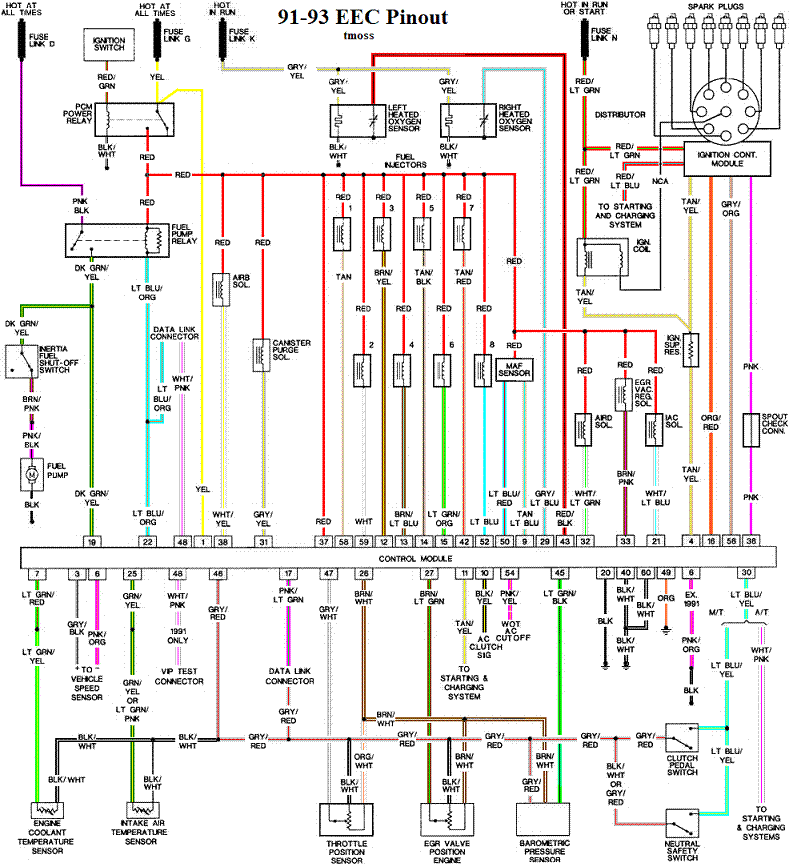
Diagram courtesy of Tmoss & Stang&2birds

Check out the diagram and notice all the places the grey/red wire goes. Almost every
sensor on the engine except the MAF is connected to it.
91-93_5.0_EEC_Wiring_Diagram.gif


See the following website for some help from Tmoss (diagram designer) & Stang&2Birds
(website host) for help on 88-95 wiring http://www.veryuseful.com/mustang/tech/engine

harness02.gif
 
My mechanic hooked a Ford break out box to the computer.
He told me the problem, but I forgot what it was called. When testing pin #25, there wasn't enough voltage. I think it was putting out just 1v and it was suppose to be 4v? Also the fuel pump relay was no good.

My car was becoming inconsistant at the track before and not running as fast as it use to. 13.6's to 13.7's. It use to run 13.4's to 13.5's.
I don't know if this was part of the computer getting ready do go ?
Now with the new computer, my car runs consistant 13.3's , 13.2 best.
I went 5 rounds and won my division last weekend.

Thanks to everyone here for all the help!
 
I've heard of a few occasions that the fuel pump would run constantly (inferring a toasted relay probably like Hissin said) and they also had no injector pulse.. Does the EEC cut off injector pulse when the fuel pump relay shorts and sticks in "diagnostic mode"
 
OK
It just died again tonight! Almost 1 year later.
It skipped a few times on a drive at about 2500 rpms, then it just died, nothing.
Should i try my old Motorcraft TFI Module before i get it it towed to my garage?
Ill check fuel pressure tomorrow also, but the pump, this time is not running all the time like before. You can hear it when you turn the key on, then it stops as usual. I changed the fuel filter last year too. I can't think that the computer went again? Is that possble?
Thanks
Any suggestions will be greatly appreciated.
 
Cranks OK, but No Start Checklist for Fuel Injected Mustangs

Revised 08-Mar-2008 to add wire color to starter solenoid & power ground check for computer.

All text applies to all models unless stated otherwise.

Note: 94-95 specific changes are in red

1.) Remove push on connector (small red/blue wire) from starter solenoid and turn ignition switch on. Place car in neutral or Park and set the parking brake. Remove the coil wire from distributor & and hold it 3/8” away from the engine block. Jumper the screw to the big bolt on the starter solenoid that has the battery wire connected to it. You should get a nice fat blue spark.
Most of the items are electrical in nature, so a test light, or even better, a voltmeter, is helpful to be sure they have power to them.
No spark, possible failed items in order of their probability:
A.) MSD or Crane ignition box if so equipped
B.) Coil
C.) TFI module
D.) PIP sensor in distributor. The PIP sensor supplies the timing pulse to trigger the TFI and injectors. See paragraph 5A - a noid light will tell if the pip is working by flashing when the engine is cranking.
E.) No ECC or computer power - ECC or computer relay failure
86-93 models only: ECC relay next to computer - look for 12 volts at the fuel injector red wires
94-95 models only: EEC or PCM power relay in the constant control relay module. Look for 12 volts at the fuel injector red wires.
F.) No ECC or computer power - fuse or fuse link failure
86-93 models only: Fuse links in wiring harness - look for 12 volts at the fuel injector red wires. All the fuse links live in a bundle up near the starter solenoid.
94-95 models only: 20 amp EEC fuse in the engine compartment fuse box. Look for 12 volts at the fuel injector red wires.
G.) Ignition switch - look for 12 volts at the ignition coil red/lt green wire. No 12 volts, blown fuse link or faulty ignition switch. Remove the plastic from around the ignition switch and look for 12 volts on the red/green wire with the switch in the Run position. No 12 volts and the ignition switch is faulty. If 12 volts is present in the Run position, then the fuse link is blown.
94-95 models only: Check inside fuse panel for fuse #18 blown – 20 amp fuse
H.) Bad or missing secondary power ground. It is located between the back of the intake manifold and the driver's side firewall. It supplies ground for the alternator, A/C compressor clutch and other electrical accessories such as the gauges.
I.) Missing or loose computer power ground. The computer has its own dedicated power ground that comes off the ground pigtail on the battery ground wire. Due to it's proximity to the battery, it may become corroded by acid fumes from the battery. It is a black cylinder about 2 1/2" long by 1" diameter with a black/lt green wire. You'll find it up next to the starter solenoid where the wire goes into the wiring harness
J.) Computer
K.) Engine fires briefly, but dies immediately when the key is released to the Run position. Crank the engine & when it fires off, pull the small push on connector (red wire) off the starter relay (Looks like it is stuck on a screw). Hold the switch in the crank position: if it continues to run there is a problem with either the ignition switch or TFI module. Check for 12 volts at the red/green wire on the coil with the switch in the Run position. Good 12 volts, then replace the TFI. No 12 volts, replace the ignition switch.

See the following links for wiring diagrams...

http://www.autozone.com/servlet/UiB..._us/0900823d/80/16/71/3c/0900823d8016713c.jsp for 79-88 model cars
Computer/fuel pump/ignition wiring diagram, 86 model http://www.autozone.com/images/cds/gif/large/0900823d80167158.gif
Computer/fuel pump/ignition wiring diagram, 87 model http://www.autozone.com/images/cds/gif/large/0900823d8016715e.gif
Computer/fuel pump/ignition wiring diagram, 88 model http://www.autozone.com/images/cds/gif/large/0900823d80167162.gif

http://www.autozone.com/servlet/UiB..._us/0900823d/80/19/59/5a/0900823d8019595a.jsp for 89-93 model cars
Computer/fuel pump/ignition wiring diagram, 89-90 cars http://www.autozone.com/images/cds/gif/large/0900823d8019595f.gif
Computer/fuel pump/ignition wiring diagram, 91-93 cars
http://www.autozone.com/images/cds/gif/large/0900823d80195960.gif

http://www.autozone.com/servlet/UiBroker?ForwardPage=/az/cds/en_us/0900823d/80/1d/db/3c/0900823d801ddb3c.jsp for 94-98 model cars

2.) Spark at coil wire, pull #1 plug wire off at the spark plug and check to see spark. No spark, possible failed items in order of their probability:
A.) Moisture inside distributor – remove cap, dry off & spray with WD40
B.) Distributor cap
C.) Rotor
D.) Spark Plug wires
E.) Coil weak or intermittent - you should see 3/8" fat blue spark with a good coil

3.) Spark at spark plug, but no start.
Next, get a can of starting fluid (ether) from your local auto parts store: costs a $1.30 or so. Then pull the air duct off at the throttle body elbow, open the throttle, and spray the ether in it. Reconnect the air duct and try to start the car. Do not try to start the car without reconnecting the air duct.

Two reasons:
1.) If it backfires, the chance for a serious fire is increased.
2.) On Mass Air cars, the computer needs to measure the MAF flow once the engine starts.
If it starts then, you have a fuel management issue. Continue the checklist with emphasis of fuel related items that follow. If it doesn’t, then it is a computer or timing issue: see Step 4.

Clue – listen for the fuel pump to prime when you first turn the ignition switch on. It should run for 5-20 seconds and shut off. To trick the fuel pump into running, find the EEC test connector and jump the connector in the Upper RH corner to ground. The EEC connector is near the wiper motor and LH hood hinge.
attachment.php


If the relay & inertia switch are OK, you will have power to the pump. Check fuel pressure – remove the cap from the schrader valve behind the alternator and depress the core. Fuel should squirt out, catch it in a rag. Beware of fire hazard when you do this. In a pinch, you can use a tire pressure gauge to measure the fuel pressure. It may not be completely accurate, but you will have some clue as to how much pressure you have. If you have any doubts about having sufficient fuel flow/pressure, rent a fuel pressure test gauge from the auto parts store. That will tell you for sure if you have adequate fuel pressure.


4.) No fuel pressure, possible failed items in order of their probability:
A.) Tripped inertia switch – Coupe & hatch cars hide it under the plastic trim covering the driver's side taillight. Use the voltmeter or test light to make sure you have power to both sides of the switch
B.) Fuel pump power relay – located under the driver’s seat in most stangs built before 92. On 92 and later model cars it is located below the Mass Air Flow meter. Look for 12 volts at the Pink/Black wire on the fuel pump relay.
C.) Clogged fuel filter
D.) Failed fuel pump
E.) 86-90 models only: Blown fuse link in wiring harness. Look for 12 volts at the Orange/Lt Blue wire on the fuel pump relay.
91-93 models only Blown fuse link in wiring harness. Look for 12 volts at the Pink/Black wire on the fuel pump relay.
The fuse links for all model years 86-93 live in the wiring harness near the starter solenoid.
94-95 models only: 20 amp fuel pump fuse in the engine compartment fuse box. Look for 12 volts at the Dark green/yellow wire on the constant control relay module.
F.) Engine seem to load up on fuel and may have black smoke at the tailpipe. Fuel pressure regulator failed. Remove the vacuum line from the regulator and inspect for fuel escaping while the pump is running. If fuel is coming out the vacuum port, the regulator has failed. Check the regulator vacuum line for fuel too. Disconnect it from the engine and blow air though it. If you find gas, the regulator has failed.

5.) Fuel pressure OK, the injectors are not firing.
A.) A noid light available from any auto parts store, is one way to test the injector wiring.
The noid light plugs into the fuel injector harness in place of any easily accessible injector. Plug it in and it will flash if the injector is firing.
B.) I like to use an old injector with compressed air applied to the injector where the fuel rail would normally connect. I hook the whole thing up, apply compressed air to the injector and stick it in a paper cup of soapy water. When the engine cranks with the ignition switch on, if the injector fires, it makes bubbles. Cheap if you have the stuff laying around, and works good too.
D.) Pull an injector wire connector off and look for 12 volts on the red wire when the ignition switch is on.
E.) No power, then look for problems with the 10 pin connecter (salt & pepper shakers at the rear of the upper manifold).
F.) No power and the 10 pin connections are good: look for broken wiring between the orange/black wire on the ECC relay and the red wire for the 10 pin connectors.
G.) TPS voltage exceeds 3.7 volts with the throttle closed. This will shut off the injectors, since the computer uses this strategy to clear a flooded engine. Use a DVM, a pair of safety pins, and probe the black/white and green wires to measure the TPS voltage.
On a 94-95 Mustang, probe the black/white and grey/white wires to measure the TPS voltage.
It should be .5-.99 volts with the key on, engine not running. Note that if the black/white wire (signal ground) has a bad connection, you will get some strange readings. Make a second measurement using the battery post as the ground to eliminate any ground problems. If the readings are different by more than 5%, you may have a high resistance condition in the black/white signal ground circuit.

6.) Spark & fuel pressure OK.
A.) Failed IAB (no airflow to start engine). Press the throttle ¼ way down and try to start the car.
B.) Failed computer (not very likely)
C.) Engine ignition or cam timing off: only likely if the engine has been worked on recently).
D.) Firing order off: HO & 351 use a different firing order from the non HO engines.
HO & 351W 1-3-7-2-6-5-4-8
Non HO 1-5-4-2-6-3-7-8
E.) No start when hot - Press the throttle to the floor & try starting it if you get this far. If it starts, replace the ECT.
F. ) Engine that has had the heads off or valves adjusted. Do a compression test to make sure the valves are not adjusted too tight. You should have a minimum of 90 PSI on a cold engine.
 
Thanks for all the great info jrichker.
For some reason , my car started right up this morning. But then as it warmed up, it started missing again. The rpms would drop everytime it missed. I was trying to get it back home , keeping it at 3000rpms and you could see the rpm gauge drop to nothing then back up.
The garage down the road from me is thinking TFI module. It's a MSD distributor and module, about 2- years old. I have my old module that I know works. I'm going to try that.
Any other thoughts?
Thanks for all the help!
 
Well I checked the PIP( check list section 1d and 5a) with a noid light and had injector pulse, the car actually started, this was after it was cooled off. So that rules out the PIP sensor. Put my other TFI module on and it's the same as with the MSD TFI module that I thought was not working properly. Starts fine, runs fine untill the car reaches operating temperature, then it starts missing , the rpm needle jumps all over, and then it will just eventually die and not start untill it is cooled down.
I don't know what to do next.
Any help would be great!!!!
Thanks!