Mud Dog Lives - Starting An Engine 101

gregski

Active Member
Mar 13, 2010
577
0
28
Sacramento, California
I am pleased to inform you that after six months the little engine that couldn't cause it had mud in it, came to life!

In this post I would like to share what I have been hoping to learn since day one of this project, and that is:

What does it take to start an engine?
Since this mid 70s 302 small block is out of the car and in an engine test stand I was able to answer that question by stripping it down to it's essentials. Below is a list of the minimum parts needed to start an engine, and a list of parts that I thought I needed but learned otherwise.

MINIMUM PARTS NEEDED
1. Ignition Module (not needed with older point based distributors)
2. Ignition Coil
3. Distributor
4. Spark Plug Wires
5. Spark Plugs
6. Engine Wiring Harness
7. Starter
8. Battery
9. Battery Cables
10. Carburetor
11. Fuel Pump (since gravity feed did not work for me)

PARTS NOT NEEDED
1. Starter Relay (sometimes erronously called Starter Solenoid)
2. Alternator (this was a suprise)
3. Ignition Switch (usually in the steering column)
4. Belts
5. Radiator
6. Fan

Here are links to two videos, and those of you who read my posts before know that I don't edit stuff I let you see the good and the bad, after all we learn from our mistakes. Please feel free to provide feedback on the lists above, all advice is greatly appreciated.

Starting A Ford 302 V8 Engine First Attempt
YouTube - ‪Starting A Ford 302 V8 Engine First Attempt‬‎

Starting A Ford 302 V8 Engine Second Attempt
YouTube - ‪Starting A Ford 302 V8 Engine Second Attempt‬‎
 
starting an engine 201

1. I would not advise starting an engine with no water in the jackets. Although a radiator is not required per se, some reservoir should be attached to the engine to maintain a safe coolant temperature, and some means of circulating it, whether an external pump or belts and pulleys on the water pump. Just because you can do something doesn't mean you should.

2. Without some means of killing power to the starter (ignition switch) the starter will be engaged while the engine is running and will be destroyed in a short time. You had to use a switch somewhere or the starter would have been running the moment you connected it to the battery.

3. A starter solenoid is most definetly correct as it is a coil of wire that is used to create a magnetic field to move a plunger. It is being used in this application as a relay i.e. one electric circuit of a more sensitive nature from the ignition switch (low amperage) used to control another electric circuit to the starter (high amperage).
 
All good points let me address them one by one.

1. I would not advise starting an engine with no water in the jackets. Although a radiator is not required per se, some reservoir should be attached to the engine to maintain a safe coolant temperature, and some means of circulating it, whether an external pump or belts and pulleys on the water pump.

Technically I said no radiator, not no water/coolant. lol I did poor water into the intake manifold / thermastat housing and it seeped down until it started coming out the bottom hose. Then I poored more water in the radiator. I've seen people run a garden hose through their engines as well without a radiator. I do agree you should have some sort of cooling going on.

2. Without some means of killing power to the starter (ignition switch) the starter will be engaged while the engine is running and will be destroyed in a short time. You had to use a switch somewhere or the starter would have been running the moment you connected it to the battery.

I only tap the positive battery lead on the started bolt to get it to turn the engine over after that it is completely disconnected, the started is NO longer engaged it is NO longer spinning the flywheel. If you look closely you will see that in addition I have two thin red positive wires running off of the positive battery terminal held on with an aligator clip, ie poor mans off switch, one runs to the ignition module the other to the coil. That's how I shut the engine off in the end, I release the aligator clip.

3. A starter solenoid is most definetly correct as it is a coil of wire that is used to create a magnetic field to move a plunger. It is being used in this application as a relay i.e. one electric circuit of a more sensitive nature from the ignition switch (low amperage) used to control another electric circuit to the starter (high amperage).

Honestly I don't know any more, I thought the starter has a built in solenoid which is what engages the bendix. On some starters it is a smaller cylinder sitting next to the starter, on some it is inside, and the thing on the inside of your fender is a relay. Source: Haynes FORD Mustang II Automotive Repair Manual, Chapter 13, page 284. LOL

Just because you can do something doesn't mean you should.

I couldn't agree more, what I have shown is dangerous, and borderline stupid. I did it to prove a point, that is what is the minimum of parts you need to start an engine. What you suggest is the better and safer way to do it, no doubt, and that's what I will be doing from now on, thank you for your comments.
 
Honestly I don't know any more, I thought the starter has a built in solenoid which is what engages the bendix. On some starters it is a smaller cylinder sitting next to the starter, on some it is inside, and the thing on the inside of your fender is a relay. Source: Haynes FORD Mustang II Automotive Repair Manual, Chapter 13, page 284. LOL

Ok, stay with me Gregski.

By definition, a solenoid is a device that uses a coiled wire to create a magnetic field to move a ferrous rod or plunger that’s inside the coil. One of the many uses of this type of device is to open or close a second circuit. If used this way, then it’s also a relay. The solenoid mounted on the fender apron uses a low amperage ignition circuit (< 5 amps) to close a larger circuit (maybe 500 amps or more depending on your battery and the temperature) directly between the battery and the starter motor. Thus it is a solenoid being used as a relay.

Down on (in) the starter there is another solenoid. When it is energized, the solenoid rod pushes on a lever that typically pushes a slide mechanism that is attached to an over running sprag clutch, that is in turn attached to a pinion gear that engages the ring gear on the flywheel. If that’s all it does, then it’s a mechanical actuator but not a relay. On late model permanent magnet starters however, it also closes a set of contacts that allows direct battery current to turn the starter, in which case it is both a mechanical actuator and a relay. That’s why the late model starters don’t require the fender mounted solenoid/relay.

The term “bendix” is technically a design where the pinion gear is mounted on a helical shaft, and the inertia of the spinning motor pushes it out to engage the ring gear rather than using a solenoid and lever arm. It was invented by Vincent Bendix and patented in 1910. It was first used on Cadillacs in 1912 and eventually came on every car made. In the early 60s, the modern design of a solenoid with a lever arm and over running sprag clutch replaced the old “bendix” type starter.

Now if you were to completely disassemble a modern starter, and asked a hundred different car guys to identify exactly which pieces make up “the bendix”, I’d bet you’d get almost as many different answers. And they’d all be wrong! From the best I can tell, shade tree mechanics started referring to the part of the starter that kicks the drive gear out as “the bendix”. The strange thing about language is that if enough people call something wrong long enough, it gets documented as such, so maybe by now they’re right after all. At least some of them anyway.
 
The strange thing about language is that if enough people call something wrong long enough, it gets documented as such, so maybe by now they’re right after all. At least some of them anyway.

So true and kind of sad, at work we debate "bimonthly" vs "semimonthly" often, and it drives my friend crazy that some dictionaries use them interchangeably.

According to the Wiki "Because of the ambiguity of this word, it is best to avoid it. Instead, use twice a month or every two months as appropriate." how ridiculous is that.

talk about a tangent, see what you made me do, lol
 
Compression Test

After hooking up the water pump and a closed gasoline tank for safety, I ran the engine a few times for about 5 to 10 minutes each time. Then I disconnected the coil wire from the coil, and removed all the spark plugs and did a Compression Test. If you have any suggestions for doing a compression test proper please don't hesitate to share, by no means am I an expert not even close, maybe a semi-amateur, lol.

COMPRESSION TEST RESULTS

Front of Engine
5. 100 - - - 1. 100
6. 110 - - - 2. 115
7. 100 - - - 3. 100
8. 115 - - - 4. 90 (this one had the mud in it)
Rear of Engine

After such a short run time I will not hold it against him, I will re test at some later time, possibly an oil change from now. Overall it runs strong, sounds great too. So how are those numbers for a stock 302? Next up is Timing stay tunned.
 
After hooking up the water pump and a closed gasoline tank for safety, I ran the engine a few times for about 5 to 10 minutes each time. Then I disconnected the coil wire from the coil, and removed all the spark plugs and did a Compression Test. If you have any suggestions for doing a compression test proper please don't hesitate to share, by no means am I an expert not even close, maybe a semi-amateur, lol.

COMPRESSION TEST RESULTS

Front of Engine
5. 100 - - - 1. 100
6. 110 - - - 2. 115
7. 100 - - - 3. 100
8. 115 - - - 4. 90 (this one had the mud in it)
Rear of Engine

After such a short run time I will not hold it against him, I will re test at some later time, possibly an oil change from now. Overall it runs strong, sounds great too. So how are those numbers for a stock 302? Next up is Timing stay tunned.

Those compression numbers, on average, should be about 40-60 points higher for a good basic engine. However, they are, somewhat consistent. So, I'm thinking it's your gauge or how you are holding it when cranking. Are you using a "screw in" adapter type? As these will give, consistently, more accurate results. Is the engine warm? The throttle blades fully open? etc.
Good Luck!
 
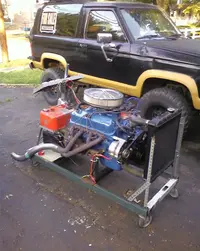
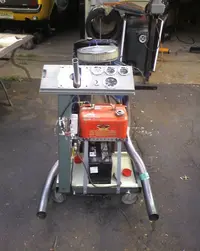
I just got done doing the same thing:nice:. I did go all out an hook up a radiator, altenator, key, guages, etc...
 

Attachments

  • Photo-0028.webp
    Photo-0028.webp
    102.2 KB · Views: 172
  • Photo-0029.webp
    Photo-0029.webp
    81.2 KB · Views: 167
I appreciate the advice, here are my answers:


So, I'm thinking it's your gauge or how you are holding it when cranking.

It's just hanging / dangling by the engine.


Are you using a "screw in" adapter type?

Yes sir with a rubber O ring on it.


Is the engine warm?

Yes sir.


The throttle blades fully open?

Dope, no forgot, but why should they be, the coil wire is unplugged, the spark plugs are out, the starter is doing all the cranking work. Is that my problem?
 
Gregski,
the pipe is the throttle, the guages are a Summit 3 piece 2 5/8" set, the tach is from an old Mack fire truck pumper engine, and yes the tread mill will not be abusing anyone anymore. Still have the rug burns on my legs from being shot across the floor:nonono:
 
I appreciate the advice, here are my answers:


It's just hanging / dangling by the engine.


Yes sir with a rubber O ring on it.


Yes sir.


Dope, no forgot, but why should they be, the coil wire is unplugged, the spark plugs are out, the starter is doing all the cranking work. Is that my problem?

Hi,
A fully warmed engine, Air cleaner removed, throttle fully blocked open, all plugs removed, then initiate test using a screw-in compression tester.
This is best test practice.
If you still get those numbers, you have a rebuild in your future.
Good Luck!