Need Help On Intercooler

Do you have any idea what the temperature of the mix going into the inter cooler was and what it was coming out? There can be a drop in pressure coming out of the inter cooler but still make more HP because it is a denser mix. A drop of 3-4 psi sounds a little high. But then I do not know your setup.

Its due to the design of the intercooler. The farther air has to travle through the cores, the greater the pressure drop will be. The air is having to travel the full length of the IC, and this is causing a pressure drop. Another problem is that only a small portion of the "cores" are exposed to direct air flow.

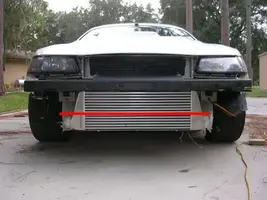
Take a look at the attach image (Rickys pic...I edited it because his photo was readily available :D ) . Now imaginem, the red line and below is the front lower bumper opening, but above is blocked by the bumper. Now at and below the red line is getting cooled down ALOT, and will be very close to ambient temps when the air reaches the other side. But ABOVE the line is air going fully accross the cores with almost no air flow, and the air will be hotter at highway speeds than the bottom. BUT since the cores are so long, ALOT of heat transfer still takes place and as the upper and lower portions remix they come to a common temp usually about 25-20*s above ambient...but that comes with a trade off. The above mentioned pressure drop....which takes power to overcome.

I personally went with a different approach...my cores are shorter in overall length, but run vertically...and EVERY core passes behind the lower opening for cooling. This is great for high speeds/loads as alot of heat will be taken out, and because the short core lengths will make for an IC that has very little pressure drop. Here is my setup...(note that this is OLD. Pipes are ceremic coated and cleaned up)

SP_A0029.jpg


SP_A0004.jpg


The thing is that at low speeds or on the dyno their setup will produce lower intake temps. I think it will be MUCH closer at highway speeds.
I did this just to be different i guess...and becuase its the only design that would work with my particular setup haha.

Which is better? I cant say, they have me in inlet temps, but I will have them in pressure drop and in reality it probably wont make any/much difference. All of our ICs are over kill (for example, mine is rated to support 1200HP LOL) and will do their job quite well :nice: . Im just throughing this out so you guys can see the options and decide what you like better. :flag:
 

Attachments

  • steven_001.webp
    steven_001.webp
    22.9 KB · Views: 109
From my experience, A/A tends to remove the heat from the air charge more efficiently as long as there's an external air source moving through it. And W/A although it can be subject to "heat soak" from the coolant often proves a more reliable and consistant cooling method.

Which is better??? Hard to say. For a track car, subjected to short WOT bursts, I'd say the A/A set up would allow you to see the most power. But for a daily driver the consistent cooling of the W/A style set up often proves the most repeatable and reliable. Hense, why essentially all factory blower cars use the method.
 
^ One word...ICE.

For the track A/W owns A/A hands down, as they can get inlet temps to BELOW ambient by means of using 35* chilled water and no external sorces that the race tracks dont like (such as spraying water on the IC...race tracks dont like that haha) . And spraying N20 accross the cores of an A/A setup costs $$$....and you can do the same thing with a A/W setup if you want.

Although I would take a A/A setup for a DD car...MUCH more reliable and it will always work. Inlet temps will always have about the same rise (usually 30* above ambient), so you know what temps your seeing. And no worry about heavy water tanks, and no worry about pumps going out.
JMO though.
 
Yes....this is true. Ice water in the coolant reservoir at the track will drop temperatures below ambient....which I admit would be an advantage at the track

What helps out the A/A set ups though, is that they often promote much more surface area than most W/A coolers and aren't subject at all to heat soak like they are either, if you don't happen to have a bag of ice lying around to drop the temperature of the coolant.