please advise on bottom end engine assembly of FRPP short block

rockin_rick

Member
Oct 9, 2003
968
1
17
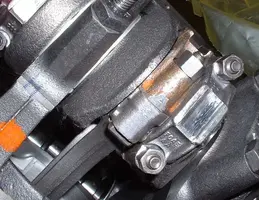
Would it hurt to check the torque on the main cap bolts and rod bolts on my new FRPP short block assy. before building the engine? Is the bearing clearances determined by the amount of torque, and if I mess with it can it cause problems? Is it better to just leave it alone? I don't plan on backing off the bolts at all, just setting the torque wrench to the correct value and confirming that they are at (or above) the correct amount by tightening.

Is there anything else I should do/check on the bottom before bolting on the oilpump, pickup, and then oil pan?

Rick
 
A correctly torqued bolt will simply click the torque wrench without moving, I see the techs as my job do this to double check all the time. If you're worried about it there's no harm in checking. Other than that make sure everything is nice and clean, then go to town putting it together.
 
Thanks for the advice, I'll run over the bolts with the clicker. Am I correct in assuming that there nothing else necessary to do before bolting on the oil pump, pickup, and oil pan, thus buttoning up the bottom end? I'd hate to overlook something silly and cause major problems later.

Thanks,
Rick
 
One thing I would make sure to do is put a little threadlock on the bolt that holds the oil pump pickup tube to the #3 Main Bearing cap. I also believe that bolt has a torque spec, but I don't know off hand. I had once heard of that nut backing out and having the oil pump pickup drop down to the bottom of the pan, resting against the bottom of the pan and causing an oil starvation problem, not to mention having that bolt rolling around in the pan :notnice: Good Luck!
 
You can check them as described above - won't hurt anything, but it also won't tell you much of anything. Once tightened, it takes a significantly higher torque than they were tightened to by the builder in order to move them because of the friction (sometimes called 'stiction') of the threads. I've played with this a little bit with lug nuts. My experience has been that even if the fastener is 10-15 lb-ft TOO LOW, the torque wrench will still click at the higher setting. That is, torque it to 70; set the wrench on 85 and pull again and it will still click without moving the fastener. That's because it takes more than the 15 lb-ft differential to get the bolt to start moving again. The higher the torques, the greater the differential it takes to overcome the stiction of the fastener. So, use your torque wrench and click away, but all it's telling you is that the fastener is tightened to somewhere between 10-15 lb-ft too low, and way, way too high. That's the other side - if it's over-torqued, what you're proposing to do won't tell you anything.

At the end of it all - if you trust the builder, leave it alone. If you don't trust the builder, loosen them enough to get a good pull back up to the specified torque. But setting your wrench and pulling on them would only tell you if something was torqued WAY too low; in which case you'd probably question the whole build anyway.
 
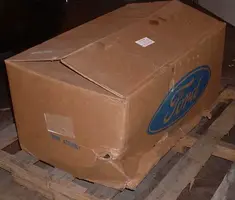
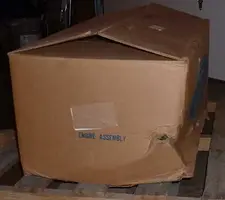
The engine builder is Ford, it's a M-6009-B50 short block. I actually got it off of ebay, someone was selling about 20 of them last december for $1000. When it arrived, the carton (heavy double-wall cardboard) that it was in, was damaged in one corner, like it had gotten dropped. It didn't seem like anything was damaged, though. The FRPP label had also been cut off (due the the carton damage??). Inside the box didn't appear tampered with, but who knows. I wish that I'd spent the extra $$ and just gotten one from a reputable dealer (but then I'd probably just gotten a DSS short block). So basically, I sorta have a 'bad vibe' with this short block, and want to take the 'extra steps' needed to not wonder if everything is OK for the next 100,000+ miles.

So is it advisable that I back off these bolts (main cap and connecting rod), and pull them back to spec? Is it POSSIBLE that I could cause less reliability by doing this? Should I just leave well enough alone? I've never built a bottom end before, and that's why I got a new short block rather than rebuilding mine. So obviously, I trust Ford's engine assembly process more than mine. Just want to ensure that everything's OK.

Thanks,
Paradiod Rick :D
 
The sort of damage that might have been incurred in shipping/dropping/etc. won't be helped by re-torquing; your visual inspection is the best clue for that. I guess the wild card is whether or not any torque-to-yield fasteners were used in the bottom end. If they were, then loosening/re-torquing cannot be done. If you loosen a torque to yield, it should be replaced.

My feeling - if you absolutely want certainty that the bottom was assembled correctly, you need to disassemble, measure, re-assemble with the proper fasteners to the proper torques. If you're willing to take some risk, go ahead and assemble the rest. How do you know it's a Ford Racing short block?
 
I believe that the carton damage had to be done before shipping. It arrived to me strapped to a crate. I got the impression that this seller had probably bought several of these short blocks as "factory seconds" or rejects because they had carton damage. The Ford Racing label on the carton had been removed, you can tell that the usual sized rectangular FRPP label had once been on the box. I thought that FRPP had probably done this because of the carton damage and then sold them as "seconds" (or whatever). The carton is very strong and for the corner of it to be smushed in like it is, it would have to have been dropped. The block is packaged upside down in the box. So the head deck was the closest thing to the corner. I've done a visual exam on it and it seems ok.

Really I don't believe that someone had purposely loosened the bolts, and I know that the damage couldn't have caused any torque issues, I'm just wanting to double check everything with this build.

Here's some pics.

Rick
 

Attachments

  • short block carton.webp
    short block carton.webp
    15.8 KB · Views: 212
  • short block carton2.webp
    short block carton2.webp
    9.4 KB · Views: 202
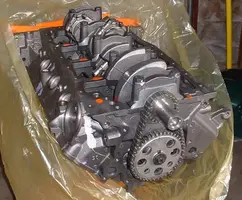
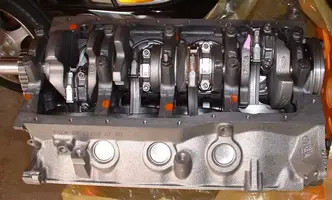
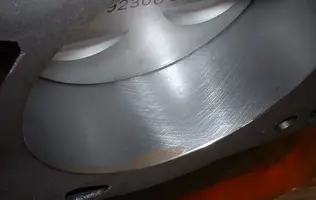
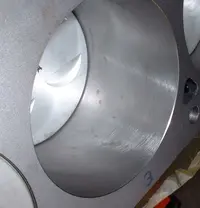
Here are some pics of some light surface rust on the bores. Should I be concerned?? Is there something that I can do to clean it off?

Rick
 

Attachments

  • bore rust.webp
    bore rust.webp
    27.1 KB · Views: 149
  • bore rust2.webp
    bore rust2.webp
    31.4 KB · Views: 155
A little scotch brite pad lubed with some oil will take off surface rust - nothing to worry about. I guess what I'd wonder most about is not torques - but assembly lube. This thing has been sitting for who knows how long, and you've got to turn it over multiple times to assemble it. Have you put a socket on the crank yet to turn it over and see how easily it rotates? If it were me, I think I'd almost want to pull one cap to see if there's any assembly lube still coating things. Alternatively, you could temporarily mount the oil pump/pickup/pan. Put a few qts. of oil in, use a drill to prime the pump - slowly turn it over so it pumps (put the sender in so it doesn't squirt out there -- watch everything else to not make a mess. And while priming have some slowly turn the crank by hand a few revolutions -- try to get oil to all the bearing surfaces so as you turn it over during assembly, stuff has some lube on it. May seem like overkill - but with it having been sitting a while, it's easy to do, and I don't think I'd take a chance.
 
if your really worried about this motor take it to a repuitable machine shop, Have them disaasemble it and check it all out. and reassemble it. It only cost about 150.00-200 to have them do this.
 
I was wondering about that lube. I haven't tried turning it over yet. The block has 9/27/00 sprayed on it as seen in pic #2 of post #9. So that's 3 1/2 years. I like the oil pump method you described. I don't have a set of bolts on hand to replace the torque-to-yeild's, and I'd like to get started on this before I could get some (for the take off cap method).

What color (grit) scotch brite pad would you recommend? How about WD-40 on a clean rag first before using an abrasive method? Is WD-40 bad to put onto the bore? Should I wipe down the bores with an oily rag after cleaning? Would this help to prevent further rust from developing?

Thanks for all your advice, Michael and everyone else. Any other advice is highly welcomed and desired.

Rick