Possible Ignition Problem...?

Honch

New Member
Jan 29, 2016
16
0
1
SW Ohio
Although another thread "Dies While Driving, Key Off/on" is similar to my issue, I figured I'd toss my story out for possible help since there are a few differences.

Firstly, my engine is an old 302 that is carburetted with the points style distributor / vac advance.

Last night, after about 15 mins of driving, I began to lose power intermittently... like I was only running on 2 cyls. This would happen like there was a loose wire... dog out at completely random times then return to normal.

Pulled over and tugged on all ignition wires, it fired up like normal but then the problem came back after a couple mins.

Eventually it got so severe, it stalled out. While trying to start, the engine would Barely turn over, like a weak / dead battery (brand new Interstate 570CCA batt in it). I let it sit for several mins, the starter returned to normal cranking strength, but it took about 5 seconds of cranking before it would fully start... almost catching and finally firing.

Any feedback on this would be greatly appreciated... beautiful day out and I'm pissed I can't drive her :(
 
Clean the battery posts, check the grounds.

If this is an 89 Mustang, it falls in the replace the ignition switch arena even if someone converted it to carb. EFI to carb conversions have all kinds of problems because the conversion job follow no standard method. Some of them are well done, but most of them are electro-mechanical road kill.


Recall on Ford Ignition switches:

Revised 7-June-2014 to add Torx bit picture and source. Also added replacement ignition switch wiring pigtail picture, part numbers and sources.

Some of the symptoms of ignition switch problems are things that don’t work or are intermittent like radio, turn signals, wipers or heater.

There was a FREE recall on Ford ignition switches. They overheat and sometimes catch fire. That burns up the steering column and sometimes the car interior. Since this is very old information, you may not be able to get the switch replaced for free anymore. The auto parts stores sell the switches for $13-$15.

4.webp


4.webp


4.webp


While you are working on the switch, check the wiring and connector closely. A replacement connector with new wiring pigtails is available from most auto parts stores

AutoZone and Advanced Auto Parts have the same Part Number: 434 - may have to order, not always in stock

Advanced Auto Parts alternate part number: PT5534

20974527_bwd_pt5534_pri_larg.webp


Saleen0679 was nice enough to dig this up for us awhile back: Replace a 1979-1993 Ignition Switch Assembly

Torx bit set from Advance Auto Parts

9021337_atc_ac571w1386_pri_larg.jpg


Autocraft torx bit set – have small hole in tip for tamper proof screws.
Part No. AC571/W1386 Cost approx. $12 +tax

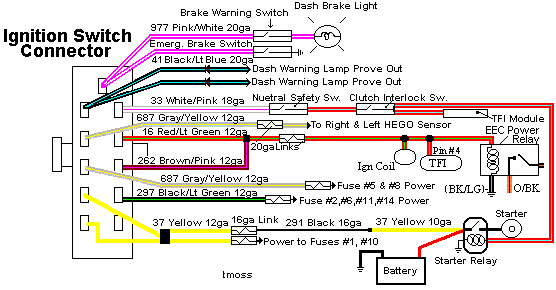
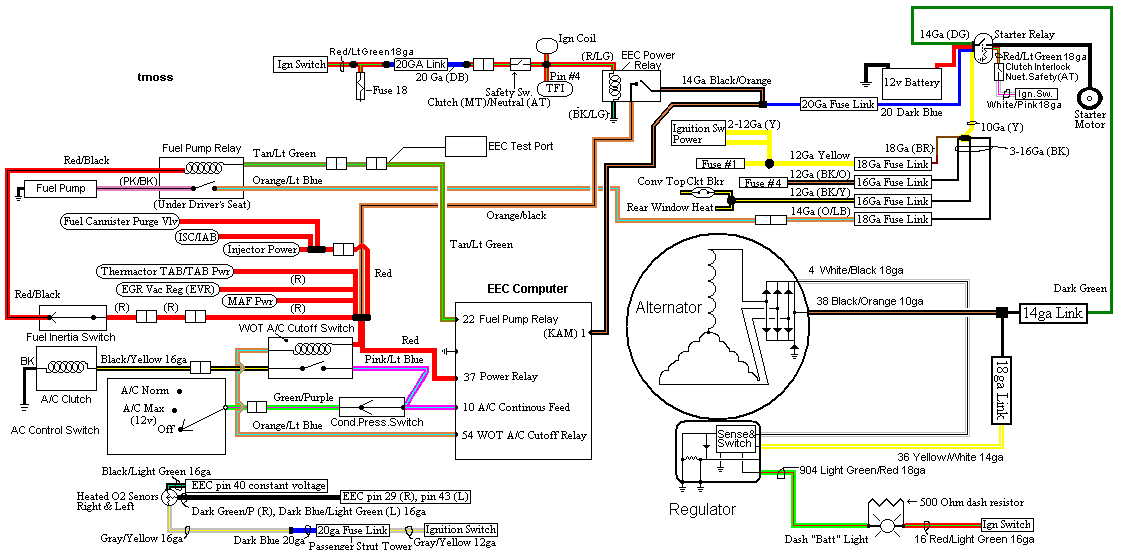
Diagrams courtesy of Tmoss & Stang&2birds

Ignition switch wiring
IgnitionSwitchWiring.gif


Fuel, alternator, A/C and ignition wiring
fuel-alt-links-ign-ac.gif


See the following website for some help from Tmoss (diagram designer) & Stang&2Birds (website host) for help on 88-95 wiring http://www.veryuseful.com/mustang/tech/engine/ Everyone should bookmark this site.

Complete computer, actuator & sensor wiring diagram for 91-93 Mass Air Mustangs
http://www.veryuseful.com/mustang/tech/engine/images/91-93_5.0_EEC_Wiring_Diagram.gif

Complete computer, actuator & sensor wiring diagram for 88-91 Mass Air Mustangs
http://www.veryuseful.com/mustang/tech/engine/images/88-91_5.0_EEC_Wiring_Diagram.gif

Ignition switch wiring
http://www.veryuseful.com/mustang/tech/engine/images/IgnitionSwitchWiring.gif

Fuel, alternator, A/C and ignition wiring
http://www.veryuseful.com/mustang/tech/engine/images/fuel-alt-links-ign-ac.gif

O2 sensor wiring harness
http://www.veryuseful.com/mustang/tech/engine/images/mustangO2Harness.gif

Vacuum diagram 89-93 Mustangs
http://www.veryuseful.com/mustang/tech/engine/images/mustangFoxFordVacuumDiagram.jpg

HVAC vacuum diagram
http://www.veryuseful.com/mustang/tech/engine/images/Mustang_AC_heat_vacuum_controls.gif

TFI module differences & pin out
http://www.veryuseful.com/mustang/tech/engine/images/TFI_5.0_comparison.gif

Fuse box layout
http://www.veryuseful.com/mustang/tech/engine/images/MustangFuseBox.gif

87-92 power window wiring
http://www.veryuseful.com/mustang/tech/engine/images/mustang87-92 PowerWindowWiring.gif

93 power window wiring
http://www.veryuseful.com/mustang/tech/engine/images/mustang93PowerWindows.gif

Visual comparison of the Ford Fuel Injectors, picture by TMoss:
http://www.veryuseful.com/mustang/tech/engine/images/Ford_Injector_Guide.jpg
 
Welp, just pulled the Ign. Switch and off to the parts store.
Yeah, the wiring in this car is quite messy... I've yet to identify What this engine is even out of. The only thing I've seen so far is on the Edlebrock intake, it says "Performer 289."
Any clues by sight?
20160507_132623.webp

20160507_132613.webp
 
Last edited:
Well, back home now... *sigh*

Same as before, post-new ignition switch. While I was sitting, blocking traffic, my battery was acting very drained as I mentioned before. Even my gauges ticked and dimmed with each flash of the hazards.

And here's the best part, after being towed back into my driveway (5 min drive), I thought to myself "I wonder...", turned the key, strong crank and runs perfectly.

Shoot me, lol.
 
You have an electrical connection/wiring problem...but I guess you figured that out by now...

When it dies, does it immediately crank back up or does it struggle to turn the engine while cranking?
 
Yeah, it does struggle to turn it, like the battery is toast. That's the weirdest part about it, is after letting it sit for about 5 or so minutes, it strongly fires right back up like nothing happened...
 
You have a wire or connection that is getting hot and causing high resistance.
Start by making sure that the battery terminals are in good shape. The clamp on type battery terminals are known problem sources. Remove the terminals and use a battery post cleaner to clean the battery posts and inside of the post terminals.

Check the alternator output wiring, especially the power plug connector on the alternator. These tend to overheat and cause problems.

Grounds

This checklist applies to all Mustangs , not just the EFI equipped cars. Some of the wiring will be different on carb cars and carb conversions

Revised 28-Oct-2012 to add signal ground description & possible problems if it is bad

Grounds are important to any electrical system, and especially to computer controlled engines. In an automobile, the ground is the return path for power to get back to the alternator and battery.

Make sure that all the ground places are clean and shiny bare metal: no paint, no corrosion.

1.) The main power ground is from engine block to battery: it is the power ground for the starter & alternator.


2.) The secondary power ground is between the back of the intake manifold and the driver's side firewall. It is often missing or loose. It supplies ground for the alternator, A/C compressor clutch and other electrical accessories such as the gauges. The clue to a bad ground here is that the temp gauge goes up as you add electrical load such as heater, lights and A/C.

Any car that has a 3G or high output current alternator needs a 4 gauge ground wire running from the block to the chassis ground where the battery pigtail ground connects. The 3G has a 130 amp capacity, so you wire the power side with 4 gauge wire. It stands to reason that the ground side handles just as much current, so it needs to be 4 gauge too.

The picture shows the common ground point for the battery , computer, & extra 3G alternator ground wire as described above in paragraph 2. A screwdriver points to the bolt that is the common ground point.

The battery common ground is a 10 gauge pigtail with the computer ground attached to it.
Picture courtesy timewarped1972
ground.webp


Correct negative battery ground cable.
%20.gif
3.) The computer's main power ground (the one that comes from the battery ground wire) uses pins 40 & 60 for all the things it controls internally: it comes off the ground pigtail on the battery ground wire. Due to its proximity to the battery, it may become corroded by acid fumes from the battery.
In 86-90 model cars, it is a black cylinder about 2 1/2" long by 1" diameter with a black/lt green wire.
In 91-95 model cars it is a black cylinder about 2 1/2" long by 1" diameter with a black/white wire.
You'll find it up next to the starter solenoid where the wire goes into the wiring harness.

All the grounds listed in items 1,2 & 3 need to bolt to clean, shiny bare metal. A wire brush or some fine sandpaper is the best thing to use to clean the ground connections.


4.) All the sensors have a common separate signal ground. This includes the TPS, ACT, EGR, BAP, & VSS sensors. This ground is inside the computer and connects pin 46 to pins 40 & 60, which are the main computer grounds. If this internal computer ground gets damaged, you won't be able to dump codes and the car will have idle/stall/ performance problems

5.) The O2 sensor heaters have their own ground (HEGO ground) coming from the computer. This is different and separate from the O2 sensor ground. It is an orange wire with a ring terminal on it. It is located in the fuel injector wiring harness and comes out under the throttle body. It gets connected to a manifold or bolt on back of the cylinder head.

6.) The TFI module has 2 grounds: one for the foil shield around the wires and another for the module itself. The TFI module ground terminates inside the computer.

7.) The computer takes the shield ground for the TFI module and runs it from pin 20 to the chassis near the computer.


See http://assets.fluke.com/appnotes/automotive/beatbook.pdf for help for help troubleshooting voltage drops across connections and components. Be sure to have the maximum load on a circuit when testing voltage drops across connections. As current across a defective or weak connection, increases so does the voltage drop. A circuit or connection may check out good with no load or minimal load, but show up bad under maximum load conditions. .

Voltage drops should not exceed the following:
200 mV Wire or cable
300 mV Switch
100 mV Ground
0 mV to <50 mV Sensor Connections
0.0V bolt together connections

attachment.php?attachmentid=64167&stc=1&d=1286329941.gif


Extra grounds are like the reserve parachute for a sky diver. If the main one fails, there is always your reserve.

The best plan is to have all the grounds meet at one central spot and connect together there. That eliminates any voltage drops from grounds connected at different places. A voltage drop between the computer ground and the alternator power ground will effectively reduce the voltage available to the computer by the amount of the drop.
 
Last edited:
guessing loose connection or maybe starter is going bad. Maybe put a timing light on it just to check that it's not too far advanced. That can cause a hard start when hot.
 
Well, an update here... I am 90% convinced that this issue is due to Vapor lock. After seeing the problem occur in the garage after 10 minutes with the hood shut and throttle set at 1500 RPMs, I witnessed the fuel boiling through the glass fuel filter.

I had re-routed the fuel line to the carb from the mechanical pump below and away from the engine but the problem continues... Hm.
 
Last edited:
Have you made sure the engine ground strap is in place? It runs from the back of the engine to the firewall. Make sure its there and make sure the connections are tight without paint preventing contact.
 
Have you made sure the engine ground strap is in place? It runs from the back of the engine to the firewall. Make sure its there and make sure the connections are tight without paint preventing contact.
Yep, bought a new 4G cable, wire brushed the contact points as well. As my last post stated, I'm pretty sure this is due to vapor lock though... after about 5-10 minutes of running, my fuel starts to boil thru my glass filter.
Rerouted the lines far away as possible from the engine and exhaust but it still remains... thinking about buying an electric pump and / or fashioning a return line and seeing what happens then.
 
Last edited:
Yep, bought a new 4G cable, wire brushed the contact points as well. As my last post stated, I'm pretty sure this is due to vapor lock though... after about 5-10 minutes of running, my fuel starts to boil thru my glass filter.
Rerouted the lines far away as possible from the engine and exhaust but it still remains... thinking about buying an electric pump and / or fashioning a return line and seeing what happens then.
An electric pump will help, but to make it work correctly, you'll need about 15 PSI in the lines and a fuel pressure regulator very close to the carb to drop it down to about 4-6 PSI. The shorter the low pressure line you have, the lower chance the fuel will boil.
 
An electric pump will help, but to make it work correctly, you'll need about 15 PSI in the lines and a fuel pressure regulator very close to the carb to drop it down to about 4-6 PSI. The shorter the low pressure line you have, the lower chance the fuel will boil.
Hmm, so buying a 6PSI pump wouldn't work then, due to the entire line being low pressure?
 
Just had an idea I thought I'd run past you guys... instead of an external electric pump... how about hooking up the stock in-tank one and using a bypass fuel regulator?

http://www.summitracing.com/parts/hly-12-803bp

Any thoughts on that?
My only concern would be that there is a point where the factory steel fuel line is severed and a rubber fuel line clamped over it (to continue to the current mechanical pump) would possibly blow under the EFI pump's pressure. Would a complete new steel / braided fuel line also be required?

Thanks
 
Just had an idea I thought I'd run past you guys... instead of an external electric pump... how about hooking up the stock in-tank one and using a bypass fuel regulator?

http://www.summitracing.com/parts/hly-12-803bp

Any thoughts on that?
My only concern would be that there is a point where the factory steel fuel line is severed and a rubber fuel line clamped over it (to continue to the current mechanical pump) would possibly blow under the EFI pump's pressure. Would a complete new steel / braided fuel line also be required?

Thanks
Not q good idea. if the bypass regulator fails, you have 40+ PSI at the carb. That will flood the engine with gas and wash all the oil of the cylinder walls. If the pistons don't seize up immediately, it will destroy the crankshaft bearings, the crank, camshaft and valve train.

If I recall correctly, the 85 Mustang used a low pressure in tank pump and a fuel pressure regulator. The 5 speed cars came with a carb and the auto trans cars came with a CFI fuel injection that used an inline fuel pump to raise the pressure.