Trying to work some bugs out

Bills89GT

Member
Jun 16, 2010
127
0
16
Canton CT
Hi Im new on here but i have spent time browsing this forum for info. I just finished my project and I'm trying to get it running right. I converted it from a 4 cyl to a v8. I did everything the right way, no hacking... I used an 89 mass air harness into my Crane Cams Interceptor II before hitting the computor
I don't want to type all my mods again because they are in my garage thing on this site. Basicly its a 302, trick flow heads, x303 cam, 30lb injectors, and just under 11:1 compression
It runs alright once its running but once i shut it off it doesn't like restarting. and sometimes it'll start but run like ass. I turned the idle up to 900 rpm so i reset the TPS but i noticed i am getting 5.12 volt to ground on the yellow which is normal but i'm also getting 5.01 off the black to ground. I suppose that makes sense if the .9 is returning via the green wire but I just wanna make sure
The reason for my concern is that on my Interceptor I getting error code 9000 which i beleive is for a missing MAP signal and missing TPS signal. The directions i am going off for the Interceptor are actually for the Anderson PMS but they seem to run Identically so I figure the error codes are the same

Any help would be appreciated
Thank you, Billy
 
Sounds like an open signal ground on the TPS and possibly the MAP sensor.

I am assuming you are still using the stock 5.0 Mass Air computer (computer tag codes A9L, A9P, A9S, A3M). Make sure you can dump the computer codes in the normal fashion. If you can't, that confirms the computer bad signal ground theory.

Dumping The computer diagnostic codes on 86-95 Mustangs

Revised 19-May-2009 to update drawing for dumping the codes on 86-88 Mustangs with no check engine light.

Dump the codes and see what the computer says is wrong…Codes may be present in the computer even if the Check Engine light isn’t on.

Here's the way to dump the computer codes with only a jumper wire or paper clip and the check engine light, or test light or voltmeter. I’ve used it for years, and it works great. You watch the flashing test lamp or Check Engine Light and count the flashes.

Be sure to turn off the A/C, and put the transmission in neutral when dumping the codes. Fail to do this and you will generate a code 67 and not be able to dump the Engine Running codes.

Dumping the Engine Running codes: The procedure is the same, you start the engine with the test jumper in place. Be sure the A/C is off and the transmission is in neutral. You'll get an 11, then a 4 and the engine will speed up to do the EGR test. After the engine speed decreases back to idle, it will dump the engine running codes.

Here's the link to dump the computer codes with only a jumper wire or paper clip and the check engine light, or test light or voltmeter. I’ve used it for years, and it works great. You watch the flashing test lamp or Check Engine Light and count the flashes.

See http://www.troublecodes.net/Ford/

B.jpg


F.jpg


If your car is an 86-88 stang, you'll have to use the test lamp or voltmeter method. There is no functional check engine light on the 86-88's except possibly the Cali Mass Air cars.

attachment.php


The STI has a gray connector shell and a white/red wire. It comes from the same bundle of wires as the self test connector.

89 through 95 cars have a working Check Engine light. Watch it instead of using a test lamp.

attachment.php


The STI has a gray connector shell and a white/red wire. It comes from the same bundle of wires as the self test connector.


WARNING!!! There is a single dark brown connector with a black/orange wire. It is the 12 volt power to the under the hood light. Do not jumper it to the computer test connector. If you do, you will damage the computer.

What to expect:
You should get a code 11 (two single flashes in succession). This says that the computer's internal workings are OK, and that the wiring to put the computer into diagnostic mode is good. No code 11 and you have some wiring problems.

Codes have different answers if the engine is running from the answers that it has when the engine isn't running. It helps a lot to know if you had the engine running when you ran the test.

Trouble codes are either 2 digit or 3 digit, there are no cars that use both 2 digit codes and 3 digit codes.

Alternate methods:
For those who are intimidated by all the wires & connections, see http://www.actron.com/product_detail.php?pid=16153 for what a typical hand scanner looks like. Normal retail price is about $30 or so at AutoZone or Wal-Mart.

Or for a nicer scanner see http://www.midwayautosupply.com/pc-7208-90-equus-digital-ford-code-reader-3145.aspx – It has a 3 digit LCD display so that you don’t have to count flashes or beeps.. Cost is $30.
 
Ok Thank you I will look into that tomorrow. I am fairly sure its an A9P or A9l. It was in the parts car I used for the V8 swap and I don't know what tranny the car had originally and the stickers are missing from the computor and it looks like its been opened up. The guy I had bought it from mentioned something about there was a chip in it or something. as far as wiring harnesses I have the original 89 4 cyl interior harness, and 89 california mass air harness, and brand new O2 harnesses for the manual tranny. I did alot of research to figure out what harnesses to use with what to try and avoid issues like this Haha
 
Ok I tried pulling some codes but I didn't have any luck. I hooked up the jumper, then the test light. as soon as i hooked up the test light the light went on. When i turned the ignition on the light flashes brighter once then stays brighter until the key is turned off. I've never done this test before but i hooked it up as shown in the drawing. single connector to black/white and tan to test light and battery. I was wondering if possibly the Interceptor is blocking those codes and showing them itself instead. I have no directions for it other than the ones for the Anderson PMS that say nothing about retrieving codes via the KOEO or KOER tests
 
Computer will not go into diagnostic mode on 86-90 model 5.0 Mustangs

Disconnect the battery positive terminal before making any resistance checks.
The small voltage drop in the battery cables will cause incorrect resistance readings.


Computer diagnostic connector:

B.jpg


How it is supposed to work:
The black/white wire (pin 46) is signal ground for the computer. It provides a dedicated
ground for the EGR, Baro, ACT, ECT, & TPS sensors as well as the ground to put the
computer into self test mode. If this ground is bad, none of the sensors mentioned will work
properly. That will severely affect the car's performance. You will have hard starting, low power
and drivability problems.
Since it is a dedicated ground, it passes through the computer on its
way to the computer main power ground that terminates at the battery pigtail ground. It should
read less than 1.5 ohms when measured from anyplace on the engine harness with the battery
pigtail ground as the other reference point for the ohmmeter probe.

What sometimes happens is that the test connector black/white wire gets jumpered to power.
There is a dark brown connector with a black/orange wire near the diagnostic connector. It is
the 12 volt power to the under the hood light. If this happens, it either burns up the wiring or
burns the trace off the pc board inside the computer. That trace connects pins 46 to pins 40 &
60. Only an experienced electronics technician can open the computer up & repair the trace if
it burns up and creates an open circuit.

The STI (Self Test Input ) is jumpered to ground to put the computer into test mode. The STI
has a gray connector shell and a white/red wire Jumpering it to power can produce unknown
results, including damage to the computer. The ohm test simply verifies that there are no breaks
in the wiring between the test connector and the computer input.

How to test the wiring :
With the power off, measure the resistance between the computer test ground
(black/white wire) on the self test connector and battery ground. You should see less than
1.5 ohms.

attachment.php


If that check fails, remove the passenger side kick panel and disconnect the computer
connector. There is a 10 MM bolt that holds it in place. Measure the resistance between
the black/white wire and pin 46 on the computer wiring connector: it should be less than
1.5 ohms. More that 1.5 ohms is a wiring problem. If it reads 1.5 ohms or less, then the
computer is suspect. On the computer, measure the resistance between pin 46 and pins
40 & 60: it should be less than 1.5 ohms. More that that and the computer’s internal
ground has failed, and the computer needs to be replaced.

If the first ground check was good, there are other wires to check. Measure the
resistance between the STI computer self test connector (red/white wire) and pin 48 on
the computer main connector: it should be less than 1.5 ohms. More that 1.5 ohms is a
wiring problem

The following is a view from the computer side of the computer wiring connector.
eec04.gif


Diagram courtesy of Tmoss & Stang&2birds

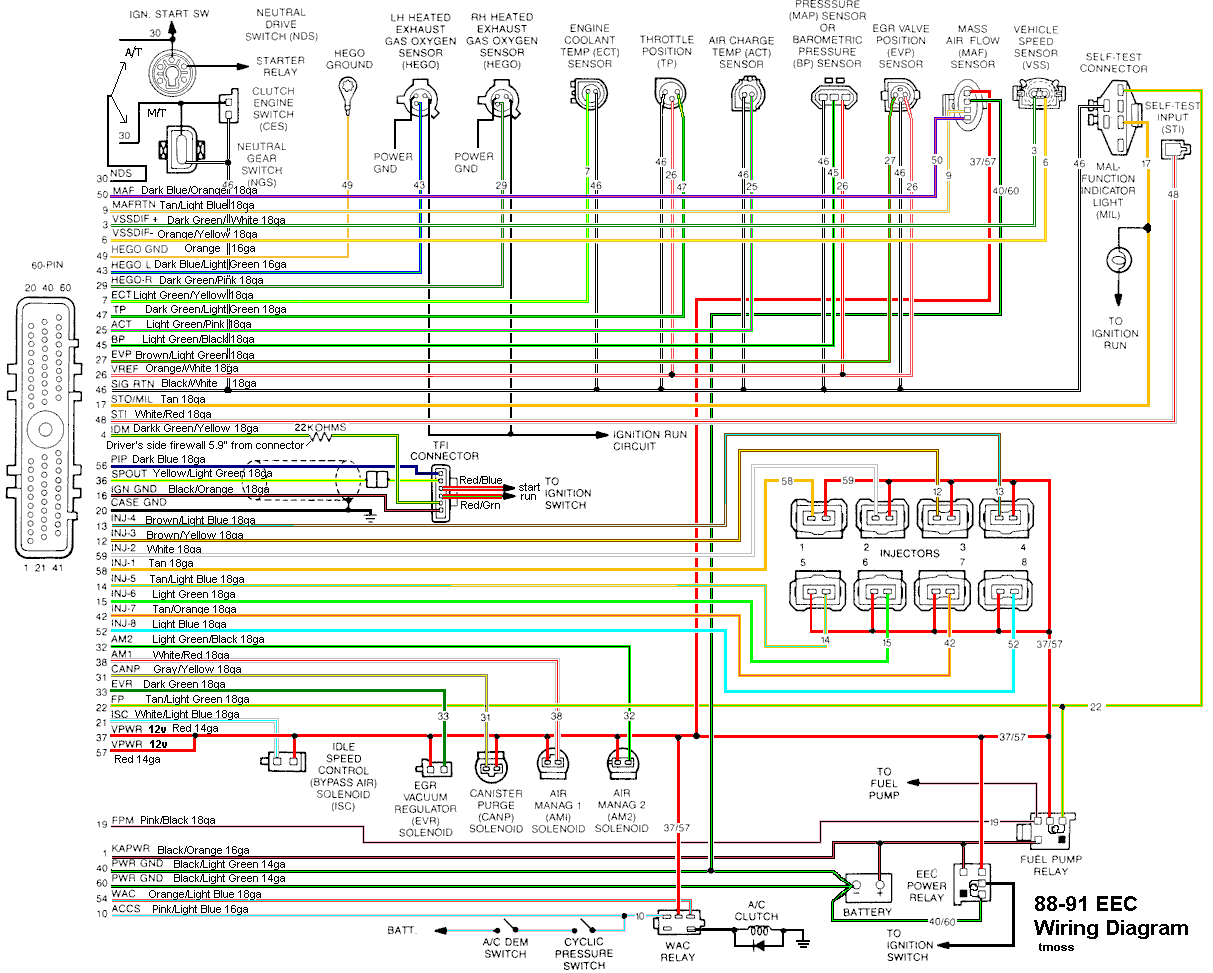
Check out the diagram and notice all the places the black/white wire goes. Almost every
sensor on the engine except the MAF is connected to it.
88-91_5.0_EEC_Wiring_Diagram.gif


See the following website for some help from Tmoss (diagram designer) & Stang&2Birds
(website host) for help on 88-95 wiring Mustang FAQ - Wiring & Engine Info


See Computer issue? - Mustang Forums at StangNet for more help on fixing the computer innards.
 
Well I found out some bad news... i think... I got ahold of the guy i bought the car from. turns out the computor is for an automatic even though he had a 5 spd in the car. I assumed it was standard so the 02 harness i purchased is for that. Sooo i'm thinking i fried the ecu :(. The reason there was no sticker on the computor is that it was brand new. so I'm feeling pretty stupid now.. is it worth running the no code test anyway? or just start searching ebay for an A9l?
 
I don't know if I still have the diagram, but there is only a slight difference between an auto and a 5 SPF o2 harness. If you look at it, there is an empty spot on the harness. The wire next to the hole is moved over. It's easy to find the wire because it just loops around. I'll see if I can get a pic tomorrow.
 
Ya I had that diagram too but i can't find it either. I do remember reading that if the wrong harness is used it will fry the ECU, which is what i think happened to me. If I caught the issue earlier I would have swapped those wires around like you said. I'm getting some strange voltage and ampere readings coming from the ECU so i think its toast. Sooo anyone got an A9L laying around? Haha
Does anyone know of somewhere in CT that can repair the ECU or is it not even worth it? If i can do that I could swap my O2 harness around as strtrcr50 said and run the A9P
 
Alright I got the new ECU its an A9L out of a 90 GT. I'm still getting a trouble code on my interceptor indicating a missing TPS signal. I don't know why it is showing that though because the interceptor is showing the correct throttle position on it.
I'm having a new issue now though. I have an inline spark tester hooked up to the coil. when I turn the key i get a single spark, while cranking there is no spark, then when i stop cranking i get one spark. Sometimes that last spark is able to start the car and it runs fine. Anyone ever seen something like this???
 
Ok so i was messing around again today with the wiring. When in the shorting plug by the distributor is removed I get perfect spark while its cranking and it starts right up... anyone have a clue whats going on??
 
Ok so i was messing around again today with the wiring. When in the shorting plug by the distributor is removed I get perfect spark while its cranking and it starts right up... anyone have a clue whats going on??


You have a bad PIP sensor in the distributor.

PIP problems & diagnostic info

Spark with the SPOUT out, but not with the SPOUT in suggests a PIP problem. The PIP signal level needs to be above 6.5 volts to trigger the computer, but only needs to be 5.75 volts to trigger the TFI module. Hence with a weak PIP signal, you could get spark but no injector pulse. You will need an oscilloscope or graphing DVM to measure the output voltage since it is not a straight DC voltage.

See http://www.wellsmfgcorp.com/pdf/counterp_v8_i2_2004.pdf and http://www.wellsmfgcorp.com/pdf/counterp_v8_i3_2004.pdf for verification of this little detail from Wells, a manufacturer of TFI modules and ignition system products.


The PIP is a Hall Effect magnetic sensor that triggers the TFI and injectors. There is a shutter wheel alternately covers and uncovers a fixed magnet as it rotates. The change in the magnetic field triggers the sensor. A failing PIP sensor will often set code 14 in the computer. They are often heat sensitive, increasing the failure rate as the temperature increases.

The PIP sensor is mounted in the bottom of the distributor under the shutter wheel. In stock Ford distributors, you have to press the gear off the distributor shaft to get access to it to replace it.

To remove the gear, first you drive out the roll pin that secures the gear to the shaft. Then you get to press the gear off with a hydraulic press or puller. When you go to press the gear back on, it has to be perfectly lined up with the hole in the gear and shaft. I have been told that the hole for the pin is offset slightly from center and may require some extra examination to get it lined up correctly.

Most guys just end up replacing the distributor with a remanufactured unit for about $75 exchange
 
Well the car has been sitting a little while now since I just bought a house and had more important things going on but today I did some messing around with the car. I put a brand new MSD distributor in it got it all timed to 10 BTC put the jumper plug back in and nothing.. still no spark when cranking and it wouldn't even start. WTFFFFF!! to make a long story short I tried a bunch of other things and finally unplugged my Interceptor II, plugged the harness directly to the ECU and she fired right up. I was even able to run codes after that I ended up getting 35, 67, 81, 82, 85, and 84 in that order in the KOEO and got lazy and didn't do the KOER
 
Code 35 EVR - EVP sensor signal is/was high – Bad sensor, or possible missing ground for EVR circuit. With the power off, measure the resistance between the black/white wire and battery ground. You should see less than 1 ohm. Check the same black /white wire on the TPS and MAP sensor. More than 1 ohm there and the wire is probably broken in the harness between the engine and the computer. The 10 pin connectors pass the black/white wire back to the computer, and can cause problems.

See the following website for some help from Tmoss (diagram designer) & Stang&2Birds (website host)

http://www.veryuseful.com/mustang/tech/engine/images/88-91eecPinout.gif

Code 67 - clutch not depressed (5 speed) or car not in neutral or park (auto) or A/C in On position when codes where dumped. Possible neutral safety switch or wiring problem. This code may prevent you from running the Key On Engine On tests. You can generally ignore this code, since it has no effect on engine performance.

The computer wants to make sure the A/C is off due to the added load on the engine for the engine running tests. It also checks to see that the transmission is in Neutral or the clutch depressed (T5, T56, Tremec 3550 & TKO). This prevents the diagnostics from being run when the car is driven. Key On Engine Running test mode takes the throttle control away from the driver for several tests. This could prove hazardous if the computer was jumpered into test mode and then driven.

The NSS code 67 can be bypassed for testing. You will need to temporarily ground computer pin 30 to the chassis. Computer pin 30 uses a Lt blue/yellow wire. Remove the passenger side kick panel and then remove the plastic cover from the computer wiring connector. Use a safety pin to probe the connector from the rear and jumper the safety pin to the ground near the computer.

Code 81 – Secondary Air Injection Diverter Solenoid failure AM2. The solenoid valve located on the back side of the passenger side wheel well is not functional. Possible bad wiring, bad connections, missing or defective solenoid valve. Check the solenoid valve for +12 volts at the Red wire and look for the Lt Green/Black wire to switch from +12 volts to 1 volt or less. The computer controls the valve by providing a ground path on the LT Green/Black wire for the solenoid valve.

With the with the ignition on, look for 12 volts on the red wire on the solenoid connector. No 12 volts and you have wiring problems.

With the engine running, stick a safety pin in the LT Green/Black wire for the solenoid valve & ground it. That should turn the solenoid on and cause air to flow out the port that goes to the pipe connected to the cats. If it doesn't, the valve is bad. If it does cause the airflow to switch, the computer or wiring going to the computer is not signaling the solenoid valve to open.

Putting the computer into self test mode will cause the solenoid valve to toggle. If you listen carefully, you may hear it change states.

If you have catalytic converters, you need to fix this code. If not you can use a TAB and TAD eliminator.

Code 82 – Secondary Air Injection Diverter Solenoid failure AM1. Possible bad wiring, bad connections, missing or defective solenoid valve. Check the solenoid valve for +12 volts at the Red wire and look for the Red/White wire to switch from +12 volts to 1 volt or less. The computer controls the valve by providing a ground path on the Red/White wire for the solenoid valve

With the engine running, stick a safety pin in the Red/White wire for the solenoid valve & ground it. That should turn the solenoid on and cause air to flow out the port that goes to the pipe connected to the heads. If it doesn't, the valve is bad. If it does cause the airflow to switch, the computer or wiring going to the computer is not signaling the solenoid valve to open.

If you have catalytic converters, you need to fix this code. If not you can use a TAB and TAD eliminator.

Both 81 & 82 codes usually mean that some uneducated person removed the solenoid control valves for the Thermactor Air system in an attempt to make the car faster. It doesn't work that way: no working control valves can cause the cat converters to choke and clog.

Code 84 EGR Vacuum Regulator failure – Broken vacuum lines, no +12 volts, regulator coil open circuit. The EVR regulates vacuum to the EGR valve to maintain the correct amount of vacuum. The solenoid coil should measure 20-70 Ohms resistance. The regulator has a vacuum feed on the bottom which draws from the intake manifold. The other vacuum line is regulated vacuum going to the EGR valve. One side of the EVR electrical circuit is +12 volts anytime the ignition switch is in the run position. The other side of the electrical circuit is the ground path and is controlled by the computer. The computer switches the ground on and off to control the regulator solenoid.


Code 85 - CANP solenoid - The Carbon Canister solenoid is inoperative or missing. Check vacuum lines for leaks and cracks. Check electrical wiring for loose connections, damaged wiring and insulation. Check solenoid valve operation by grounding the gray/yellow wire to the solenoid and blowing through it.
The computer provides the ground for the solenoid. The red wire to the solenoid is always energized any time the ignition switch is in the run position.

Charcoal canister plumbing - one 3/8" tube from the bottom of the upper manifold to the rubber hose. Rubber hose connects to one side of the canister solenoid valve. Other side of the solenoid valve connects to one side of the canister. The other side of the canister connects to a rubber hose that connects to a line that goes all the way back to the gas tank. There is an electrical connector coming from the passenger side injector harness near #1 injector that plugs into the canister solenoid valve. It's purpose is to vent the gas tank. The solenoid valve opens at cruse to provide some extra fuel. The canister is normally mounted on the passenger side frame rail near the smog pump pulley.

attachment.php


It does not weigh but a pound or so and helps richen up the cruse mixture. It draws no HP & keeps the car from smelling like gasoline in a closed garage. So with all these good things and no bad ones, why not hook it up & use it?


The purge valve solenoid connector is a dangling wire that is near the ECT sensor and oil filler on the passenger side rocker cover. The actual solenoid valve is down next to the carbon canister. There is about 12"-16" of wire that runs parallel to the canister vent hose that comes off the bottom side of the upper intake manifold. That hose connects one port of the solenoid valve; the other port connects to the carbon canister.
Purge valve solenoid:
6


The carbon canister is normally mounted on the passenger side frame rail near the smog pump pulley.
Carbon Canister:
getimage.php
 
if you don't investigate and correct the code 67, you can't get the Key ON, Engine Running diagnostics to dump the codes. There may be more codes hidden that you can't get to.

TAB & TAD solenoid valve eliminators – eliminate codes 81 & 82.
You will still get 44 & 94 codes because the computer looks for a change in the amount of oxygen by checking the O2 sensors when the solenoids are actuated. Actuating the solenoids provides more oxygen in the exhaust, changing the O2 sensor output. No change and you get the 44 & 94 codes.

Don’t do this if you have a catalytic converter H pipe. The catalytic converters must have the air from the smog pump or they will eventually clog up and choke.

See US - Electronic Components Distributor | Newark.com for the resistors to replace the TAB & TAD solenoids

OHMITE|43F82RE|RESISTOR, WIREWOUND, 82OHM, 3W | Newark.com
If the link fails do a search using the part number
82 ohm, 3 watt wirewound resistor, 94 cents each.
Newark P/N 64K8974
Ohmite part # 43F82RE.
Or use the following part number if the first part number isn't available:
OHMITE|23J82RE|RESISTOR, WIREWOUND, 82OHM, 3W | Newark.com
Newark P/N 64K8241
Ohmite part #23J82RE

Pay a visit to your local Radio Shack to get some heat shrink and some crimp on tap terminals. They do not stock the resistors. Or you can use the Ford connector pin kit from AutoZone.

pRS1C-2266040w345.jpg

18 gauge crimp on taps Catalog #: 64-3053

Put the resistor inside the heat shrink tubing and crimp the connectors on. I would choose the Ford pin connectors since they should plug in the TAB & TAD wiring. That way you haven't modified the wiring so it is easy to re-install the TAB & TAD solenoids if emissions testing comes to your area.

52.jpg

Two flat pin connectors.
One 82 ohm, 3 watt resistor.
One piece 3/8" heat sink tubing 2" long.
Two pieces 3/16" heat shrink tubing 1 1/2" long.
Solder the pins onto the resistor leads using electrical solder.
Slide the 3/8" heat shrink tubing over the resistor.
Slide the two pieces of 3/16" heat shrink tubing over the two wires, leaving the flat part of the pins uncovered.
53.jpg


It helps to have the resistor leads straight and not bent as shown in the first picture when you apply heat to the heat shrink tubing. That way, the tubing shrinks more evenly.
Finally, apply heat to shrink all the tubing uniformly.

55.jpg


Bend the leads to fit the spacing on the female TAB & TAD connector sockets.

56.jpg


Push the connector pins of the completed resistor assembly into the empty female TAD or TAD connector sockets on the wiring harness. The resistor assemblies replace the missing solenoids: one resistor assembly per solenoid socket.

Do not crimp on the pins and wrap the mess with electrical tape and say you got the idea from me. If you do, and I hear of it, I will say unkind things about your intelligence and family heritage. Do Quality Work!

This information is for informational purposes only and is intended for use only on off road vehicles. It should not be used on any vehicle operated on public roads.

Operating a vehicle modified in such a manner on public roads is a violation of the EPA codes regarding modification of emission controlled vehicles.
 
Ya I have been meaning to get those resistors. I will definitely do it eventually. as for code 67, I was out of the car when i ran the test so the clutch was not depressed so I figured I didn't have to worry about it.