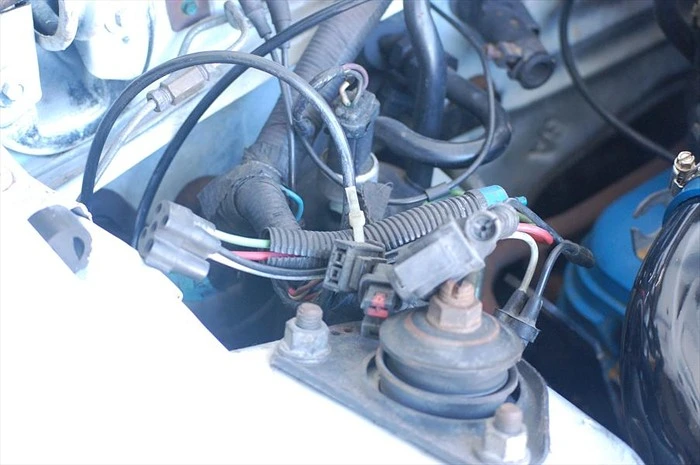
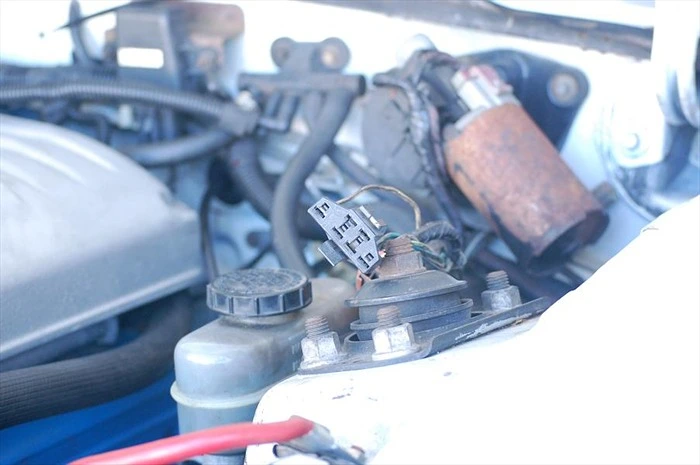
First picture: EGR Vacuum regulator connector, TAD & TAB Smog pump solenoid connectors, vacuum lines for EGR and Smog pump actuators.
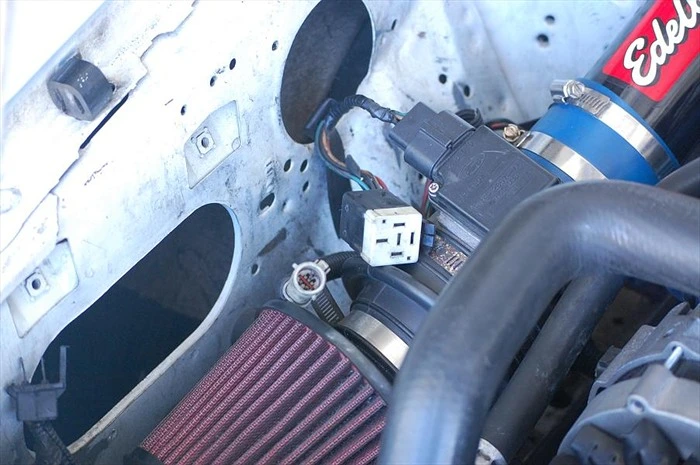
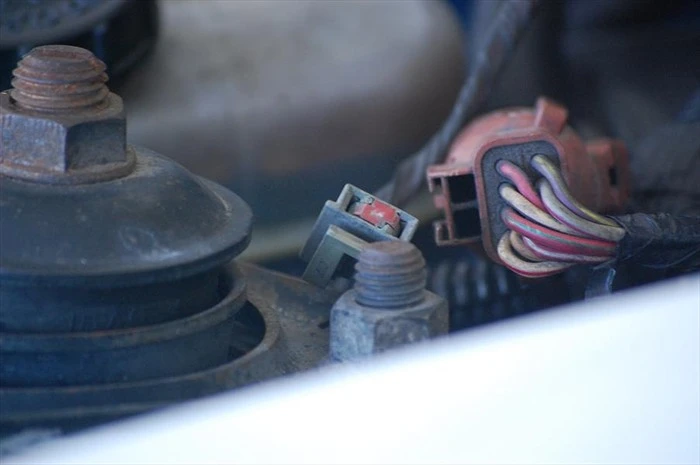
Second picture: The relay is probably for the A/C WOT cutoff, which turns the A/C compressor off at Wide Open Throttle (WOT).
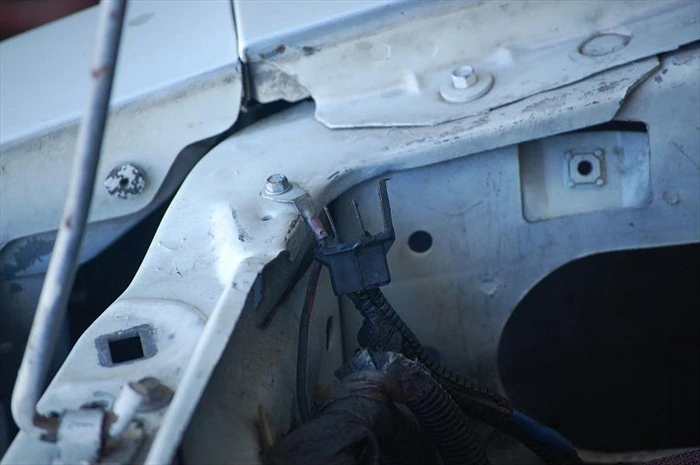
Third picture: connector up near the hood prop is probably for the air bag crash sensor.
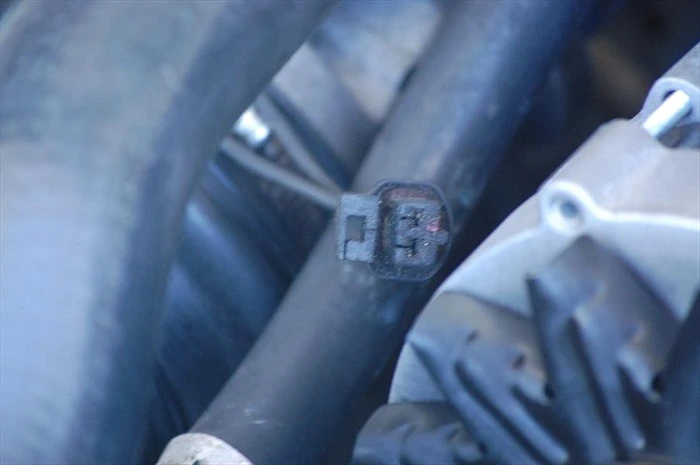
Fourth picture: may be for the canister purge solenoid connector.
The cone air filter in the engine compartment is a big no-no. It sucks up hot air from the engine and the turbulence from the fan cause airflow problems through the MAF. The stock airbox will make much more power that the setup you now have.
The STI has a gray connector shell and a white/red wire. It comes from the same bundle of wires as the self test connector.
Dumping the computer diagnostic codes on 86-95 Mustangs
Revised 26-July-2011. Added need to make sure the clutch is pressed when dumping codes.
Here's the way to dump the computer codes with only a jumper wire or paper clip and the check engine light, or test light or voltmeter. I’ve used it for years, and it works great. You watch the flashing test lamp or Check Engine Light and count the flashes.
Post the codes you get and I will post 86-93 model 5.0 Mustang specific code definitions and fixes. I do not have a complete listing for 94-95 model 5.0 Mustangs at this time.
Be sure to turn off the A/C, and put the transmission in neutral when dumping the codes. On a manual transmission car, be sure to press the clutch to the floor.
Fail to do this and you will generate a code 67 and not be able to dump the Engine Running codes.
If your car is an 86-88 stang, you'll have to use the test lamp or voltmeter method. There is no functional check engine light on the 86-88's except possibly the Cali Mass Air cars.
The STI has a gray connector shell and a white/red wire. It comes from the same bundle of wires as the self test connector.
89 through 95 cars have a working Check Engine light. Watch it instead of using a test lamp.
The STI has a gray connector shell and a white/red wire. It comes from the same bundle of wires as the self test connector.
WARNING!!! There is a single dark brown connector with a black/orange wire. It is the 12 volt power to the under the hood light. Do not jumper it to the computer test connector. If you do, you will damage the computer.
What to expect:
You should get a code 11 (two single flashes in succession). This says that the computer's internal workings are OK, and that the wiring to put the computer into diagnostic mode is good. No code 11 and you have some wiring problems.
This is crucial: the same wire that provides the ground to dump the codes provides signal ground for the TPS, EGR, ACT and Map/Baro sensors. If it fails, you will have poor performance, economy and driveablity problems
Some codes have different answers if the engine is running from the answers that it has when the engine isn't running. It helps a lot to know if you had the engine running when you ran the test.
Dumping the Engine Running codes: The procedure is the same, you start the engine with the test jumper in place. Be sure the A/C is off, and clutch (if present) is pressed to the floor, and the transmission is in neutral. You'll get an 11, then a 4 and the engine will speed up to do the EGR test. After the engine speed decreases back to idle, it will dump the engine running codes.
Trouble codes are either 2 digit or 3 digit, there are no cars that use both 2 digit codes and 3 digit codes.
Alternate methods:
For those who are intimidated by all the wires & connections, see
Actron® for what a typical hand scanner looks like. Normal retail price is about $30 or so at AutoZone or Wal-Mart.
Or for a nicer scanner see
Equus - Digital Ford Code Reader (3145) – It has a 3 digit LCD display so that you don’t have to count flashes or beeps.. Cost is $30.
Or for a nicer scanner see
http://www.midwayautosupply.com/p-7208-equus-digital-ford-code-reader-3145.aspx– It has a 3 digit LCD display so that you don’t have to count flashes or beeps.. Cost is $30.
The guy you bought the car from must have been metally retarded. Removing the pollution control equipment from a 5.0 Mustang is a bad idea. All you have accomplished is to make the computer mad and spit codes. The pollution control equipment all shuts off at wide open throttle, so the HP losses from it on the car are 2-5 HP. The catalytic converters may soak a few more HP than that. None of the pollution control equipment reduces the HP enough to cost you a race in anything but professional drag strip competition. I doubt that the car will be in the top runoff for "Pinks", so he did harm to the car and you by his efforts.
Know what does what
before removing it. Remove or disable the wrong thing and the computer sets the check engine light and runs in "limp mode". Limp mode means reduced power and fuel economy.
Here's a book that will get you started with how the Ford electronic engine control or "computer" works.
Ford Fuel Injection & Electronic Engine Control 1988-1993 by James Probst :ISBN 0-8376-0301-3.
It's about $20 from Borders.com see http://www.amazon.com/ . Select boo...e to check cars, but it is still Federal law.