
Hello, I have an '88 Hatch 5 spd with Mass air conversion. My problem is that I tried to adjust my throttle postion sensor today and noticed that I'm not getting anything. I have the right wires (green and black) but I'm not getting any volts on my meter. I have a 5 volt reference, I checked continuity for both the black wire (ground) and the green wire (signal) and I have continuity from the ECU connector to the TPS connector. With the TPS off the throttle body, even when I move it inside, nothing changes. I even tried a new TPS and still nothing. I know I'm doing it right because BEFORE the mass air conversion(which was like last month) I set the tps without a problem. This time around there is not volts. I dont know if the tps wasnt working when i put the mass air in because i never felt a difference. The only reason that I even tried to re-adjust it is because I was running a little rich. Anyway, someone please help because whether the tps is connected or not, the car runs the same (Pretty strong but could be better) Can anyone please give me steps as to DIAG this problem. I dont know, maybe its the ECU, maybe its the wiring. PLEASE HELP!!
You are using an out of date browser. It may not display this or other websites correctly.
You should upgrade or use an alternative browser.
You should upgrade or use an alternative browser.
TPS has no voltage.
- Thread starter BaBiLuTH
- Start date

Code 63 - Throttle Position Sensor (TPS) signal too low TPS. Vref missing (5 volt reference voltage supplied by the computer), bad connections or damaged wiring, TPS sensor failed, TPS sensor way out of adjustment. Use a DVM to check for 5 volts on the Orange wire. If it is missing, look for +5 volts at the Orange wire on the EGR or MAP sensor located on the firewall near the center of the car.
Check the 10 pin salt & pepper shaker connectors for the 5 volt Vref to make sure you don't have bad connections. You might want to clean the pins while you are at it.

Check the 10 pin salt & pepper shaker connectors for the 5 volt Vref to make sure you don't have bad connections. You might want to clean the pins while you are at it.

stang22
Active Member
Did you have the key on? I know that is a silly question, but just thought I would throw that out there. Adjusting your TPS will not cure your running rich problem. It will only help throttle response. Good luck!
Tim
Tim
Yes I had the ignition on.  because I had a 5 Volt ref. I'm going to try to check the reistance of ground tomorrow (monday). Thanks again for replying guys. Also, I'm mostly concerned with throttle response because I know when I adjusted the TPS once before, second gear felt like a totally different animal!!
because I had a 5 Volt ref. I'm going to try to check the reistance of ground tomorrow (monday). Thanks again for replying guys. Also, I'm mostly concerned with throttle response because I know when I adjusted the TPS once before, second gear felt like a totally different animal!!I rechecked vref and signal 5 volt and what I get is 5.02 volts at the red wire, 4.9 volts at the BLACK wire, and 0volts at the green wire with the sensor disconnected. How is this possible if the BALCK wire is supposed to be ground? Also, is it possible that this is happening because of the MASS AIR conversion?
mustang-a-holic
New Member
- Jul 8, 2005
- 51
- 0
- 0
Diagnosing an electrical problem over the web can be difficult. When describing voltages it is important to describe the two points to which you are measuring.
Example: Verified battery voltage measured "across" the battery studs and had 8.5 vdc.
Example: Measured volts on black wire referenced to the negative battery post. Had 0 volts. Reversed lead to + side of battery now have 12vdc. This idicates you have a a ground referenced to the battery.
The Orange wire or Vref is referenced to the black wire which is in turn referenced to the battery negative terminal. If you have +5vdc between the orange wire and the black wire then you have a working Vref. Also, are you probing at the tps...I mean right where it mounts is generally an inch of exposed wires. Are you probing throuh those wires?
Test your TPS when connected. You can't get a signal on the TPS in (pin5 white connectors) without the tps connected.
Here is what I would do.
1. connect the tps sensor.
2. Place the black lead of your meter onto your battery negative.
3. Probe the Orange wire. should have Vref = 5vds +/-10 %
4. Move black lead to black wire of tps. should read 5vdc. If no, bad ground (black wire on tps)
You hae established a ground reverence is working. No move onto the tps out
6. Measure between th e black wire and the green. should have less than 1vdc with throttle blade closed. If no voltage, bad tps.
Probing the insulation can be tricky you need to be positive you have good contact with the inner wire.
I have a set of probes I sharpened on the grinder to a pin-point for this purpose.
Also, you can test the tps. disconnect it from its connector.
set meter to resisitance.
probe the orange and gree wires. turn tps sensor (like the throttle mnoving) and the resistance should change.
swithc lead from orange wire to black. Repeat resistance test. should have a variable resistance on both tests.
Example: Verified battery voltage measured "across" the battery studs and had 8.5 vdc.
Example: Measured volts on black wire referenced to the negative battery post. Had 0 volts. Reversed lead to + side of battery now have 12vdc. This idicates you have a a ground referenced to the battery.
The Orange wire or Vref is referenced to the black wire which is in turn referenced to the battery negative terminal. If you have +5vdc between the orange wire and the black wire then you have a working Vref. Also, are you probing at the tps...I mean right where it mounts is generally an inch of exposed wires. Are you probing throuh those wires?
Test your TPS when connected. You can't get a signal on the TPS in (pin5 white connectors) without the tps connected.
Here is what I would do.
1. connect the tps sensor.
2. Place the black lead of your meter onto your battery negative.
3. Probe the Orange wire. should have Vref = 5vds +/-10 %
4. Move black lead to black wire of tps. should read 5vdc. If no, bad ground (black wire on tps)
You hae established a ground reverence is working. No move onto the tps out
6. Measure between th e black wire and the green. should have less than 1vdc with throttle blade closed. If no voltage, bad tps.
Probing the insulation can be tricky you need to be positive you have good contact with the inner wire.
I have a set of probes I sharpened on the grinder to a pin-point for this purpose.
Also, you can test the tps. disconnect it from its connector.
set meter to resisitance.
probe the orange and gree wires. turn tps sensor (like the throttle mnoving) and the resistance should change.
swithc lead from orange wire to black. Repeat resistance test. should have a variable resistance on both tests.
mustang-a-holic
New Member
- Jul 8, 2005
- 51
- 0
- 0
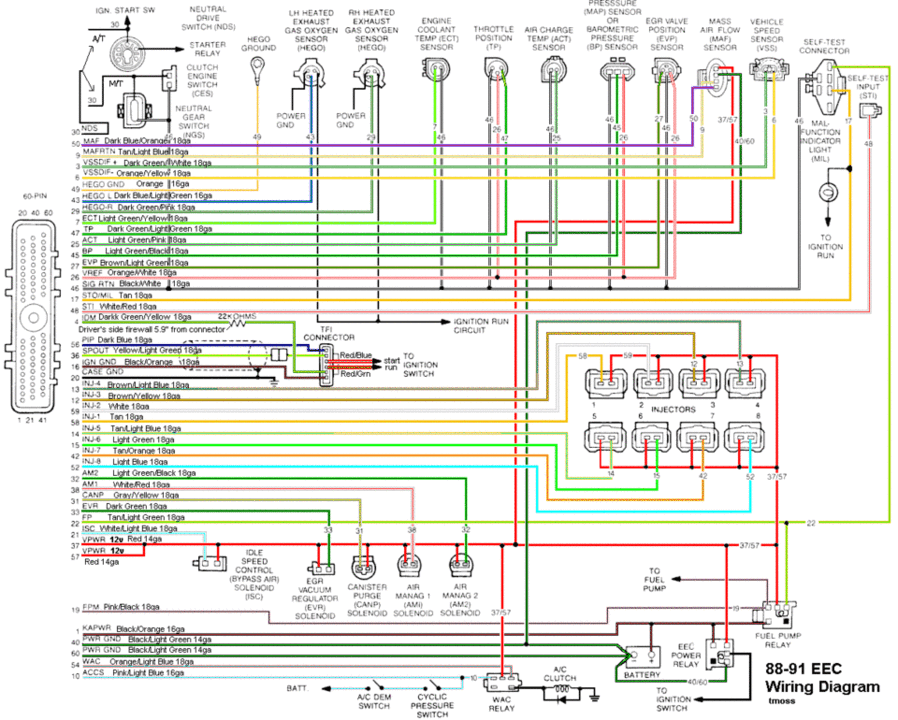
Jrichker....you rock. Excellent pin-out diagram. Many thanks for your help and support. THe mustang community is a better place with you in it!
PS are you a mechanic? You are so knowledgeable, especially with the electrical stuff.
PS are you a mechanic? You are so knowledgeable, especially with the electrical stuff.
There is a very high degree of probablity that the black wire is broken and is no longer connected to ground, or has a high resistance connection. That would account for the 4.9 volt reading you got.
With power off, check the resistance between the black wire and battery ground. You should see less than 1 ohm.
With power off, check the resistance between the black wire and battery ground. You should see less than 1 ohm.
Thank you for the vote of confidence.mustang-a-holic said:are you a mechanic? You are so knowledgeable, especially with the electrical stuff.
I have been doing the shade tree mechanic routine since 1965. The electrical/electronic skills are from fixing computers & networks for the last 26 years.
Thanks guys for responding, I REALLY REALLY appriciate it. So I measured the resistance of all 3 wires. I disconnected the ECU connector and the tps connector. From the ECU connector to the TPS connector, the BLACK wire reads .01 OHMS, the Red wire reads .01OHMS and so does the GREEN wire. So to me(and my little knowledge) The wires seem ok, dont they?
The TPS signal ground (computer pin 46) makes connection to power ground inside the computer. That's why I said to measure the resistance between the black wire and the battery negative post. I have seen the signal ground open circuit inside the computer.
Ok, not to bother or annoy you guys but, since I'm a little retarded when it comes to this, can you guys please give me a step by step of what I should do. I mean like even put yourselves in my shoes and see what you can come up with. I know its asking for ALOT but if one of you can find the time I'd be forever greatful. Thank you again, Paul.
Step 1.) Find the instruction book that came with your Multimeter. Read it and familiarize yourself with how it works and how use it. If you lost the book or didn’t get one with it, do a Google search on the web to find the manufacturer’s web site & download a copy of the manual.
Step 2. ) Make sure that you know what test lead plugs into which jacks on the Multimeter. There are usually several different jacks on most Multimeters, and they have different functions. Make sure that your battery(s) in the Multimeter are good: if you have any doubts, replace the battery(s).
Step 3.) Once you are sure that the Multimeter is functional and you have the leads plugged into the jacks for Ohms ( the upside down “U” symbol), do some simple measurements to make sure that you know how to use it correctly. Set the switch to the lowest range and touch the leads together: you should not see “nothing” but you should see 1.0-0.3 ohms. Measure a 60 watt light bulb: cold it will measure about 17.5 Ohms. It you measure it while it is hot, the reading will be greater.
Step 4.) Make several test measurements using the ohms function and the DC volts function. Remember all resistance measurements must be done with the power off the circuit. This avoids false readings and possible damage to the ohmmeter.. Repeat steps 3 & 4 until you are sure that you can do it without making any mistakes.
Step 5.) Then see http://www.autozone.com/servlet/UiB..._us/0900823d/80/16/71/3c/0900823d8016713c.jsp and carefully study ALL the information under the Heading Chassis Electrical, Basic Electricity – Understanding & Troubleshooting
Step 7.) With power off, connect one meter lead to the black/white wire on the TPS. Connect the other meter lead to the battery negative post. Set the meter on the lowest ohms scale and take a reading. You should see less than 1 ohm.
Step 2. ) Make sure that you know what test lead plugs into which jacks on the Multimeter. There are usually several different jacks on most Multimeters, and they have different functions. Make sure that your battery(s) in the Multimeter are good: if you have any doubts, replace the battery(s).
Step 3.) Once you are sure that the Multimeter is functional and you have the leads plugged into the jacks for Ohms ( the upside down “U” symbol), do some simple measurements to make sure that you know how to use it correctly. Set the switch to the lowest range and touch the leads together: you should not see “nothing” but you should see 1.0-0.3 ohms. Measure a 60 watt light bulb: cold it will measure about 17.5 Ohms. It you measure it while it is hot, the reading will be greater.
Step 4.) Make several test measurements using the ohms function and the DC volts function. Remember all resistance measurements must be done with the power off the circuit. This avoids false readings and possible damage to the ohmmeter.. Repeat steps 3 & 4 until you are sure that you can do it without making any mistakes.
Step 5.) Then see http://www.autozone.com/servlet/UiB..._us/0900823d/80/16/71/3c/0900823d8016713c.jsp and carefully study ALL the information under the Heading Chassis Electrical, Basic Electricity – Understanding & Troubleshooting
Step 7.) With power off, connect one meter lead to the black/white wire on the TPS. Connect the other meter lead to the battery negative post. Set the meter on the lowest ohms scale and take a reading. You should see less than 1 ohm.
Attachments
mustang-a-holic
New Member
- Jul 8, 2005
- 51
- 0
- 0
JRICHKER....UM I'M SPEACHLESS. ANOTHER WONDERFUL SCHEMATIC ****. WAY COOL.
I agree. Sounds like a ground issue. with no ground the green (center wire) to Orange should read Vref at 5v. Correct?
You could jumper a new ground wire onto the TPS ground wire to eliminate the (possible) open ground wire (as fed through the computer)
I agree. Sounds like a ground issue. with no ground the green (center wire) to Orange should read Vref at 5v. Correct?
You could jumper a new ground wire onto the TPS ground wire to eliminate the (possible) open ground wire (as fed through the computer)
mustang-a-holic said:JRICHKER....UM I'M SPEACHLESS. ANOTHER WONDERFUL SCHEMATIC ****. WAY COOL.
I agree. Sounds like a ground issue. with no ground the green (center wire) to Orange should read Vref at 5v. Correct?
You could jumper a new ground wire onto the TPS ground wire to eliminate the (possible) open ground wire (as fed through the computer)
Credit for the diagrams go to Tmoss (diagram designer) & Stang&2Birds (website host) . Their site, http://www.veryuseful.com/mustang/tech/engine/ is one that everyone should bookmark and visit regularly.
You are right, with no ground, the green wire will float up to Vref, at 5 volts or very close. Adding another ground wire is one way to fix this problem. Just be sure you run the wire either to the computer power ground (computer pins 40 & 60) or the body power ground by the battery.
Sometimes the computer will burn open the trace on it's circuit board that connects pin 46 to pins 40 & 60, which are the power grounds. Then you can't dump the codes either.
Most of the time there are other things that lose the ground at the same time. The EGR, TPS, ACT, ECT and MAP all share the same ground. Anytime you have a ground problem with one sensor, it is a good idea to check the ground on all of them.
Check the Signal Return (signal ground) at the 10 pin connectors. It is pin 1 in the white connector.
Diagram courtsey of http://fordfuelinjection.com/index.php?p=6
Similar threads
- Replies
- 7
- Views
- 244


- Replies
- 51
- Views
- 1K

Electrical
Stumped No Start...
- Replies
- 8
- Views
- 335
- Replies
- 7
- Views
- 309